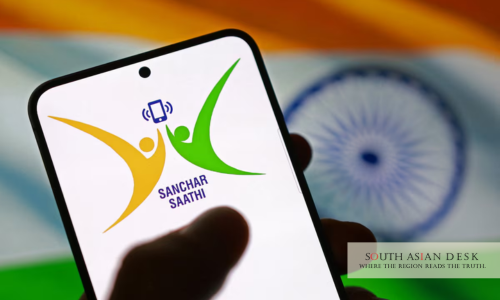
India’s opposition demands parliamentary debate on the Sanchar Saathi app mandate, citing surveillance fears, as Apple resists compliance and the government withdraws the order amid uproar.
India’s Department of Telecommunications issued a directive on 28 November 2025 requiring smartphone makers to pre-install the Sanchar Saathi app on all devices sold or imported into the country within 90 days. The move aimed to combat telecom fraud but ignited concerns over India cyber safety app privacy concerns. By 3 December 2025, the government reversed the mandate following intense Sanchar Saathi opposition backlash. What triggered the order? Who objected? The controversy unfolded in Parliament and on social media, with 1.4 crore users already engaged via the app.
The Sanchar Saathi app mandate sought to verify IMEI numbers and report fraud, yet critics viewed it as a gateway to mass surveillance. This episode underscores tensions in South Asia’s digital landscape, where cyber threats cost billions annually but privacy rights remain fragile amid rising authoritarian trends.
Sanchar Saathi App Mandate: Directive and Reversal
The Department of Telecommunications (DoT) notified manufacturers on 28 November 2025 under the Telecommunications (Telecom Cyber Security) Rules, 2024. The order mandated pre-installation of the Sanchar Saathi app on every mobile handset manufactured or imported for use in India starting 26 February 2026. Manufacturers faced a 120-day deadline to submit compliance reports.
The app, launched in January 2025, enables users to check device IMEI authenticity, report lost or stolen phones, and flag suspicious communications like spam calls or malicious links. Government data shows it has facilitated 2,000 daily cyber fraud reports, blocking blacklisted IMEIs to curb smuggling and call-centre scams.
On 3 December 2025, the government withdrew the mandatory pre-installation clause. A Press Information Bureau (PIB) release stated: “Given Sanchar Saathi’s increasing acceptance, Government has decided not to make the pre-installation mandatory for mobile manufacturers.” Officials emphasised the app’s voluntary nature, with users able to delete it post-setup. Telecom Minister Jyotiraditya Scindia posted on X: “This is a completely voluntary and democratic system – users may choose to activate the app and avail its benefits, or if they do not wish to, they can easily delete it from their phone at any time.”
The U-turn came hours after parliamentary protests and media scrutiny. Scindia addressed the Rajya Sabha, rejecting snooping allegations: “Snooping is neither possible nor will it happen.” He cited the app’s role in “Jan Bhagidari,” or public participation, against digital threats.
India Cyber Safety App Privacy Concerns Fuel Debate
India cyber safety app privacy concerns dominated discussions from the outset. The directive required the app to remain “readily visible and accessible” at first use, with functionalities “not disabled or restricted.” Critics argued this violated Article 21 of the Constitution, which upholds the right to privacy as a fundamental liberty.
Congress spokesperson Pawan Khera held a press conference in New Delhi on 3 December 2025. “The recent diktat forcing all smartphone manufacturers and importers to pre-install the Sanchar Saathi app on every new device is a blatant assault on the Fundamental Right to Privacy and a chilling attempt to normalise mass surveillance,” Khera said. He highlighted Section 7(b) of the order, which barred removal or restriction, calling the government’s clarification “false and deceptive.”
Priyanka Gandhi Vadra, Congress general secretary, echoed this on X: “Sanchar Saathi is a snooping app. There’s a very fine line between reporting fraud and seeing what every citizen of India is doing on their phone.” In a video statement, she added: “Citizens have the right to privacy. Everyone must have the right to privacy to send messages to family and friends without the government looking at everything.”
Randeep Singh Surjewala, Congress MP in the Rajya Sabha, moved a notice for debate on 3 December 2025. “Pre-installation of Sanchar Saathi app is a clear breach of privacy of every smartphone and cell phone users of India,” he stated. Surjewala flagged risks of real-time geo-location tracking, search history monitoring, and interception of SMS or WhatsApp conversations.
K C Venugopal, Congress general secretary, termed it “beyond unconstitutional.” In a 2 December 2025 X post, he wrote: “A pre-loaded government app that cannot be uninstalled is a dystopian tool to monitor every Indian. It is a means to watch over every movement, interaction and decision of each citizen.” A party video quoted him: “In the name of helping the people, the BJP is trying to attack the privacy of the common people. We have had an experience with Pegasus here in India.”
The Internet Freedom Foundation warned the app could gain “system level or root level access,” eroding app isolation and enabling non-consensual data peering. With India’s 735 million smartphones by mid-2025—4.5% iOS per Counterpoint Research—the scale amplifies fears.
Sanchar Saathi Opposition Backlash in Parliament and Beyond
Sanchar Saathi opposition backlash peaked during the winter session of Parliament on 3 December 2025. Congress MPs staged protests outside, demanding the mandate’s rollback. Leader of Opposition Rahul Gandhi announced plans to address the issue, linking it to broader surveillance patterns.
Shiv Sena (UBT) MP Priyanka Chaturvedi called it a “BIG BOSS surveillance moment” on X, vowing resistance. “Such shady ways to get into individual phones will be protested and opposed,” she posted on 2 December 2025.
Netizens amplified the outcry. Tehseen Poonawala tweeted: “Outrageous! Wake up INDIA! The Govt’s Sanchar Saathi app mandate is a blatant assault on our privacy & freedom!” Hashtags like #SancharSaathiSnooping trended, drawing parallels to Russia’s MAX app mandate.
The backlash forced the government’s hand. PIB noted 1.4 crore downloads as evidence of voluntary uptake, but opposition leaders dismissed it as coerced. Scindia countered in Parliament: “People should not fall for rumours. The claims that the app cannot be uninstalled is false.”
Apple Resists India App Preload Amid Global Scrutiny
Apple resists India app preload efforts, citing ecosystem risks. On 2 December 2025, Reuters reported Apple would not comply, planning to inform New Delhi privately. Sources said: “Apple does not follow such mandates anywhere in the world as they raise a host of privacy and security issues for the company’s iOS ecosystem.”
One executive described it as “a double-barrel gun,” warning of vulnerabilities. Apple, holding 9% market share, avoids public confrontation but prioritises iOS integrity. Counterpoint analyst Tarun Pathak noted: “Apple has historically refused such requests from governments.”
Samsung and Xiaomi reviewed the order but stayed silent. The directive’s reversal eases pressure, yet Apple’s stance highlights tensions in India’s push for local compliance.
Background
Sanchar Saathi emerged amid surging cyber fraud in South Asia. India reported over 1.3 million cases in 2024, with losses exceeding INR 10,000 crore (USD 1.2 billion). The app integrates with the Central Equipment Identity Register to blacklist 20,000+ fraudulent IMEIs monthly.
Similar mandates exist in China and Russia, but India’s democratic context amplifies backlash. The Telecommunications Act 2023 empowers DoT to enforce cyber rules, yet privacy advocates invoke the 2017 Puttaswamy judgment affirming privacy as intrinsic to life.
In Pakistan and Bangladesh, parallel scams via spoofed numbers prompt regional calls for cooperation, but surveillance fears persist. Dawn reported cross-border implications, noting potential for data sharing under SAARC frameworks.
What’s Next
The Sanchar Saathi app mandate reversal leaves questions on enforcement. Parliament may debate revisions to cyber rules. Apple and others await clarity on voluntary nudges versus mandates. Users can download the app via Google Play or App Store, but experts urge monitoring for updates. As cyber threats evolve, balancing security and privacy will define South Asia’s digital future. The Sanchar Saathi app mandate saga signals a pivotal shift in policy responsiveness.
Published in SouthAsianDesk, December 3rd, 2025
Follow SouthAsianDesk on X, Instagram, and Facebook for insights on business and current affairs from across South Asia.