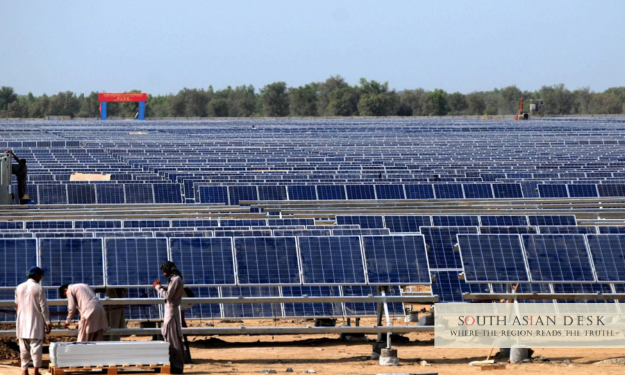
Islamabad, Pakistan – December 8, 2025, 4:35 PM Pakistan’s Ministry of Science and Technology (MoST) and the Korea International Cooperation Agency (KOICA) inaugurated the country’s first solar photovoltaic (PV) testing laboratory on December 6. This facility in Islamabad will certify solar panels to international standards, enhancing quality control for solar energy Pakistan projects.
The PAK-KOREA Testing Laboratory for PV Modules and Allied Equipment addresses a key gap in solar energy Pakistan infrastructure. It supports local manufacturers in exporting panels to Europe and Central Asia. Imported solar panels will undergo random testing to ensure compliance. This step accelerates Pakistan’s shift to renewables amid rising demand.
Solar energy Pakistan now accounts for over 25% of total electricity production in 2025, up from negligible shares a decade ago. The laboratory’s launch coincides with a rooftop solar boom, where installations reached 5.3 gigawatts (GW) through net metering by mid-year. Such growth offsets grid demand during peak sunlight hours, easing pressure on fossil fuel-dependent utilities.
Advancing Solar Energy Pakistan through Bilateral Ties
The inauguration highlights deepening Pakistan Korea solar cooperation. KOICA provided a $9.5 million (PKR 2.65 billion) grant for construction, equipment, and training. Pakistan contributed Rs185.8 million via the Public Sector Development Programme (PSDP). The project includes a nine-month training programme for local technicians.
KOICA President Chang Won Sam attended the event. He stated, “Pakistan’s abundant sunshine offers a tremendous opportunity in solar energy, and I firmly believe Pakistan is well-positioned to accelerate its transition toward clean and green energy.” Sam added that Korea aims to help Pakistan build capacity for testing and certifying solar PV modules to international standards.
Dr Jaesang Park, KOICA project manager, echoed this. “The completion of this testing lab is expected to significantly contribute to the development of Pakistan’s solar power industry,” he said.
The facility falls under the Pakistan Standards and Quality Control Authority (PSQCA), an arm of MoST. Once accredited to ISO-17025 and issuing IEC-61215 and IEC-61730 certificates, it will operate as a Certification Body Testing Laboratory (CBTL). This status allows direct issuance of compliance certificates, cutting certification costs for exporters.
Solar energy Pakistan imports surged to 17 GW of panels in 2024, making the country the world’s third-largest buyer after the US and India. Cumulative imports hit 50 GW by August 2025. Prices dropped to $0.08 per watt, driven by Chinese supplies. Yet, without local testing, manufacturers faced hurdles in global markets.
KOICA Solar Pakistan: A Milestone in Quality Assurance
The KOICA solar Pakistan partnership began in 2022 with project approval. Initial PSDP allocations covered local shares, while KOICA handled technical aspects. Construction wrapped up in late 2025, enabling the December launch.
This lab fills a void in solar testing facility Pakistan capabilities. Previously, panels required overseas certification, delaying exports and inflating costs. Now, random checks on imports will curb substandard goods flooding the market. Local firms gain an edge in bidding for utility-scale projects.
Aisha Moriani, secretary of the Ministry of Climate Change, noted the broader impact. “Pakistan will experience negative grid-linked demand during certain daytime hours because behind-the-meter solar is offsetting grid consumption completely,” she told Reuters at COP30 in Brazil. Grid demand grew just 3-4% this year, far below historical rates, thanks to solar adoption.
Pakistan’s solar potential stands at 2,900 GW, per Ministry data. Yet, renewables comprised only 7% of the 46,000 MW capacity in 2024, with solar at 530 MW utility-scale plus rooftop additions. The Alternative and Renewable Energy Policy targets 20% renewables by 2025 and 30% by 2030.
Power cuts and tariff hikes fuelled the rooftop rush. Net-metered capacity jumped from 2.5 GW in 2024 to 5.3 GW by March 2025, per National Electric Power Regulatory Authority (NEPRA) reports. Projections show 6.3 GW by fiscal year-end. This shift cut emissions and bills for households but strained utilities’ revenues.
Solar Testing Facility Pakistan: Boosting Exports and Industry
The new solar testing facility Pakistan enables compliance with European and Central Asian standards. Manufacturers can now certify panels locally, reducing turnaround times from months to weeks. KOICA’s training equips 50 Pakistani engineers in advanced testing protocols.
Pakistan Korea solar ties extend beyond this lab. Korea supported earlier renewable initiatives, including wind farms under the China-Pakistan Economic Corridor (CPEC). The 10,000 MW National Solar Energy Initiative, approved recently, aligns with these efforts. It promotes solar in transport and industry to cut carbon emissions.
In South Asia, Pakistan leads solar uptake. Neighbours like India focus on utility-scale, but Pakistan’s distributed model—driven by net metering—offers lessons. The lab positions Pakistan as a regional hub for PV certification, potentially attracting investment.
Challenges remain. Accreditation could take six to 12 months [VERIFY: exact timeline from PSQCA]. Grid integration needs upgrades to handle variable solar input. Still, the facility signals commitment.
Background
Solar energy Pakistan evolved rapidly post-2021 floods, which exposed fossil fuel vulnerabilities. Imports tripled yearly, with 16.62 GW in 2024 alone. The government’s green taxonomy, drafted in February 2025, classifies solar projects for incentives. This includes efficiency gains of 15-20% in buildings.
The KOICA project stems from 2019 bilateral agreements. Early PSDP funding in 2022-23 totalled Rs71 million annually, scaling to Rs185.8 million for completion. KOICA’s role mirrors its support in water and health sectors.
What’s Next
Accreditation will unlock operations in mid-2026. Plans include expanding to battery and inverter testing. Pakistan Korea solar collaboration may fund more labs. Officials eye 10 GW additional capacity by 2030.
This solar testing facility Pakistan enhances reliability, paving the way for solar energy Pakistan to power sustainable growth.
Published in SouthAsianDesk, December 7th, 2025
Follow SouthAsianDesk on X, Instagram, and Facebook for insights on business and current affairs from across South Asia.