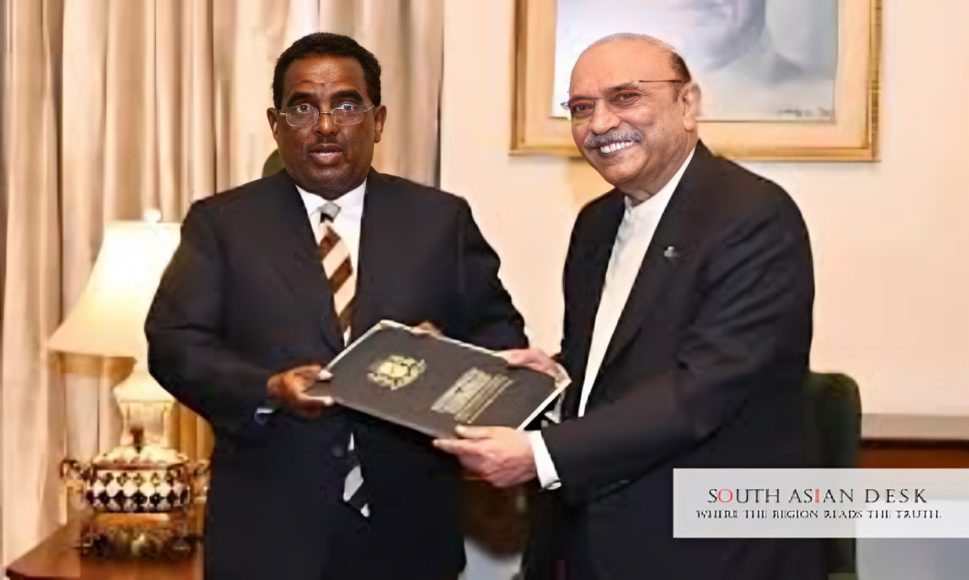
Pakistan and Somalia signed a pact on 24 January 2026 in Islamabad to abolish visas for diplomats. President Asif Ali Zardari witnessed the event during a meeting with Somali Interior Minister Ali Yousuf at Aiwan-i-Sadr.
Pakistan’s move to deepen links with Somalia through this agreement signals broader engagement with African nations. It could foster security partnerships amid rising transnational threats in South Asia and the Horn of Africa.
Pakistan and Somalia have taken a significant step in their relations by agreeing to abolish visas for diplomats. The Somalia Pakistan visa agreement facilitates easier official travel and sets the stage for expanded collaboration.
The signing occurred on Saturday at the Presidency in Islamabad. Hamza Adan Haadoow, Permanent Secretary of Somalia’s Ministry of Foreign Affairs and International Cooperation, and Dawood Muhammad Baraech, Special Secretary at Pakistan’s Ministry of Interior and Narcotics Control, inked the document.
President Asif Ali Zardari hosted Somali Interior Minister Ali Yousuf for discussions. This marked the first official bilateral visit from Somalia to Pakistan in 35 years. The leaders explored ways to strengthen ties in multiple areas.
Officials present included Pakistan’s Interior Minister Mohsin Raza Naqvi and State Minister for Interior Talal Chaudhry. From the Somali side Ambassador Sheikhnur Mohamed Hassan and Deputy Police Chief Osman Abdullahi attended.
The Pakistan Somalia diplomatic visa waiver aims to boost diplomatic mobility. It reflects a commitment to closer relations between the two countries.
Pakistan Somalia Bilateral Cooperation Explored
During the meeting Zardari emphasised Africa’s role in global geopolitics. He stated Pakistan seeks stronger ties with African states including Somalia. The President highlighted shared interests and support for collaboration.
Zardari noted Pakistan’s dedication to combating transnational crime and narcotics trafficking. Broader geopolitical issues and bilateral opportunities were discussed.
Ali Yousuf thanked Pakistan for the hospitality. He visited on invitation from his Pakistani counterpart. The minister conveyed appreciation to Zardari and the Pakistani people.
Ali Yousuf handed a letter from Somalia’s President. It included greetings and a reaffirmation of desire for deeper ties.
The Somali minister described Pakistan as a reliable partner since Somalia’s independence. He recalled Pakistani peacekeepers’ sacrifices in UN missions in Somalia during the 1990s. Some laid down their lives under the UN flag.
Talks focused on law enforcement and criminal justice. Both sides considered negotiating a bilateral extradition treaty. They reviewed legal frameworks for extradition.
Possibilities for mutual legal assistance in criminal matters arose. Transfer of sentenced persons was explored.
Cooperation against drug trafficking and organised crime featured prominently. Information and intelligence sharing were key points.
Capacity building and personnel training were agreed upon. Pakistan offered help from the National Database and Registration Authority.
NADRA assistance covers advanced identity management civil registration and secure documentation systems. Training for Somali police forces is included.
This Pakistan Somalia bilateral cooperation extends to counter-narcotics efforts. It addresses organised crime threats.
The agreement to abolish visas for diplomats aligns with these goals. It simplifies official exchanges.
Background
Pakistan and Somalia share historical connections. Pakistan supported Somalia post-independence in 1960.
In the 1990s Pakistan contributed to UN peacekeeping in Somalia. Over 5000 Pakistani troops participated in operations.
These efforts helped stabilise regions amid civil unrest. Somalia faced prolonged conflict and instability.
Relations cooled over decades due to internal challenges. This visit revives engagement after 35 years.
Pakistan has increased focus on Africa recently. Initiatives include economic and security partnerships.
Somalia seeks international support for reconstruction. Ties with Pakistan offer expertise in various fields.
The Somalia Pakistan visa agreement builds on this foundation. It promotes Pakistan Somalia diplomatic visa waiver as a trust-building measure.
What’s Next
Future steps include finalising the extradition treaty. Negotiations on mutual legal assistance will proceed.
Training programmes for Somali officials may start soon. NADRA collaboration could enhance Somalia’s systems.
High-level visits are expected to continue. Economic cooperation might follow.
Both nations aim to combat shared threats like narcotics. Intelligence sharing protocols could develop.
The Pakistan Somalia abolish visas for diplomats pact opens doors for more agreements. It strengthens Pakistan Somalia bilateral cooperation.
This development promises sustained engagement. Pakistan Somalia abolish visas for diplomats remains a key milestone.
Published in SouthAsianDesk, January 25th, 2026
Follow SouthAsianDesk on X, Instagram and Facebook for insights on business and current affairs from across South Asia.