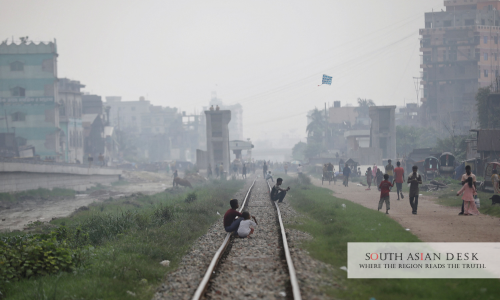
Cities across South Asia choke under hazardous smog as the air pollution crisis intensifies. Over 2 million premature deaths occur annually from poor air quality, according to World Bank data. Officials urge cross-border action to curb emissions from industry, vehicles, and farms. What drives this shared threat? Transboundary flows and seasonal traps lock pollutants in place, hitting India, Pakistan, Bangladesh, and Nepal hardest.
This crisis spans borders, trapping 900 million people in a toxic haze that slashes life expectancy and drains economies. In the Indo-Gangetic Plain, where nine of the world’s 10 most polluted cities cluster, air pollution erodes health and productivity. Governments face pressure to shift from reactive measures to unified strategies, as fragmented efforts fail against winds that carry soot from Punjab fields to Delhi streets.
Smog Causes South Asia’s Deadly Haze
Smog forms rapidly in South Asia due to a mix of human activity and weather patterns. Industrial emissions release nitrogen oxides and sulphur dioxide into the air. Vehicles add hydrocarbons and carbon monoxide. Farmers burn crop residue after harvests, sending black carbon aloft.
Winter inversions trap these particles near the ground. Cool air sits below warmer layers, blocking dispersal. Winds as low as 5 km/h push smoke from one country to another. In November 2024, the India-Pakistan smog event saw Lahore’s Air Quality Index (AQI) hit 1,200, rivaling Delhi’s 1,100. Satellite images captured brown clouds stretching 2,000 km across the region.
The World Health Organization (WHO) links these smog causes South Asia to rising respiratory cases. PM2.5 levels often exceed 300 µg/m³, 20 times the WHO daily guideline of 15 µg/m³. Dr. Maria Neira, WHO Director for Environment, Climate Change and Health, stated in a February 2025 press release: “Air pollution is a silent emergency. It shortens lives and burdens health systems across South-East Asia.” This underscores the urgency for emission controls.
Data from the Central Pollution Control Board (CPCB) in India shows PM2.5 concentrations in northern states averaged 101 µg/m³ in 2025, double the national standard of 40 µg/m³. Punjab reported 23 districts over the limit, driven by stubble burning that contributes 30% of seasonal spikes.
Air Pollution Indo-Gangetic Plain Traps Millions
The Indo-Gangetic Plain acts as a natural basin for air pollution. Stretching 3,000 km from Pakistan to Bangladesh, its flat terrain and Himalayan barriers create stagnant air pockets. Pollutants from brick kilns, power plants, and traffic accumulate here, affecting 600 million residents.
A 2025 ICIMOD press release highlighted plumes of PM2.5 sweeping from Lahore to Kolkata in November. Concentrations reached 300 µg/m³ in hotspots, fueled by post-monsoon residue burns. The plain’s airshed means emissions in one area impact all. Nepal’s Kathmandu saw AQI jumps to 350 from trans-Himalayan flows.
The World Bank’s June 2025 report on Nepal called air pollution the top health risk. It estimated 352,000 premature deaths in South Asia from PM2.5 in 2021, with figures climbing in 2025. Household sources like biomass cooking add 63% of indoor exposure in the region, per WHO data. Women and children bear the brunt, with acute infections rising 25% in polluted zones.
Economic toll mounts. India’s GDP loses 1.36% yearly to pollution-related illnesses, per The Lancet. Pakistan spends PKR 500 million annually on respiratory treatments in Punjab alone. The plain’s urban boom vehicle sales up 15% in 2025 worsens the cycle. Construction dust and waste burning add fine particles that penetrate lungs.
Climate links amplify risks. UNEP’s 2023 report notes that warming patterns extend inversion periods by 10 days yearly. Floods from erratic monsoons displace communities into high-emission areas. Officials in Delhi enforced odd-even vehicle rules in October 2025, cutting traffic by 20%, but AQI stayed above 300.
Transboundary Air Pollution India Pakistan Demands Unity
Transboundary air pollution India Pakistan exemplifies the crisis. Smoke from Indian Punjab drifts west, coating Lahore in haze. In 2025, low winds carried 40% of Delhi’s pollutants to Islamabad, per Copernicus Atmosphere Monitoring Service data.
The shared airshed ignores borders. ICIMOD’s December 2024 release warned of 20-fold PM2.5 spikes affecting both nations. Bangladesh and Nepal import haze from upstream burns, with Dhaka’s AQI hitting 400 in January 2025.
Government responses vary. India’s National Clean Air Programme (NCAP) targets 40% reduction by 2026, but northern cities lag. Pakistan’s Punjab Green Development Programme subsidizes clean tractors, yet enforcement gaps persist. A joint India-Pakistan task force met in 2024, pledging data sharing, but progress stalls on farm reforms.
WHO’s updated 2025 Air Quality Standards database covers 140 countries, urging stricter PM2.5 limits. “Seventeen percent more nations now align with guidelines,” the release noted, calling for regional pacts. The World Bank campaign, launched June 2025, pushes electric vehicles and renewables to slash emissions 30% by 2030.
Health data paints a grim picture. South Asia sees 7 million pollution deaths globally yearly, with 2 million local. Children under five face 600,000 pneumonia cases tied to dirty air. Labor productivity drops 5% in haze seasons, costing billions.
Background of This Air Pollution Crisis
Air pollution in South Asia traces to rapid industrialization post-1990s. Coal plants tripled, vehicles quadrupled. The 2019 UNEP report listed 25 clean air measures, yet implementation covers under 50% of sites. The 2024 smog event marked a turning point, prompting SAARC talks on airshed management. IIT Bhubaneswar studies advocate borderless monitoring, but political hurdles delay action.
What’s Next
Regional forums like the 2026 SAARC summit could forge binding emission caps. Pilot projects in the Indo-Gangetic Plain test drone surveillance for burns. Success hinges on funding, World Bank pledges USD 1 billion for clean tech. Without unity, the South Asia air pollution crisis will claim more lives.
The South Asia air pollution crisis demands immediate, collective resolve to clear the skies for future generations.
Published in SouthAsianDesk, December 5th, 2025
Follow SouthAsianDesk on X, Instagram, and Facebook for insights on business and current affairs from across South Asia.