Sri Lanka landslides have intensified following Cyclone Ditwah, pushing the Sri Lanka floods toll to 618 confirmed deaths across the island. Heavy rains since November 28 have displaced over 2 million people, with 209 still missing. Authorities warn of more slides in central highlands as relief efforts strain under Asia floods 2025 pressures.
The Disaster Management Centre (DMC) reports 464 fatalities in the tea-rich central region alone, where unstable hillsides gave way under torrential downpours. Northwestern midlands and Colombo outskirts like Wellampitiya also suffered severe inundation. Cyclone Ditwah, the worst storm this century, struck the eastern coast before unleashing widespread chaos.
This disaster underscores South Asia’s vulnerability to climate-amplified events. Sri Lanka’s fragile post-economic recovery now faces a $7 billion reconstruction bill, per government estimates. Regional neighbours grapple with similar Asia floods 2025, straining shared resources and humanitarian networks from India to Indonesia.
Cyclone Ditwah Sparks Unprecedented Havoc
Cyclone Ditwah made landfall on November 28, 2025, with winds up to 90 km/h and rainfall exceeding 500 mm in 72 hours. The storm triggered Sri Lanka landslides in vulnerable mountainous areas, burying villages under mud and debris. In Nuwara Eliya and Kandy districts, entire communities vanished overnight.
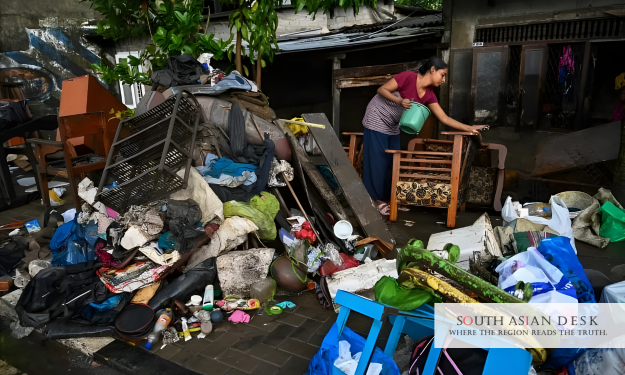
The Sri Lanka floods toll climbed rapidly as rivers burst banks, submerging 75,000 homes. Nearly 5,000 structures lie in ruins, according to DMC data. Over 100,000 remain in shelters, down from a peak of 225,000, as waters recede in lowlands.
President Anura Kumara Dissanayake addressed the nation on December 5. “Sri Lanka’s economy had made a significant recovery, but was not strong enough to withstand the latest shock alone,” he stated. His words highlight the intersection of natural fury and fiscal strain.
International partners mobilise swiftly. The United States deployed two C-130J aircraft on December 7 at Katunayake Air Base. U.S. Ambassador Julie Chung joined Deputy Minister of Defence Major General KP Aruna Jayasekara (Retd.) for the handover. “This support reflects the goodwill of the American people,” Chung said.
The Sri Lanka Air Force coordinates airlifts of shelter materials, water purification kits, and food. A $2.1 million equipment package from the U.S., including fuel trucks and forklifts, aids rapid distribution.
Sri Lanka Landslides Devastate Central Heartland
Focus turns to the central highlands, epicentre of Sri Lanka landslides. In Gampola town, Kandy district, uprooted trees and collapsed buildings mark the aftermath. Rescue teams recovered 150 bodies from one slide site alone.
DMC Director General Major General Sampath Kotuwegoda issued warnings on December 6. Fresh monsoon bands threaten further instability. “Hillsides remain saturated; evacuation orders stand for high-risk zones,” Kotuwegoda said.
Evacuations reached 233,000 at peak, per UN Office for the Coordination of Humanitarian Affairs (OCHA) Flash Update 4, dated December 3. That report logged 474 deaths and 356 missing then, with numbers surging since. All 25 districts declared disaster zones.
Children bear heavy brunt. UNICEF’s Humanitarian Situation Report No. 2, December 5, notes contaminated water risks diarrhoea outbreaks. Over 20,000 partially damaged homes expose families to elements.
Economic ripples extend beyond borders. Tea plantations, vital to Sri Lanka’s exports, face months of disruption. The International Monetary Fund (IMF) eyes $200 million in extra aid for rebuilding, as announced December 6.
Asia Floods 2025: A Regional Reckoning
Sri Lanka’s crisis mirrors broader Asia floods 2025 patterns. Indonesia reports over 900 deaths on Sumatra, where survivors navigate log-strewn paths for aid. Thailand tallies 276 fatalities from northern deluges. Malaysia battles Kuala Lumpur inundations, while Vietnam contends with coastal submersion affecting hundreds of thousands.
OCHA data shows Asia-wide toll exceeding 1,750. Heavy rains, linked to La Niña shifts, hamper recoveries everywhere. In Aceh Tamiang, Indonesia, children fall ill from tainted supplies, echoing Sri Lankan fears.
The World Health Organization (WHO) supports Sri Lanka’s Ministry of Health with rapid teams. As of December 2, WHO tallied 410 deaths, 336 missing, and 1.4 million affected. “Coordination across sectors ensures timely response,” a WHO statement reads.
IOM expands non-food aid, targeting 209,000 displaced as of December 1. Their efforts align with DMC priorities, distributing tarps and hygiene kits.
Japan’s JICA donated relief consignments on December 4, handed over at Bandaranaike International Airport. DMC tweeted gratitude: “This supports communities severely affected by Cyclone Ditwah.”
Mercy Malaysia met DMC officials December 3, pledging medical teams. Such partnerships bolster local capacity amid global strains.
Background: Monsoon Vulnerabilities Exposed
Sri Lanka’s disaster management evolved post-2004 tsunami, yet gaps persist. The DMC, under the Ministry of Disaster Management, coordinates via 120/2, Vidya Mawatha, Colombo-7. Annual monsoons claim lives yearly, but Cyclone Ditwah’s scale dwarfs norms.
Climate models predicted intensified storms for 2025. Northeast monsoon, peaking December-January, amplified Ditwah’s fury. Satellite imagery from November 28 showed eye-wall structure dumping rain over highlands.
Historical parallels include 2019 floods killing 250. This event, however, rivals 1957’s record deluges. Government data from Central Bank underscores $7 billion losses, equating 3% of GDP.
South Asia watches closely. India’s Kerala floods in 2018 displaced 1.4 million; Bangladesh faces annual cyclones. Shared lessons in early warning systems could mitigate future Asia floods 2025.
What’s Next: Rebuilding Amid Warnings
Relief transitions to recovery. DMC plans long-term zoning for slide-prone areas. IMF talks accelerate for fiscal buffers.
Fresh Sri Lanka landslides loom with ongoing rains. Authorities urge compliance with alerts. International pledges mount, but local resilience defines path forward.
As Sri Lanka tallies scars from these landslides, hope rests on unified action. Cyclone Ditwah’s legacy demands regional climate pacts, ensuring no repeat in vulnerable terrains.
Published in SouthAsianDesk, December 7th, 2025
Follow SouthAsianDesk on X, Instagram, and Facebook for insights on business and current affairs from across South Asia.