A strong earthquake hit Dhaka on Friday, November 21, 2025, at 10:38am local time, registering 5.5 magnitude with its epicentre in Narsingdi district, 50km east of the capital. The quake, which lasted 26 seconds, killed three people and injured several others as buildings swayed and residents fled in fear. Tremors rippled into Kolkata and northeast India. How did authorities respond, and what risks loom for this vulnerable region?
This strong earthquake Dhaka event underscores the seismic fragility of South Asia’s densely populated urban centres. Bangladesh sits at the crossroads of the Indian, Eurasian, and Burmese tectonic plates, where annual shifts build immense pressure. Dhaka, home to over 20 million people in a 1,500 square kilometre area, ranks among the world’s top 20 earthquake-vulnerable cities. A similar event could devastate infrastructure, displace millions, and strain regional economies reliant on cross-border trade. The quake’s reach into India highlights shared vulnerabilities, urging coordinated preparedness across borders.
5.5 Magnitude Quake Narsingdi Dhaka Shakes Capital
The earthquake originated 14km west-southwest of Narsingdi at a shallow depth of 10km, intensifying its impact. The United States Geological Survey (USGS) clocked it at 5.5 magnitude, while Bangladesh’s official body, the Bangladesh Meteorological Department (BMD), recorded 5.7. Farzana Sultana, a BMD meteorologist, confirmed the epicentre lay 13km east of Dhaka’s Agargaon seismic centre. “The shaking persisted for 26 seconds,” she stated in a press release. This discrepancy in readings reflects varying measurement methods but aligns on the event’s severity.
Panic erupted immediately. In Dhaka’s high-rise districts like Gulshan and Banani, office workers and residents poured into streets, clutching belongings. Videos captured cupboards toppling and ceilings cracking. The quake interrupted a Test cricket match between Bangladesh and Ireland at Mirpur Stadium, halting play for 10 minutes as players and spectators evacuated. Similar scenes unfolded in Narsingdi, where the ground heaved visibly.
Bangladesh Earthquake Deaths Dhaka Tremors Claim Lives
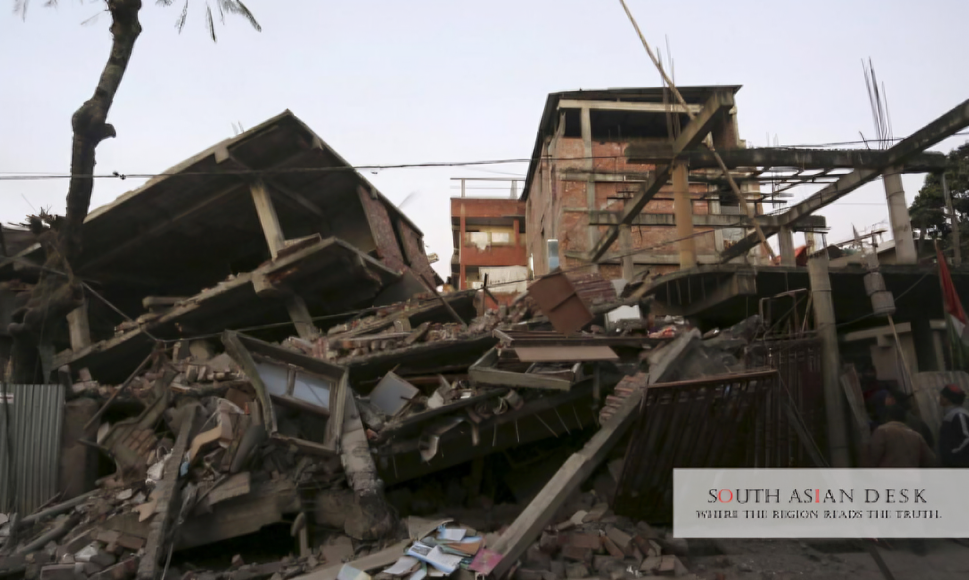
Casualties mounted quickly. Police reported three deaths in Dhaka: two pedestrians crushed by a collapsing building railing in Old Dhaka, and a newborn killed when a wall fell in Narayanganj. Several injuries stemmed from the chaos, including falls during evacuations and impacts from debris. “Emergency teams reached sites within 15 minutes,” said a Dhaka Metropolitan Police spokesperson in an official update. No further fatalities emerged by 4:35pm, but hospitals treated dozens for shock and minor wounds.
Damage assessments revealed cracks in mid-rise structures across Dhaka and Narsingdi. In Madhabdi, the epicentre town, at least five homes partially collapsed. Power lines snapped in rural Narsingdi, causing outages for 2,000 households. The BMD issued an advisory urging structural checks. “Buildings over 20 years old face highest risk,” Sultana added. Officials deployed engineers from the Capital Development Authority to inspect bridges and flyovers.
Kolkata Feels Dhaka Quake November Ripples Across Borders
Tremors extended beyond Bangladesh, felt keenly in Kolkata, 250km west. Residents in West Bengal’s capital described moderate swaying lasting 5-10 seconds. IT hubs in Salt Lake saw workers evacuate, mirroring Dhaka’s frenzy. The India Meteorological Department (IMD) confirmed intensity at III-IV on the Mercalli scale, enough to rattle windows but not topple edifices. No damage or injuries occurred in India, per state disaster management reports.
Further afield, shakes reached Assam, Tripura, and Meghalaya. In Guwahati, 400km northeast, mild vibrations prompted school drills. Agartala reported similar effects. This cross-border propagation, common in shallow quakes, amplifies regional alarm. The 5.5 magnitude quake Narsingdi Dhaka event joins a pattern: Bangladesh logs 58 quakes over magnitude 4 yearly within 300km. The Madhupur fault, a 100km fracture under Dhaka, Gazipur, and Tangail, drives most activity.
Seismic Risks in South Asia’s Tectonic Hotspot
Bangladesh’s geology amplifies threats. The Indian plate barrels northeast at 6cm annually, clashing with the Eurasian plate’s 2cm northward creep. This compresses the region, fuelling faults like Madhupur and Dauki. Dhaka’s density 30,000 people per square kilometer exacerbates dangers. A 2024 Rajdhani Unnayan Kartripakkha (Rajuk) study warns a 6.9 magnitude strike on Madhupur could collapse 864,619 to 1,391,685 buildings, or 40-65% of the capital’s stock. Economic losses might exceed 1% of GDP, hitting BDT 5.5 trillion (USD 46 billion).
Historical precedents loom large. The 1984 magnitude 6.0 quake east of Dhaka killed 20 via landslides. More devastating was 1897’s 8.0 event, which levelled structures across Assam and Bangladesh. Today’s strong earthquake Dhaka serves as a drill. The BMD’s real-time monitoring, upgraded in 2023 with 15 new stations, detected this event in seconds. Yet gaps persist: only 60% of Dhaka buildings meet seismic codes.
Authorities mobilised swiftly. The Ministry of Disaster Management activated 500 volunteers for relief. Prime Minister’s Office released BDT 10 million (USD 85,000) for immediate aid. “We prioritise vulnerable zones,” said a ministry press note. Neighbouring India offered technical support via the IMD-BMD pact.
Background: Bangladesh’s Quake-Prone Legacy
Earthquakes define Bangladesh’s seismic narrative. Straddling three plates, it endures moderate events yearly. The 2004 Indian Ocean tsunami, though offshore, killed 2,000 via tsunamis. Closer, 2016’s 5.1 Manikganj quake injured 50. Dhaka’s unplanned growth, 20% annual urbanization worsens exposure. Slum dwellers, 40% of residents, shelter in tin shacks prone to collapse. Rajuk’s zoning laws, enforced since 2010, cover just half the city.
Climate change compounds risks. Rising seas erode fault stability, per a 2025 UN report. South Asia-wide, 500 million live in high-risk zones. India’s northeast, with 100 quakes yearly, shares this burden. Collaborative drills, like the 2024 BIMSTEC exercise, build resilience.
This strong earthquake Dhaka highlights enforcement needs. Only 30% of schools comply with retrofitting mandates. Hospitals, vital in crises, house 70% outdated equipment. International aid, from USAID’s BDT 2 billion (USD 17 million) seismic project, bolsters sensors but not structures.
What’s Next for Quake Preparedness
Recovery unfolds rapidly. By Friday, crews cleared Old Dhaka debris, restoring traffic. BMD forecasts no aftershocks above 4.0, but monitoring continues 24/7. Long-term, Rajuk plans audits for 50,000 buildings by 2026. Public campaigns will drill 1 million residents quarterly.
Regionally, India-Bangladesh talks resume next week on shared early-warning systems. The 5.5 magnitude quake Narsingdi Dhaka demands investment: BDT 50 billion (USD 425 million) for resilient infrastructure. As plates grind, vigilance averts catastrophe. This strong earthquake Dhaka, though deadly, spotlights action’s urgency.
Published in SouthAsianDesk, November 21st, 2025
Follow SouthAsianDesk on X, Instagram, and Facebook for insights on business and current affairs from across South Asia.