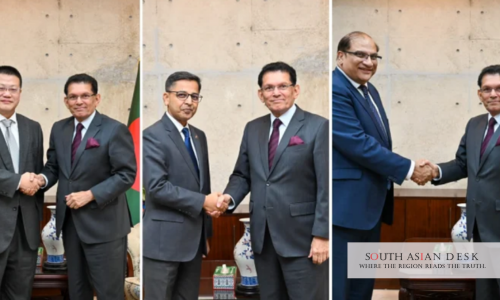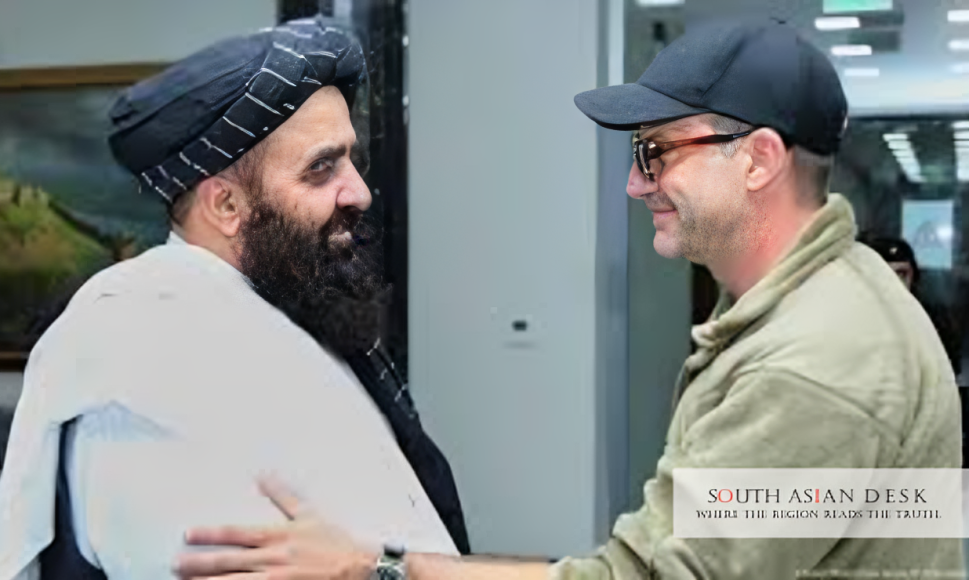
In a significant diplomatic engagement, Taliban leaders and US envoys forge ahead on detainee exchanges, hinting at thawing relations in Kabul.
Kabul witnessed the Taliban US meeting 2025 on Saturday, September 13, when acting Foreign Minister Amir Khan Muttaqi hosted US Special Envoy for Hostage Response Adam Boehler and former Special Envoy Zalmay Khalilzad to explore bilateral ties, culminating in an agreement for prisoner swaps to address detained citizens.
Why it Matters
This Taliban US meeting 2025 carries profound implications for South Asia, where Afghanistan’s stability directly influences neighbouring Pakistan’s security dynamics. Enhanced Taliban US bilateral ties could mitigate cross-border tensions, facilitate humanitarian aid flows, and unlock investment channels, potentially curbing extremism spillover and bolstering regional economic corridors. For Pakistan, it signals a pathway to indirect US engagement on shared concerns like counter-terrorism, fostering a more predictable geopolitical landscape amid ongoing flux.
Key Details from the Taliban US Meeting 2025
The encounter in Kabul marked a rare direct interaction between high-level US representatives and Taliban officials since the group’s 2021 takeover. According to a Taliban statement, comprehensive discussions centred on advancing Taliban US bilateral ties, encompassing citizen-related issues and untapped investment prospects in Afghanistan. The meeting underscored mutual interest in resolving humanitarian bottlenecks, with both sides committing to future dialogues.
Participants exchanged views on longstanding detainee cases, a focal point of recent US-Taliban engagements. The Taliban highlighted prior goodwill gestures, describing earlier releases as humanitarian steps. US officials, meanwhile, emphasised exploring viable pathways for freeing unlawfully held individuals, aligning with broader objectives of normalisation.
No formal joint communiqué emerged immediately, but the Taliban’s account portrayed the talks as constructive. The Taliban noted that the session delved into mechanisms for developing bilateral relations, including economic opportunities that could stabilise Afghanistan’s fragile recovery.
Advancing Taliban US Bilateral Ties 2025
At the heart of the Taliban US meeting 2025 lay efforts to strengthen Taliban US bilateral ties. Conversations reportedly touched on investment avenues, with the Taliban advocating for US involvement in Afghanistan’s reconstruction amid international isolation. Such ties could encompass sectors like mining and infrastructure, where Afghan resources hold promise but require foreign capital.
Citizen issues dominated, particularly the plight of Americans detained in Afghanistan and Afghan nationals held abroad. The agreement on prisoner exchanges builds on precedents: in March 2025, US citizen George Glezmann was freed following negotiations, while January 2025 saw the release of Ryan Corbett and William Wallace McKenty in swap for Afghan national Khan Mohammad. These steps reflect incremental progress in Taliban US bilateral ties, though full normalisation remains elusive without Taliban concessions on governance and rights.
From the US perspective, Secretary of State Marco Rubio addressed the developments in September 2025 remarks, stating: “Well, I don’t know – look, our special envoy for the unlawfully detained has been having conversations for a while. I think he went there to explore what’s possible. Obviously it’ll be the President’s decision in terms of any trades or any exchanges. But we most certainly want any Americans or anyone who’s being unlawfully detained to be released. And so he went there to explore what that would look like.”
This cautious tone from Washington highlights the exploratory nature of the Taliban US meeting, prioritising hostage recovery over immediate diplomatic recognition. The Taliban, in turn, pressed for the release of Muhammad Rahim, the last Afghan at Guantanamo Bay, framing it as reciprocal goodwill.
Background
US-Taliban interactions have evolved cautiously since the 2021 Doha Accords. A March 2025 delegation visit to Kabul yielded Glezmann’s release, setting a template for humanitarian-focused diplomacy. These engagements occur against a backdrop of non-recognition by the US and allies, with sanctions persisting due to Taliban policies on women’s rights and inclusive governance.
The current Taliban US bilateral ties trajectory draws from such precedents, where prisoner swaps serve as low-stakes confidence-builders. Afghanistan’s economic woes, exacerbated by frozen assets and aid restrictions underscore the urgency of investment talks, potentially aligning with US interests in preventing vacuum-driven instability.
What’s Next for Taliban US Relations
Prospects for Taliban US bilateral ties 2025 hinge on follow-through from the Taliban US meeting 2025. Upcoming sessions may address broader economic pacts, with the US envoy’s role pivotal in navigating presidential oversight. Regional stakeholders, including Pakistan, will monitor for ripple effects on border management and trade routes.
As Taliban US bilateral ties 2025 gain momentum post the meeting, sustained dialogue could herald a new chapter in Afghanistan’s reintegration, offering South Asia a buffer against prolonged conflict.
Published in SouthAsianDesk, September 14th, 2025
Follow SouthAsianDesk on X, Instagram, and Facebook for insights on business and current affairs from across South Asia.