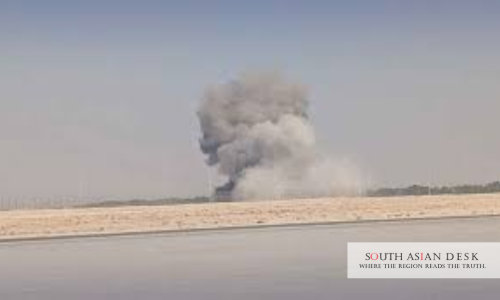
Wing Commander Namansh Syal died when a Tejas fighter jet crashed during a display at the Dubai Airshow on Friday, dealing a blow to India’s ambitions as the Tejas crash harms India export hopes for the lightweight combat aircraft. The incident occurred at 2pm local time on 21 November 2025 at Al Maktoum International Airport, where the jet nosedived after a low-altitude manoeuvre and burst into flames, witnesses said. The cause remains unknown pending an inquiry, but the timing in front of potential international customers has sparked concerns over reliability.
This tragedy underscores a setback for India’s drive towards defence self-reliance, a cornerstone of Prime Minister Narendra Modi’s agenda since 2014. In South Asia, where nations like Pakistan and Bangladesh eye modern air forces amid rising tensions, a robust Indian exports programme could reshape regional power dynamics. Yet the Tejas Dubai Airshow crash impact exports by eroding confidence just as India seeks to penetrate markets in Africa, Latin America and Southeast Asia. With squadrons shrinking to 29 from a sanctioned 42, the Indian Air Force now faces heightened pressure to diversify acquisitions, potentially slowing Tejas production ramps.
Tejas Dubai Airshow Crash Impact Exports in Key Showcase
The Dubai Airshow serves as a prime venue for defence deals, drawing delegations from over 100 nations. India showcased the Tejas Mk-1 alongside BrahMos missiles to highlight its growing aerospace prowess. The single-engine, multi-role jet, priced at around USD 40 million per unit, promises technology transfer and integration flexibility, appealing to budget-conscious air forces.
But the crash unfolded in seconds. Video footage captured the aircraft, callsign ‘BHARAT’, executing a vertical climb before losing control and slamming into the ground, igniting a fireball that sent black smoke billowing across the tarmac. Spectators, including families, watched in horror from grandstands. No ground injuries occurred, but the pilot could not eject.
The Indian Air Force confirmed the accident swiftly. “An IAF Tejas aircraft met with an accident during an aerial display at Dubai Air Show today,” it stated. “The pilot sustained fatal injuries. IAF deeply regrets the loss of life and stands firmly with the bereaved family. A court of inquiry is being constituted to ascertain the cause.” Wing Commander Syal, a decorated test pilot with over 2,000 flying hours, received national tributes. President Droupadi Murmu and Defence Minister Rajnath Singh offered condolences, calling him a “valiant warrior”.
Hindustan Aeronautics Limited, the state-owned manufacturer, echoed the grief. “HAL is deeply saddened by the loss of the courageous IAF pilot during the aerial display at the Dubai Air Show,” it posted on X. “HAL expresses its heartfelt condolences to the bereaved family.” HAL noted this as the second Tejas incident in 20 months, referencing a March 2024 crash near Jaisalmer where the pilot ejected safely after an engine seizure.
Experts view the event as a public relations hit. Douglas A. Birkey, executive director of the Mitchell Institute for Aerospace Studies, described the imagery as “brutal” and a “dramatic failure” that sends the opposite signal to buyers. A former HAL executive added that the Tejas crash harms India export hopes, ruling out immediate overseas sales and shifting focus to domestic output.
India Tejas Fatal Accident Defence Sales Momentum
India’s defence sector has surged under ‘Atmanirbhar Bharat’. Production hit a record INR 1.54 lakh crore in FY 2024-25, up from INR 46,429 crore a decade ago. Exports reached INR 23,622 crore that year, a 12% rise from INR 21,083 crore prior, supplying ammunition, missiles and drones to 80 countries. The private sector drove 64% of these shipments, with destinations spanning the US, Armenia and France.
Yet the Tejas programme lags in global sales. No exports materialise despite pitches to Egypt, the Philippines and Nigeria. HAL opened a Malaysian office in 2023 to tap Southeast Asia, but production bottlenecks persist. General Electric’s engine supply chain delays hold up 180 Mk-1A deliveries, leaving only 40 Tejas in service across two squadrons. An IAF officer noted ongoing issues: “The Tejas was supposed to be their replacement for vintage aircraft. But it is facing production issues.”
The India Tejas fatal accident defence sales outlook dims further. Defence Minister Rajnath Singh targets INR 50,000 crore in annual exports by 2029, but this crash at a high-profile event could deter suitors wary of single-engine risks. Birkey tempered fears, however: “Fighter sales are driven by high-order political realities, which supersede a one-off incident.” Still, the Tejas pilot death export setback arrives amid IAF woes, with plans for more Rafales or Su-57s on the table.
Prior Incidents and Safety Record
The Jaisalmer mishap in March 2024 involved a Mk-1 variant during training. An engine failure caused the spin, but the pilot’s safe ejection bolstered confidence in the ejection seat. Overall, Tejas logs thousands of incident-free hours since induction in 2016. The Dubai crash, however, marks a fatal first, amplifying scrutiny on the GE F404 engine and flight envelope.
Potential Markets at Risk
Southeast Asian nations like Vietnam and Indonesia seek affordable fighters to counter China. Armenia, a recent buyer of Indian Akash systems, eyed Tejas for its terrain adaptability. The Tejas Dubai Airshow crash impact exports these prospects, as buyers prioritise proven track records. HAL insists the jet’s 4.5-generation features, supercruise capability and advanced avionics remain unmatched at the price point.
Background: The Tejas Journey
Conceived in 1983 under the Light Combat Aircraft programme, Tejas overcame decades of hurdles. Initial delays stemmed from technology imports and funding shortfalls, but the first flight occurred in 2001. Full operational clearance came in 2019, paving induction.
Key milestones include a INR 48,000 crore deal for 83 Mk-1A jets in 2021 and approval for 97 more in 2023. The upgraded Mk-1A debuted on 17 October 2025 at HAL’s Nashik facility. By 2030, projections see 220 units bolstering IAF strength, though exports elude the fleet.
India’s pivot to exporter status reflects policy shifts: 75% indigenous content mandates and export clearances streamlined to 1,762 approvals last year. Tejas symbolises this, yet the recent fatal accident tests resilience.
What’s Next for Tejas Programme
A court of inquiry, led by IAF experts, convenes imminently to probe avionics, engine performance and pilot inputs. Preliminary findings could emerge within weeks, HAL sources indicate. Parallelly, GE addresses supply snarls, aiming first Mk-1A deliveries by mid-2026.
Government eyes recovery through diplomacy. Outreach to UAE partners, who hosted the show, underscores ties. Broader reforms, including a INR 500 crore deep-tech fund, aim to fortify programmes like Tejas.
As inquiries unfold, the Tejas crash harms India export hopes but may galvanise fixes. One DNA India editorial urged: “Tejas tragedy has hard lessons but it should not clip aerospace ambitions.” With regional rivals modernising fleets, India cannot afford prolonged stumbles. The fighter’s future hinges on swift transparency and unyielding production drives, ensuring the Tejas Dubai Airshow crash impact exports proves temporary.
Published in SouthAsianDesk, November 23rd, 2025
Follow SouthAsianDesk on X, Instagram, and Facebook for insights on business and current affairs from across South Asia.