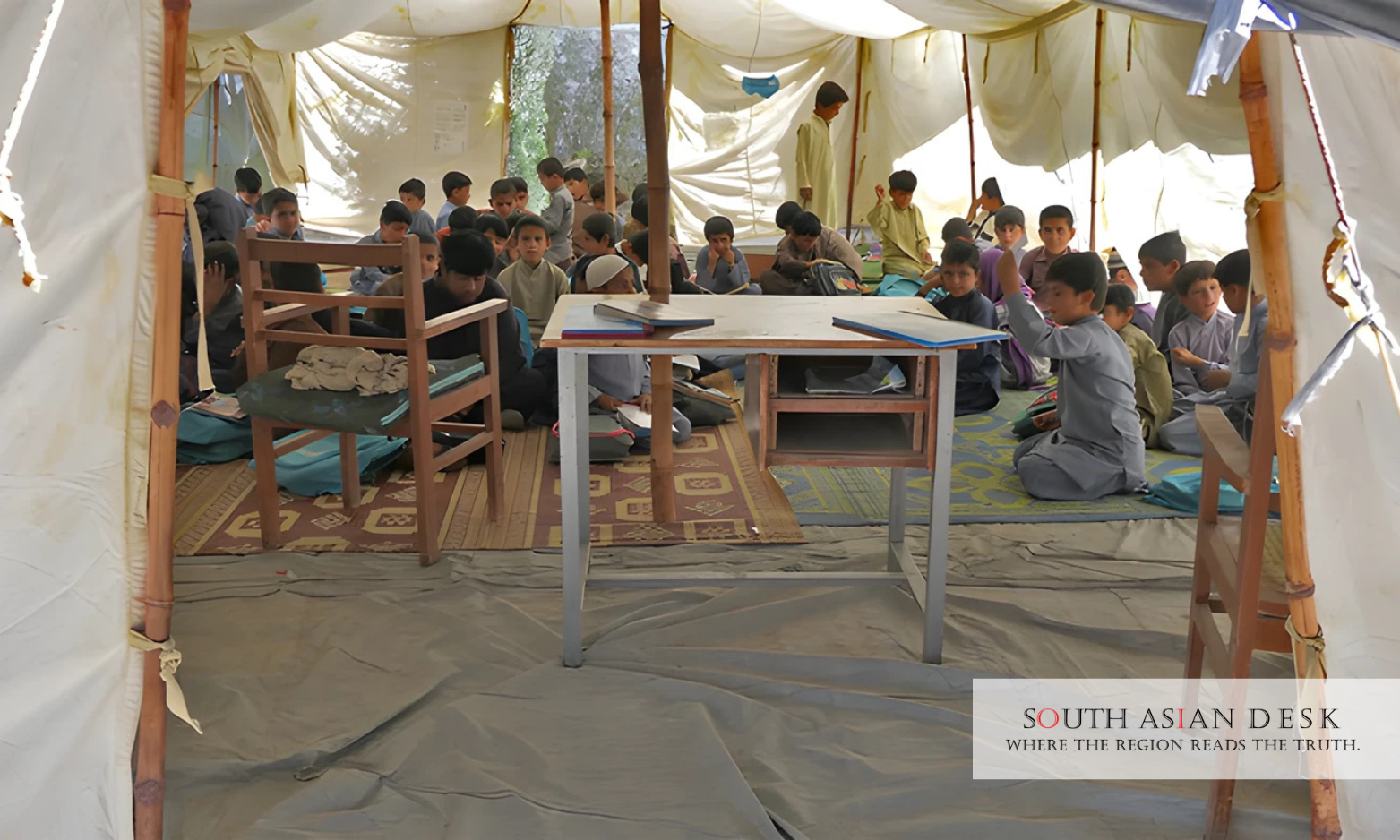
In the shadow of devastation, 72 tents transformed into classrooms offer a fragile lifeline to education for thousands of Afghan children reeling from a deadly earthquake.
Kunar province’s education authorities have established 72 temporary classrooms Afghanistan in earthquake-affected areas to resume schooling for children displaced by the 31 August tremor that levelled schools and claimed hundreds of lives. The initiative, announced by local officials, addresses the destruction of 306 educational buildings, with classes held in displacement camps until permanent reconstruction begins.
The earthquake in Kunar underscores the fragility of Afghanistan’s education infrastructure amid recurring natural disasters, a challenge that reverberates across South Asia where seismic activity threatens millions of schoolchildren. With over 157,000 students disrupted, these temporary classrooms Afghanistan 2025 efforts highlight the urgent need for resilient rebuilding to safeguard future generations in a region prone to such crises.
Temporary Classrooms Bring Hope Amid Rubble
In the wake of the 6.0-magnitude earthquake Kunar schools temporary measures became imperative as 53 schools were completely destroyed and 253 partially damaged, according to Kunar’s education department. The department, led by Mohibullah Haidari, swiftly activated 72 tent-based temporary classrooms in displacement camps, ensuring that education resumes for affected pupils. These facilities, operational as of early September, will persist as long as the camps remain active, allowing students to continue lessons without further interruption.
The earthquake Kunar schools temporary setup addresses immediate gaps, but survivors emphasise the long-term toll. Among the 272 students and four teachers killed, and 882 others—including 20 educators—injured, the loss extends beyond numbers. Tajbano, a second-grade pupil whose home, school, and madrasa were razed, shared her relief: “For fifteen days, we had no lessons and sat without schooling. Now we are happy that classes have resumed here.” Her account, echoed by peers Khalid and Soheil, reveals the psychological strain of suspended learning amid grief.
Haideri, in an official statement, affirmed the commitment: “We have activated 72 classrooms in the earthquake-affected areas. These classes have been established temporarily. As long as these camps are operational, the schools and classrooms will also remain active, and students will continue their education.” This provisional approach aligns with broader humanitarian responses, including UNICEF’s push for temporary learning spaces while assessments proceed.
Devastation’s Toll on Education in Kunar
The earthquake Kunar schools temporary crisis unfolded on Sunday, 31 August, 2025, when the quake struck eastern Afghanistan, epicentred near Jalalabad and ravaging Kunar province. Official tallies report over 2,200 fatalities and 3,640 injuries nationwide, with Kunar bearing the brunt—approximately 800 deaths and 2,500 wounded in the province alone. Among the wreckage: 6,700 homes collapsed, roads buried under debris, and educational sites reduced to ruins.
Kunar’s education department detailed the sector’s plight, noting that the disaster hindered preparations for the new academic year, affecting 157,000 students region-wide. Survivor Azizullah, whose community lost multiple facilities, urged action: “All the destroyed schools in our areas should be rebuilt so that our children can continue their education in their own schools.” Soheil, another child, pleaded for local reconstruction to avoid prolonged displacement.
Health impacts compound the educational fallout. The World Health Organization (WHO) assessed 21 health centres in Kunar and neighbouring Nangarhar, finding one fully destroyed and 20 damaged, straining support for injured students and staff. Dr Abdul Mateen Sahak, WHO’s local emergency lead, recounted the chaos: “Fortunately, we were able to quickly reach the most affected area.” His team distributed medical supplies, but the overlap with school reopenings amplifies vulnerabilities for young learners.
International aid has mobilised, with over 35 metric tonnes of WHO supplies arriving in Kabul by 8 September to bolster survivor care in eastern Afghanistan. Ireland pledged €500,000 to the Red Cross and Red Crescent for earthquake Kunar schools temporary relief, targeting 1,457 confirmed affected individuals. Yet, gaps persist: temporary camps often lack dedicated educational amenities, forcing reliance on ad-hoc tents.
Background
Afghanistan’s eastern provinces, including Kunar, sit astride active fault lines, making seismic events a perennial threat. The 31 August quake, shallow and intense, exacerbated existing challenges like Taliban-era restrictions on female education and underfunded infrastructure. Prior tremors, such as the 2023 Herat series, destroyed thousands of structures, underscoring the need for seismic-resistant designs in temporary classrooms Afghanistan 2025 initiatives. Kunar’s rugged terrain delayed initial assessments, but data now reveals the education sector’s disproportionate hit, over 300 sites compromised in a province already grappling with conflict legacies.
Path Forward for Reconstruction
As temporary classrooms Afghanistan 2025 sustain learning through the academic year, calls grow for permanent fixes. Kunar officials and aid groups advocate accelerated rebuilding, potentially incorporating 2025 timelines for donor-funded projects. “The school where I used to study has been destroyed. My request is that schools be rebuilt in our homes and local areas,” Soheil implored, voicing a collective plea. With UNICEF assessing repairs, sustained international support could transform these tents into enduring symbols of resilience by mid-2026, ensuring no child is left behind in post-quake recovery.
Published in SouthAsianDesk, September 17th, 2025
Follow SouthAsianDesk on X, Instagram, and Facebook for insights on business and current affairs from across South Asia.