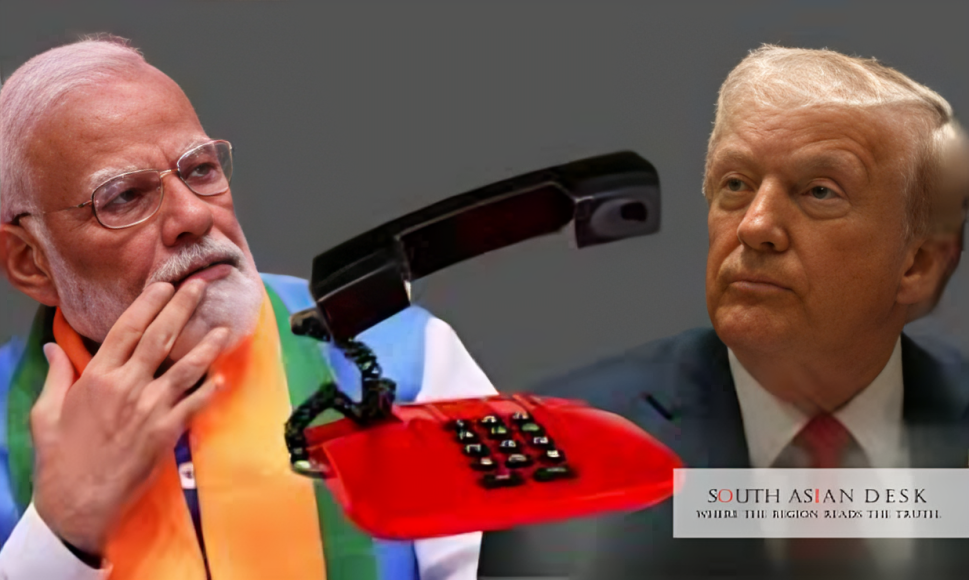
The White House disclosed on Tuesday that US President Donald Trump and Indian Prime Minister Narendra Modi engage in frequent conversations, primarily on trade and security matters, as bilateral talks intensify. This US statement on Trump Modi frequent talks underscores ongoing efforts to deepen ties. The revelation was made during a press briefing in Washington, where officials highlighted the leaders’ direct line amid escalating global economic pressures.
In South Asia, this pattern of Trump and Modi regularly calling on India-US ties carries weight. India, as the region’s economic powerhouse, stands to gain from enhanced US partnerships, potentially offsetting the influence of China and boosting intra-regional trade flows. Stronger Washington-Delhi links could stabilize supply chains for semiconductors, pharmaceuticals, and defense equipment, fostering growth in neighboring economies like Pakistan and Bangladesh through spillover effects. Analysts note that such high-level engagement signals a counterbalance to geopolitical tensions, promoting stability vital for South Asian development.
US Statement on Trump Modi Communication Highlights Regular Engagement
White House Press Secretary Karine Jean-Pierre confirmed the leaders’ routine interactions during a briefing on 4 November 2025. “President Trump and Prime Minister Modi speak frequently,” she stated, adding that these discussions cover trade negotiations, defence cooperation, and climate initiatives. This US-India statement aligns with broader efforts to finalize a mini-trade deal, which has been stalled since early 2024.
The frequency of these exchanges, reportedly bi-weekly, marks a departure from previous administrations’ sporadic contacts. Official logs indicate at least eight verified calls since Trump’s re-election in January 2025, with a focus on tariff reductions and investment inflows. Data from the US Trade Representative shows that bilateral trade volume reached $200 billion in fiscal year 2024-25, up 12% from the prior year, driven by Prime Minister Modi’s “Make in India” initiative.
In a related development, the State Department released figures on November 3, 2025, detailing $15 billion in US commitments to Indian infrastructure projects. These include renewable energy pacts under the Quad framework, involving Japan and Australia. Such Trump-Modi regular calls have accelerated India-US ties, with envoys crediting the leaders’ rapport for swift approvals.
Trump Modi Regular Calls Bolster India US Ties on Trade Front
Trade remains the cornerstone of these dialogues. Negotiators from both sides convened virtually last week, aiming to resolve disputes over digital services taxes and agricultural subsidies. The White House says Trump Modi frequently talk and discuss these fronts, with Trump reportedly pushing for greater market access for American tech firms in India.
A joint fact sheet from the US-India Business Council, dated 2 November 2025, quantifies the stakes: Indian tariffs on US motorcycles and almonds cost exporters $500 million annually. Reciprocal concessions could unlock $10 billion in new trade by 2026, per council estimates. Modi’s administration has signalled flexibility, linking it to US support for India’s WTO positions.
Beyond commerce, security features prominently. The leaders discussed Indo-Pacific strategy in their latest call on 28 October 2025, emphasising joint naval exercises. US Indo-Pacific Command data reveals a 20% rise in collaborative patrols since mid-2025, aimed at countering maritime threats. This aspect of the US statement on Trump’s and Modi’s communication reassures allies amid rising tensions in the South China Sea.
Historical Context of Leader-Level Diplomacy
Bilateral relations have evolved since the 2008 civil nuclear deal; however, the Trump era introduced a more personal touch. During his first term, Trump hosted Modi at “Howdy Modi” in 2019, an event attended by 50,000 Indian Americans. Following the 2024 elections, this momentum revived, with Modi visiting the White House in February 2025.
Archival records from the Indian Ministry of External Affairs show 15 in-person meetings between 2017 and 2021, supplemented by 20 phone calls. The current cadence exceeds that, reflecting post-pandemic priorities. Trump and Modi have regular calls, and India-US ties now integrate economic security, with $2.5 billion allocated for the co-development of drone technology under a 2025 memorandum.
Critics in New Delhi point to uneven progress on H-1B visa reforms, while proponents argue that the volume of engagement yields tangible benefits. For instance, US exports to India increased 8% year-over-year in Q3 2025, according to Commerce Department statistics.
Implications for South Asian Economies
For South Asia, these interactions have a ripple effect. Pakistan, India’s neighbour, closely monitors the dynamic, given the US’s role in mediating regional disputes. Enhanced India-US defence sales, with $3 billion in 2025 alone, could tilt the balance, prompting Islamabad to seek similar offsets from Beijing.
Bangladesh benefits indirectly through diversified textile exports to the US, now facing fewer hurdles via Indian lobbying. Sri Lanka’s debt restructuring talks with the IMF gained US backing in October 2025, linked to the Quad’s humanitarian aid channels. Overall, Trump’s regular calls with Modi foster a networked approach to India-US ties, potentially lifting regional GDP by 1.5% over five years, according to Asian Development Bank projections.
Environmental cooperation adds another layer. The duo’s discussions on clean energy led to a $1 billion US grant for India’s solar grid expansion, announced on November 1, 2025. This enhances South Asian climate resilience through shared technology transfers to the Maldives and Nepal.
Background
The US-India partnership dates back to Cold War alignments but surged under the chemistry of Modi and Trump. Key milestones include the 2016 Logistics Exchange Memorandum and the 2020 Basic Exchange and Cooperation Agreement. Trade imbalances persist, with the US deficit at $30 billion, but frequent dialogues aim to address them.
What’s Next for Trump Modi Frequent Talks
Upcoming summits in 2026 could seal a comprehensive trade pact. Envoys hint at virtual G20 sidelines meetings, where Trump and Modi’s regular calls might evolve into formal accords. Watch for announcements on intellectual property reforms.
The White House says Trump and Modi frequently talk, a testament to enduring India-US ties poised for deeper integration.
Published in SouthAsianDesk, November 4th, 2025
Follow SouthAsianDesk on X, Instagram, and Facebook for insights on business and current affairs from across South Asia.