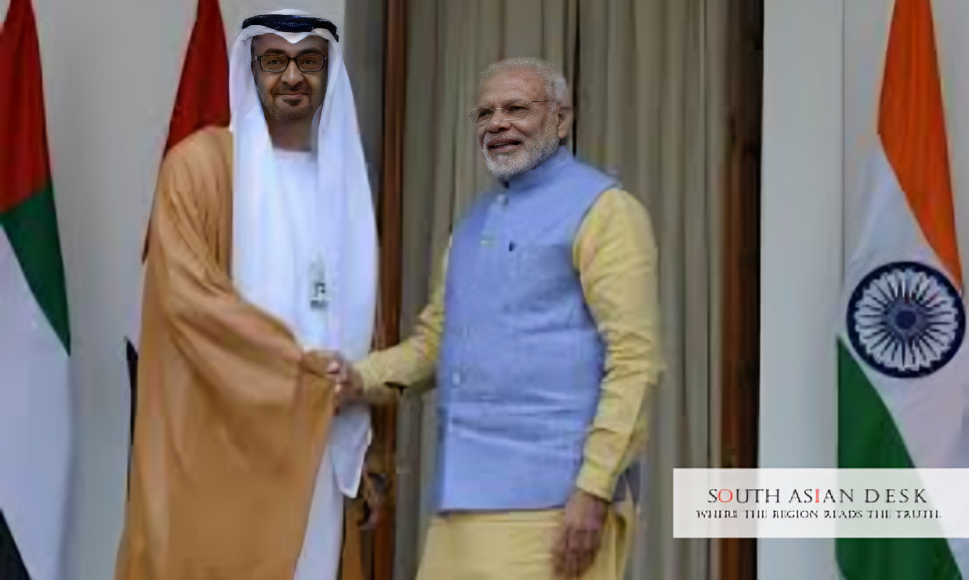
United Arab Emirates President Sheikh Mohamed bin Zayed Al Nahyan arrived in New Delhi on Monday, 19 January 2026, for an official visit at the invitation of Prime Minister Narendra Modi. The UAE President visit to India focuses on bilateral talks to explore new areas in trade, investment, defence and energy. Officials from both sides confirmed the agenda includes regional issues like the Middle East situation.
The discussions hold significance for South Asia as India deepens ties with Gulf nations to enhance economic stability and security cooperation amid global challenges.
Sheikh Mohamed bin Zayed India Visit Details
Sheikh Mohamed bin Zayed India visit marks his third official trip to the country since becoming UAE President in 2022 and his fifth visit over the past decade. The Ministry of External Affairs stated that the visit builds on recent exchanges. These include the September 2024 visit by Sheikh Khaled bin Mohamed bin Zayed Al Nahyan, Crown Prince of Abu Dhabi, and the April 2025 visit by Sheikh Hamdan bin Mohammed bin Rashid Al Maktoum, UAE Deputy Prime Minister and Minister of Defence.
During the one-day visit, President Sheikh Mohamed bin Zayed Al Nahyan and Prime Minister Narendra Modi will hold delegation-level talks. The leaders aim to review progress in bilateral relations and identify opportunities for collaboration. The UAE President visit to India comes at a time when both nations seek to expand their Comprehensive Strategic Partnership established in 2015.
Trade remains a key pillar. Bilateral trade reached US$100.06 billion in fiscal year 2024-25, making UAE India’s third-largest trading partner and second-largest export destination. India exported US$36.63 billion worth of goods to UAE, including gems, jewellery, food items, textiles, chemicals and engineering products. UAE exported US$63.4 billion to India, primarily petroleum products.
The Comprehensive Economic Partnership Agreement signed in 2022 has driven this growth. Non-oil trade hit nearly US$38 billion in the first half of 2025. Both sides target US$100 billion in non-oil trade by 2030. Investments also surged. Cumulative foreign direct investment from UAE to India stood at US$22.84 billion from April 2000 to March 2025, ranking UAE as the seventh-largest investor. Sectors include real estate, infrastructure, energy and financial services. Abu Dhabi Investment Authority opened an office in Gujarat International Finance Tec-City in 2024.
MBZ Modi Meeting Agenda
The MBZ Modi meeting will cover defence cooperation. The 13th India-UAE Joint Defence Cooperation Committee meeting in July 2025 agreed to elevate ties in training, joint exercises and counter-terrorism. Joint military drills like Desert Eagle and Gulf Star-1 have strengthened maritime security. Counter-terrorism efforts intensified since 2014 with intelligence sharing and operations.
Energy security features prominently. UAE supplies long-term liquefied natural gas to India under agreements. Renewable energy projects align with both nations’ sustainability goals. Technology and connectivity are emerging areas. The Local Currency Settlement system facilitates trade in Indian rupees and UAE dirhams, reducing transaction costs.
Regional and global issues will be discussed. India and UAE share views on Middle East stability, including recent developments in Gaza. The UAE President visit to India allows exchange on multilateral forums like the United Nations and BRICS, where UAE joined in 2024.
Cultural ties underpin the relationship. Over 3.5 million Indians live in UAE, contributing to its economy. People-to-people exchanges grew through education, health and tourism initiatives.
Background
India-UAE relations date back centuries through trade routes. Modern ties formalised in 1972 with diplomatic relations. Prime Minister Indira Gandhi visited UAE in 1981. The partnership elevated during Prime Minister Narendra Modi’s 2015 visit, the first by an Indian leader in 34 years.
Sheikh Mohamed bin Zayed’s previous visits as Crown Prince included 2016 as Republic Day chief guest and 2017 for further agreements. As President, he attended the G20 Summit in New Delhi in September 2023 and the Vibrant Gujarat Summit in January 2024. These laid groundwork for current cooperation.
The Bilateral Investment Treaty signed in February 2024 and effective from August protects investments. Defence pacts focus on co-production and technology transfer. In 2025, External Affairs Minister S Jaishankar co-chaired the 16th Joint Commission Meeting in Abu Dhabi, reviewing progress in trade, energy, defence and culture.
Economic data shows resilience. Despite global slowdowns, bilateral trade grew 15 percent annually post-CEPA. UAE investments in Indian startups exceeded US$5 billion by 2025. Joint ventures in renewable energy aim for 50 gigawatts capacity by 2030.
Security collaboration extends to cybersecurity and space. India and UAE signed memorandums for satellite launches and data sharing. Counter-piracy operations in the Arabian Sea protect shipping lanes vital for South Asian trade.
What’s Next
Future plans include expanding fintech ties through unified payment interfaces. Joint research in artificial intelligence and biotechnology is under discussion. Infrastructure projects like the India-Middle East-Europe Economic Corridor, announced at the 2023 G20, involve UAE ports.
Annual high-level dialogues will monitor progress. The next Joint Commission Meeting is slated for 2027. Both nations aim to double investments by 2030.
The UAE President visit to India reinforces commitment to mutual growth. As Sheikh Mohamed bin Zayed Al Nahyan departs, the strengthened India UAE strategic partnership promises enhanced prosperity for South Asia and beyond.
Published in SouthAsianDesk, January 19th, 2026
Follow SouthAsianDesk on X, Instagram and Facebook for insights on business and current affairs from across South Asia.