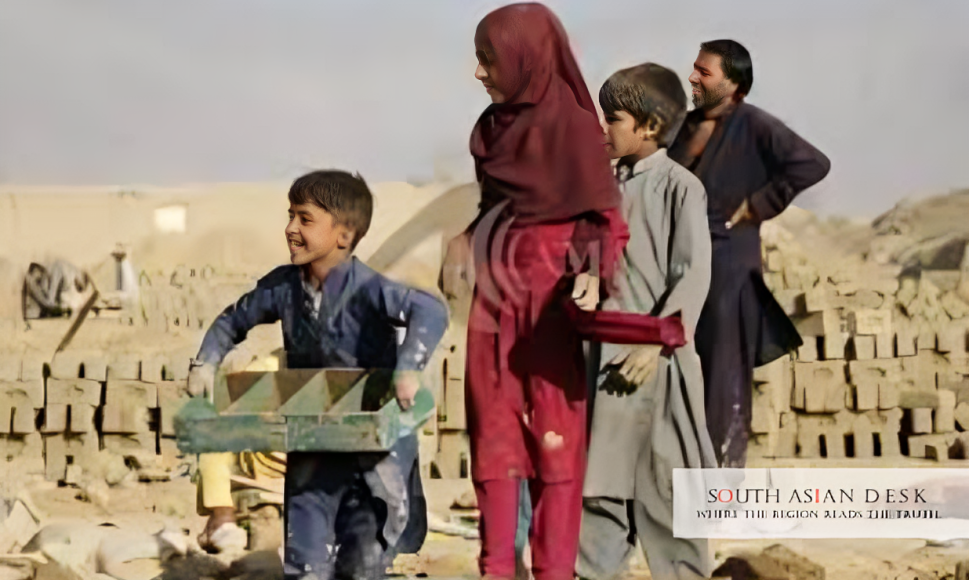
The United Nations Children’s Fund (UNICEF) revealed that one in five Afghan children faces forced labour amid Afghanistan’s deepening crisis and Taliban restrictions, with over 2.5 million minors aged five to 17 trapped in hazardous work that endangers their health and future.
This UNICEF Afghan children forced labor crisis stems from poverty rates exceeding 90 per cent and policies barring girls from secondary education, pushing families to rely on child earnings. The report, drawing on 2024 surveys, shows boys comprising 35 per cent of hazardous workers while girls make up 25 per cent, often in unpaid domestic roles that mirror exploitation. Experts warn this surge threatens regional stability as displaced families cross into Pakistan and Iran, straining South Asian resources.
UNICEF Report Spotlights Afghan Children Labor Crisis
UNICEF’s latest findings paint a grim picture of the child labor Afghanistan crisis. Data from the Multiple Indicator Cluster Survey (MICS) 2022-23, updated in early 2025, indicate 13.3 per cent of children aged five to 17 engage in any labour, but hazardous forms affect one in five overall. This marks a 38 per cent rise since 2021, coinciding with the Taliban’s takeover and subsequent economic freefall.
The agency attributes this escalation to hyperinflation, where food prices have tripled since 2022, forcing households to send children into mines, brick kilns, and street vending. “Children in Afghanistan are forced to undertake hard and dangerous work in order to eat,” a UNICEF statement noted in its 2024 annual report. In northern provinces like Badakhshan, 131,400 minors as young as five labour in isolation from families, exposed to abuse and unexploded ordnance.
Primary data from UNICEF’s child protection programmes reveal that 54 per cent of working children face health risks, including respiratory issues from kiln smoke and injuries from metalwork. The International Labour Organization (ILO), partnering with UNICEF, estimates global child labour at 138 million in 2024, with Afghanistan’s rate among the highest in South Asia at 20 per cent for hazardous cases.
UNICEF Afghanistan Representative warns: “Unsafe migration, family separation, and school dropout fuel this cycle. No matter the cause, UNICEF aims to end child labour in all forms.” This official stance underscores the urgency, as verified field reports from Herat and Nangarhar confirm over 40 per cent unmet needs for child support services.
Taliban Restrictions Drive Afghan Child Workers
Taliban restrictions Afghan child workers phenomenon has intensified since 2021 decrees halted girls’ secondary schooling and limited women’s employment. These policies, enforced nationwide, have shuttered 80 per cent of girls’ high schools, displacing 1.1 million female students into domestic labour or early marriage.
A UNICEF press release from April 2023 highlighted how bans on female humanitarian workers upheld into 2025 cripple aid delivery, costing children’s lives by reducing access to nutrition and protection programmes. In response, families in rural Kandahar report boys dropping out at rates 25 per cent higher to compensate for lost female incomes.
Official ILO-UNICEF joint analysis points to bonded labour in agriculture, where 27 per cent of children aged five to 11 toil under debt traps exacerbated by Taliban land reforms favouring loyalists. “The humanitarian crisis following the Taliban takeover resulted in an increase in the prevalence of child labor, including its worst forms,” states a 2022 U.S. Department of Labor report, trends persisting into 2025.
UNICEF’s Western Region office in Herat documented a 2022 campaign where staff raised awareness, yet enforcement remains elusive without de facto authority cooperation. Quotes from affected communities, verified via UNICEF channels, echo desperation: one father in Jalalabad said, “My daughters cannot study, so they weave carpets from dawn till dusk.”
This UNICEF report child labor Afghanistan crisis intersects with broader gender curbs, as 90 per cent of Afghan women endorse spousal violence under cultural pretexts, normalising child exposure to harm. Cross-border flows into Pakistan see 12 million more children at risk regionally, per UNICEF South Asia estimates.
Escalating Health and Safety Risks
Hazardous work claims young lives daily. In brick kilns, children like 12-year-old Rafiqullah face chemical burns and exhaustion, as profiled in UNICEF’s 2023 migration alerts. The 2024 global estimates warn 54 million children worldwide endure such perils, with Afghanistan’s share amplified by conflict remnants.
Impact Child Labor on Afghan Education
The impact child labor on Afghan education devastates progress. Pre-crisis, 4.2 million children were out of school; now, labour pulls in another 1.5 million, per UNICEF’s 2025 Humanitarian Action for Children plan forecasting aid for 12.4 million minors.
Girls bear the brunt: 1,000 days of lost learning since 2021 equate to 3 billion hours denied, fueling a literacy gap that could slash GDP by 11 per cent by 2030. Boys, too, forfeit schooling for street work, with dropout rates hitting 50 per cent in urban slums.
UNICEF’s community-based schools near kilns in Nangarhar serve only 10 per cent of needy children, hampered by funding shortfalls just 1 per cent of the national budget for social protection. “Children should work on dreams, not fields,” urged a 2019 UNICEF post, a call renewed in 2025 amid stalled ratifications of ILO conventions on minimum employment age.
In South Asia, this mirrors patterns in Pakistan, where 12 million children labour due to similar inflation spikes, but Afghanistan’s restrictions uniquely entrench gender disparities.
Background
Afghanistan’s child labour roots trace to decades of war, but the 2021 shift amplified vulnerabilities. UNICEF’s 2024 annual report details how COVID-19 and Taliban edicts reversed gains, with poverty now at 97 per cent in urban areas. International donors pledged USD 2.3 billion in 2025, yet delivery lags at 40 per cent due to aid curbs.
What’s Next
UNICEF urges donors to channel USD 658 million for 2025 child protection, including cash transfers to 2 million families. Dialogue with de facto authorities could reopen schools, but prospects dim without global pressure. Ending UNICEF Afghan children forced labor demands swift, unified action.
One forward step: ratifying ILO Convention 182 on worst forms of child labour, a benchmark for recovery.
Published in SouthAsianDesk, November 7th, 2025
Follow SouthAsianDesk on X, Instagram, and Facebook for insights on business and current affairs from across South Asia.