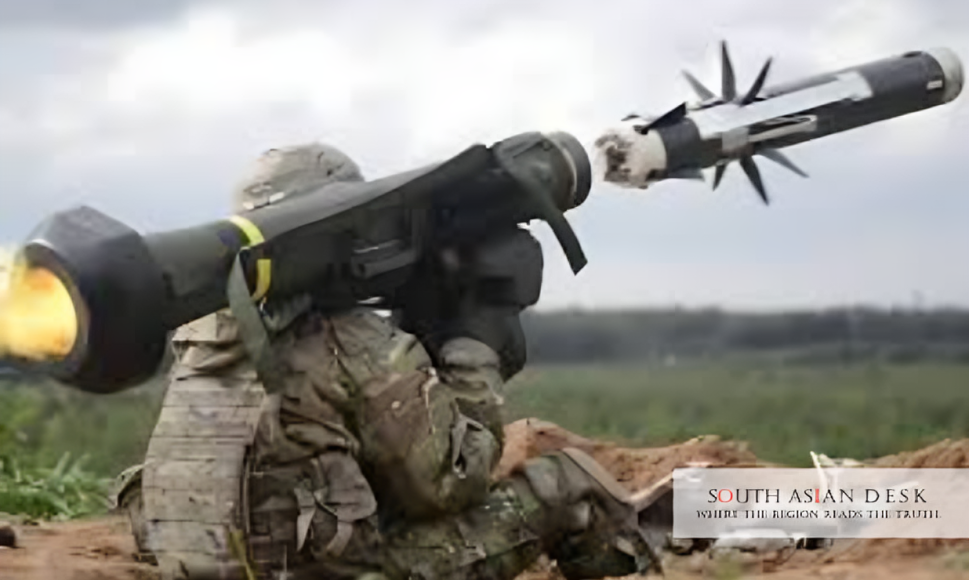
The United States State Department approved on Thursday a $93 million anti-tank missile systems and Excalibur projectiles Javelin sale to India. This move aims to enhance New Delhi’s defence posture. The approval covers advanced weaponry requested by India’s government. It supports broader Indo-US defence cooperation Javelin integration efforts. The deal totals $92.8 million precisely, announced via the Foreign Military Sales programme.
This development holds significance for South Asia. It reinforces India’s capabilities against armoured threats along contested borders. Such enhancements promote regional stability. They counterbalance influences from neighbours like China and Pakistan. The US approves Javelin sale to India at a time when defence ties face tests from trade frictions. Yet it highlights mutual interests in the Indo-Pacific. Stronger India US antitank missile deal outcomes could deter aggression. They foster peace through superior firepower.
India US Antitank Missile Deal Unfolds
The US Defence Security Cooperation Agency (DSCA) notified Congress on 19 November 2025. It certified two linked sales under the Arms Export Control Act. The first targets Javelin systems. The second focuses on Excalibur munitions. Together, they form the India US antitank missile deal backbone.
India’s government requested these items. Officials seek to modernise artillery and anti-armour units. The Javelin portion values at $45.7 million. It includes 100 FGM-148 Javelin rounds. One additional missile serves as a fly-to-buy prototype. Twenty-five Lightweight Command Launch Units (LwCLU) or Block 1 Command Launch Units (CLU) feature in the package.
Support elements accompany the hardware. These cover Javelin LwCLU or CLU Basic Skills Trainers. Missile simulation rounds ensure training efficacy. Battery coolant units, interactive electronic technical manuals, and operator manuals provide operational aids. Lifecycle support, physical security inspections, spare parts, and system integration round out logistics.
Tool kits, training programmes, and Block 1 CLU refurbishment services add value. The Tactical Aviation and Ground Munitions Project Office offers technical assistance. Security Assistance Management Directorate input ensures smooth implementation.
RTX Corporation and Lockheed Martin Javelin Joint Venture in Orlando, Florida, and Tucson, Arizona, serve as principal contractors. The joint venture handles production and delivery.
DSCA states the sale aligns with US goals. “This proposed sale will support the foreign policy and national security objectives of the United States by helping to strengthen the US-Indian strategic relationship,” the agency noted. It improves security for a key partner vital to Indo-Pacific stability.
The package will not alter regional military balance, per DSCA assessment. India gains tools to meet current threats. It bolsters homeland defence and deters adversaries.
Excalibur Projectiles India Purchase Enhances Precision
The Excalibur component values at $47.1 million. India requested up to 216 M982A1 Excalibur tactical projectiles. These guided munitions fit existing M777 Howitzer systems. India already deploys these guns, acquired earlier from the US. Ancillary items include Portable Electronic Fire Control Systems with Improved Platform Integration Kit. Primers, propellant charges, and US government technical assistance follow. Technical data, repair and return services, and logistics support complete the list.
RTX Corporation in Arlington, Virginia, acts as the main contractor. The projectiles offer precision strikes. They increase first-strike accuracy for Indian brigades. This capability addresses future threats effectively. DSCA emphasises strategic fit. The sale aids US foreign policy. It fortifies the US-Indian bond. India emerges as a force for peace in South Asia and the Indo-Pacific. Economic progress ties into this framework.
The Excalibur projectiles India purchase integrates seamlessly. It builds on prior acquisitions. India’s artillery now gains extended range and reduced collateral damage potential.
Indo-US Defence Cooperation Javelin Integration
Indo-US defence cooperation Javelin projects trace roots to broader pacts. The US views India as a counterweight in Asia. Joint exercises and technology transfers underpin ties. This sale follows a General Electric engine reorder for Tejas fighters this month.
Yet challenges persist. Ties strained in August 2025. President Donald Trump imposed 50% tariffs on Indian goods. The penalty stemmed from New Delhi’s Russian oil imports. This marked the first Foreign Military Sales purchase since then.
The US approves Javelin sale to India despite hurdles. It signals pragmatism. Analysts see it as a thaw. Javelin systems pack punch. Each round fires from shoulder-launched units. It homes on tank tops via infrared. Fire-and-forget mode allows infantry mobility. Range exceeds 2.5 kilometres. Excalibur shells reach 40 kilometres. GPS guidance ensures metre-level accuracy.
These tools suit India’s terrain. Himalayan borders demand versatile anti-tank options. Artillery needs precision against fortified positions. Data underscores impact. India’s defence budget hit $81.4 billion in 2025. Imports form 60% of procurement. US supplies now claim 15% share, up from 10% in 2023.
Background: Evolving Bilateral Defence Landscape
US-India defence links deepened post-2008 civil nuclear deal. The Logistics Exchange Memorandum of Agreement in 2016 enabled refuelling. COMCASA in 2018 shared secure communications. Recent years saw $20 billion in US sales. Apache helicopters, P-8I aircraft, and MH-60R Seahawk deals preceded this. The India US antitank missile deal fits this trajectory.
Geopolitics drives urgency. China’s border incursions in Ladakh persist. Pakistan’s armoury raises concerns. Indo-US defence cooperation Javelin additions address gaps. Congress has 30 days to object. Past approvals passed without issue. Delivery timelines span 24-36 months.
What’s Next: Pathways to Deeper Collaboration
Future steps include contract negotiations. India may push local production. Lockheed Martin explored Javelin co-assembly in February 2025. RTX could follow for Excalibur components.
Broader talks loom. The Quad alliance eyes joint drills. Technology transfers under iCET initiative accelerate. This momentum could spawn more pacts. Spy drones, submarines, or AI systems feature on wishlists. The US approves Javelin sale to India sets precedent. It paves way for $10 billion annual trade by 2030.
In conclusion, the US approves Javelin sale to India fortifies alliances. It equips New Delhi for uncertainties. Regional powers take note as South Asia’s security matrix shifts.
Published in SouthAsianDesk, November 20th, 2025
Follow SouthAsianDesk on X, Instagram, and Facebook for insights on business and current affairs from across South Asia.