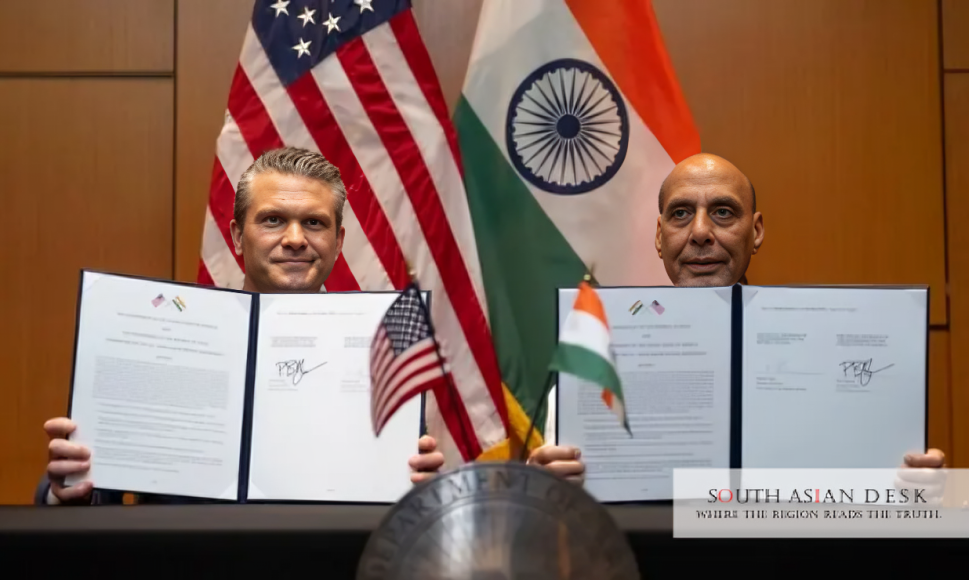
US India 10 year defence pact says Hegseth as the United States and India signed a landmark 10-year defence framework agreement on Friday, October 31, 2025, during bilateral talks here. US Secretary of War Pete Hegseth and Indian Defence Minister Rajnath Singh inked the deal on the sidelines of the 19th ASEAN Defence Ministers’ Meeting (ADMM) and 12th ADMM-Plus. The pact aims to fortify coordination, intelligence sharing and technological collaboration between the two nations.
The agreement, titled the Framework for the US-India Major Defence Partnership, marks a new chapter in bilateral ties. Hegseth announced the signing via a post on X, stating it advances the defence partnership as a cornerstone for regional stability and deterrence. Singh echoed this sentiment, describing the framework as providing policy direction across the India-US defence relationship and heralding a new decade of partnership.
This development occurs against a backdrop of heightened geopolitical tensions in the Indo-Pacific, where both countries share concerns over maritime security and territorial disputes.
Why This Pact Matters for South Asia
The US India 10 year defence pact says Hegseth in a context that directly impacts South Asia’s security architecture. India, as a regional powerhouse, faces persistent border frictions with neighbours and seeks to counterbalance assertive actions in the Indian Ocean. This framework bolsters New Delhi’s capabilities through joint exercises, supply chain resilience and co-development of defence technologies, reducing reliance on single suppliers.
For South Asia, the pact signals a shift towards a multipolar order where India leverages US partnerships without compromising strategic autonomy. It aligns with the Quadrilateral Security Dialogue (Quad), involving the US, India, Japan and Australia, to promote a free and open Indo-Pacific. Analysts note this could deter adventurism along critical sea lanes, vital for 90% of global trade passing through the region. Enhanced US-India ties may also influence Pakistan’s calculus, given Islamabad’s complex relations with Washington, potentially stabilising or complicating subcontinental dynamics.
The agreement arrives amid US tariffs on Indian steel and textiles, valued at USD 1.2 billion annually, yet defence cooperation persists as a buffer. This resilience highlights defence as an insulated pillar of bilateral relations, fostering economic spillovers like joint manufacturing hubs projected to generate 50,000 jobs in India’s defence sector by 2030.
Hegseth, Rajnath Singh Sign Defence Framework in Kuala Lumpur
US Secretary of War Pete Hegseth and Indian Defence Minister Rajnath Singh convened for over an hour in Kuala Lumpur, where they exchanged documents formalising the Hegseth Rajnath Singh sign defence framework. Hegseth, on his first regional tour since assuming office, praised the move as elevating ties to unprecedented levels. “Our defence ties have never been stronger,” he posted on X, accompanied by images of the signing ceremony.
Singh, representing India’s Act East Policy, emphasised the pact’s role in strategic convergence. “This will usher in a new era in our already strong defence partnership,” he stated on X, noting its importance for a rules-based Indo-Pacific. The framework builds on prior pacts, including the 2016 Logistics Exchange Memorandum of Agreement (LEMOA), 2018 Communications Compatibility and Security Agreement (COMCASA) and 2020 Basic Exchange and Cooperation Agreement (BECA), which have enabled real-time geospatial data sharing.
Key provisions include annual policy reviews, expanded officer exchanges and priority access to US military facilities for Indian forces. It also prioritises co-production of unmanned systems and advanced radars, with initial funding allocations of USD 500 million over five years from US defence budgets. These elements address India’s modernisation drive, targeting self-reliance under the Atmanirbhar Bharat initiative.
The signing unfolded amid the ADMM-Plus plenary, attended by 18 nations, where Hegseth and Singh also discussed counter-terrorism and humanitarian assistance. No immediate joint statement followed, but officials confirmed the pact’s non-binding nature allows flexibility in implementation.
India US Defence Agreement Strengthens Indo-Pacific Posture
The India US defence agreement in Kuala Lumpur extends beyond bilateral gains, embedding South Asian security into broader alliances. Joint exercises like Malabar, now in its 29th iteration, will incorporate AI-driven simulations under the new framework, enhancing interoperability for 20,000 personnel annually.
Technological cooperation forms a core pillar. The pact facilitates transfer of dual-use technologies, including quantum encryption for secure communications, vital amid rising cyber threats. India, which imported USD 19.3 billion in arms last year, 15% from the US stands to diversify suppliers, mitigating risks from ongoing Ukraine-related disruptions.
Regional implications ripple through South Asia. Bangladesh and Sri Lanka, key Indian Ocean players, may seek similar frameworks, fostering a networked defence ecosystem. For Maldives, recently pivoting from Chinese influence, US-India alignment offers patrol vessel support, curbing illicit trafficking routes.
Hegseth’s visit also touched on supply chain reforms. The duo reviewed progress on India’s acquisition of six Boeing P-8I maritime patrol aircraft, valued at USD 3 billion, with deliveries slated for 2027. This bolsters surveillance over the Andaman Sea, a chokepoint for 80,000 commercial vessels yearly.
Critics in New Delhi caution against over-dependence, but proponents argue the pact’s 10-year horizon provides predictability. Data from the Stockholm International Peace Research Institute shows US-India defence trade surging 400% since 2014, reaching USD 20 billion by 2025.
Background: Evolution of US-India Defence Ties
US-India defence relations have transformed from Cold War-era suspicions to strategic indispensability. The 2008 civil nuclear deal thawed ice, paving the way for Major Defence Partner status in 2016 the only non-NATO recipient.
Subsequent milestones include the 2020 Quad summit, where leaders committed USD 1 billion to infrastructure resilience. Amid the 2020 Galwan clash with China, US intelligence sharing proved decisive, underscoring real-world value.
The Hegseth Rajnath Singh sign defence framework caps this trajectory, responding to Beijing’s USD 296 billion military spending in 2024 triple India’s USD 81 billion. It aligns with Washington’s Indo-Pacific Strategy, allocating 60% of naval assets to the region.
In South Asia, this pact complements India’s Brahmos missile exports to the Philippines, signalling offensive capabilities. Yet, challenges persist: technology transfer barriers and differing views on Russia arms sales, which supply 45% of India’s inventory.
What’s Next for the US India 10 Year Defence Pact
Implementation begins with a joint working group convening in New Delhi next month, focusing on tech roadmaps. Annual summits will track metrics like exercise frequency, up 25% since 2023.
Future horizons include integrating the pact with AUKUS Pillar II for undersea tech sharing, potentially by 2028. For South Asia, expect trilateral drills with Japan, enhancing disaster response in cyclone-prone bays.
As Hegseth departs Kuala Lumpur, the US India 10 year defence pact says Hegseth remains a beacon of enduring alliance, poised to shape regional equilibria for the next decade.
Published in SouthAsianDesk, October 31st, 2025
Follow SouthAsianDesk on X, Instagram, and Facebook for insights on business and current affairs from across South Asia.