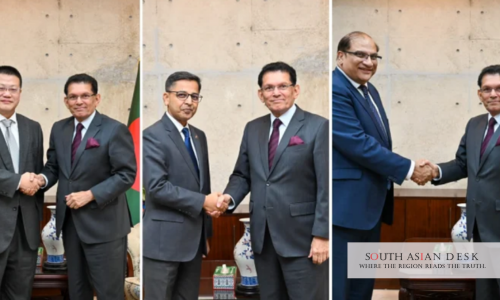
Bangladesh and Pakistan have taken a significant step towards strengthening bilateral ties by approving visa-free travel for holders of diplomatic and official passports. This landmark agreement, finalised on August 21, 2025, during a meeting of Bangladesh’s advisory council chaired by Chief Adviser Professor Muhammad Yunus, marks a new chapter in the evolving relationship between the two South Asian nations. The move is expected to facilitate seamless exchanges between government officials, fostering deeper cooperation in diplomacy, security, and trade.
A New Era for Bangladesh-Pakistan Relations
The decision to allow visa-free entry for diplomatic and official passport holders was formalised following high-level discussions, including a key meeting in Dhaka on July 23, 2025, between Pakistan’s Interior Minister Mohsin Naqvi and Bangladesh’s Home Affairs Adviser, Lieutenant General (retired) Jahangir Alam Chowdhury. According to a press release from Bangladesh’s Cabinet Division, the draft agreement received both policy-level and final approval, underscoring the mutual commitment to enhancing ties. Shafiqul Alam, press secretary to Professor Yunus, noted that this agreement aligns with Bangladesh’s existing visa-exemption pacts with 30 other countries, bringing the total to 31 with Pakistan’s inclusion.
This development comes at a time when relations between Bangladesh and Pakistan have seen a notable thaw, particularly since the establishment of Bangladesh’s interim government under Professor Yunus. The agreement reflects a shared desire to move beyond historical tensions, rooted in the 1971 Bangladesh Liberation War, and to build a collaborative future. For South Asian audiences, this move evokes hope for greater regional connectivity and mutual prosperity, as both nations seek to overcome past challenges.
Boosting Cooperation Beyond Diplomacy
The visa-free arrangement is more than a symbolic gesture; it is part of a broader effort to deepen cooperation across multiple sectors. During the July meeting, officials from both countries discussed enhancing collaboration in internal security, police training, counter-terrorism, and efforts to combat narcotics and human trafficking. Pakistan has extended an offer to train Bangladeshi police officials, a gesture warmly received by Chowdhury, who described the visit as “extremely important” for bilateral ties. A high-level Bangladeshi delegation is set to visit Islamabad soon to explore Pakistan’s Safe City Project and National Police Academy, further cementing this partnership.
The agreement also holds promise for economic and cultural exchanges. Posts on X have highlighted optimism about increased interactions in trade, education, and cultural spheres, with some users noting the potential for resuming direct flights between the two countries, suspended since 2018. Such developments could ease travel for government officials and pave the way for broader people-to-people connections, resonating deeply with South Asians who value regional unity.
Regional Implications and Concerns
While the agreement signals progress, it has raised concerns in neighbouring India, particularly regarding security along its eastern and northeastern borders. Indian media reports suggest that the visa-free regime could facilitate the movement of Pakistan’s Inter-Services Intelligence (ISI) officials, potentially strengthening anti-India elements in the region. New Delhi’s apprehensions stem from the improving ties between Islamabad and Dhaka, especially following the political shift in Bangladesh after the ouster of former Prime Minister Sheikh Hasina. The interim government’s more flexible approach towards Pakistan has contrasted with Hasina’s pro-India stance, prompting India to remain vigilant.
Despite these concerns, the agreement is a routine diplomatic step, as Bangladesh has similar arrangements with several countries. The five-year pact, approved by both nations, underscores a pragmatic approach to fostering trust and cooperation. For South Asia, this move highlights the delicate balance of regional diplomacy, where economic and security interests often intersect.
Looking Ahead: Bangladesh, Pakistan, and Regional Connectivity
The visa-free travel agreement for government officials is a testament to the evolving relationship between Bangladesh and Pakistan. As both nations work to reset ties, the move promises to enhance diplomatic engagement and pave the way for broader collaboration. For South Asia, this development signals a hopeful step towards regional integration, though it also underscores the need for careful navigation of geopolitical sensitivities. With Bangladesh, Pakistan, and visa policies in focus, the region watches closely as this partnership unfolds.
Published in SouthAsianDesk, August 21st, 2025
Follow SouthAsianDesk on X, Instagram, and Facebook for insights on business and current affairs from across South Asia.