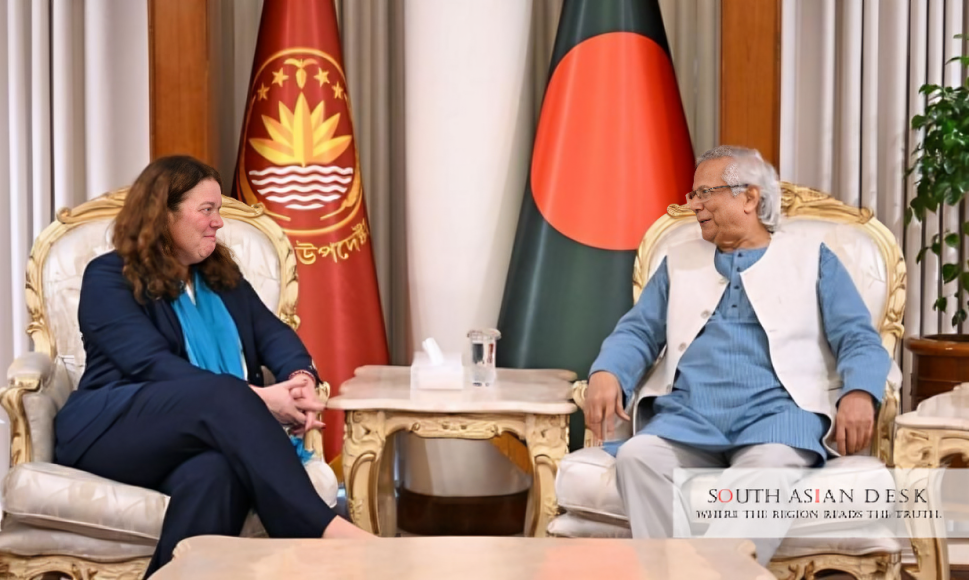
Chief Adviser Professor Muhammad Yunus held talks with Dutch Vice-Minister for International Cooperation Pascalle Grotenhuis at the State Guest House Jamuna in Dhaka on Tuesday, November 18, 2025. The Yunus and Dutch minister meeting focused on Bangladesh Netherlands cooperation Yunus Grotenhuis, with Yunus confirming February elections during the Dutch visit. Discussions covered trade, agriculture, and technology. An upcoming Dutch investment MoU Bangladesh Yunus emerged as a highlight.
This Yunus and Dutch minister meeting carries weight for South Asia. It signals strong European backing for Bangladesh’s post-uprising reforms. As the region grapples with democratic backsliding and economic pressures, such alliances could stabilise supply chains and foster inclusive growth. Enhanced Dutch involvement may inspire similar ties with neighbours like India and Sri Lanka, bolstering collective resilience against climate and migration challenges.
Yunus Confirms February Elections in Dutch Visit
Professor Yunus reaffirmed his government’s pledge for a free, fair, credible, and festive national election in the first half of February 2026. He stressed the historic nature of the polls during the Yunus and Dutch minister meeting. A record number of young voters, denied participation in three prior rigged elections under the ousted regime, will cast ballots for the first time.
“It is a historic moment for all of us,” Yunus stated. “The young people who filled the walls of Dhaka and other cities with graffiti and drawings during the uprising will now come to vote.” This youth surge, with half of Bangladesh’s population under 27, promises high turnout and a vibrant democratic reset.
Grotenhuis praised the interim government’s swift preparations despite limited time. “The government had a few months to get ready for the election,” she noted, highlighting the commitment to inclusivity. The meeting underscored international confidence in Bangladesh’s transition, with observers from the EU and US already mobilised.
Awami League Barred from Upcoming Polls
Yunus clarified that the Awami League cannot contest the February elections. The party’s activities stand banned under anti-terrorism laws. The Election Commission has suspended its registration, removing it from the list of eligible parties.
This decision stems from the league’s role in the prior autocratic era. Yunus linked it to broader reforms ensuring a level playing field. The exclusion aims to prevent repeats of past manipulations, fostering trust among voters and global partners.
Bangladesh Netherlands Cooperation Yunus Grotenhuis Takes Centre Stage
The Yunus and Dutch minister meeting delved into expanding Bangladesh Netherlands cooperation Yunus Grotenhuis across vital sectors. Leaders identified agriculture, trade, investment, technology, and youth development as priority areas. A proposed social business fund targets young and women entrepreneurs, aligning with Yunus’s microfinance legacy.
Grotenhuis outlined the evolution of ties. “For 50 years, Bangladesh and the Netherlands were development partners,” she said. “Now we want to transform this into an equitable partnership in politics, trade, and investment.” Dutch firms plan to shift from mere procurement to active investment roles, creating jobs and technology transfers.
In agriculture, cooperation focuses on flood management and sustainable farming. The Netherlands, a global leader in water technology, will share expertise to combat Bangladesh’s vulnerability to rising seas. Trade talks emphasised diversifying exports beyond ready-made garments, with tech partnerships eyeing digital innovation hubs.
Youth development emerged as a cornerstone. Both sides committed to skills training programmes. These initiatives address unemployment among the under-30 demographic, which constitutes 60% of the workforce. Early data from similar EU-backed projects show a 25% rise in employability for participants.
The dialogue also touched on climate resilience. Bangladesh, hosting 1.1 million Rohingya refugees, seeks Dutch aid for camp infrastructure. Grotenhuis pledged continued humanitarian support, tying it to long-term regional stability in South Asia.
Dutch Investment MoU Bangladesh Yunus on Horizon
A key outcome of the Yunus and Dutch minister meeting involves the Dutch investment MoU Bangladesh Yunus. Grotenhuis announced plans to sign a memorandum on public-private partnerships with Bangladesh’s investment authorities. This pact will streamline Dutch capital inflows, targeting infrastructure and green energy.
New labour laws, approved by the cabinet last week and signed by the president on Monday, November 17, underpin these efforts. The reforms enhance worker rights and dispute resolution, making Bangladesh more attractive to European investors. Grotenhuis commended them as “a step forward in attracting Dutch and European investment.”
Figures indicate potential impact. Dutch direct investment in Bangladesh reached EUR 200 million in 2024, up 15% from the previous year. The MoU could double this within three years, focusing on ports, renewables, and agribusiness. Bangladesh Investment Development Authority data projects 50,000 new jobs from such collaborations.
Yunus highlighted the shift to equitable partnerships. “We move from aid recipients to co-creators,” he remarked, envisioning joint ventures in social enterprises. This aligns with the interim government’s 100-day reform agenda, which has already drawn EUR 500 million in pledges from European donors.
Challenges remain. Bureaucratic hurdles and infrastructure gaps persist. Yet, the Yunus and Dutch minister meeting signals momentum. Officials aim to finalise the MoU by December 2025, ahead of the elections.
Background: 50 Years of Evolving Partnership
Bangladesh and the Netherlands share a half-century bond rooted in development aid post-1971 independence. The Dutch contributed to flood control via the Delta Plan, mirroring their own polder expertise. Over decades, this grew into trade exceeding EUR 2 billion annually, with Bangladesh exporting textiles and the Netherlands supplying machinery.
Post-July 2024 uprising, relations pivoted. The interim government under Yunus prioritised democratic and economic reforms. Prior meetings, including Yunus’s September 2025 UN encounter with Dutch Prime Minister Dick Schoof, laid groundwork for deeper engagement. This Yunus and Dutch minister meeting builds on that, embedding politics into economic dialogue.
What’s Next for Bilateral Momentum
The Dutch investment MoU Bangladesh Yunus signing looms large. It will facilitate joint funding for 10 pilot projects in 2026, per preliminary outlines. Election observers from the Netherlands will join EU teams in January, ensuring transparency.
Broader Bangladesh Netherlands cooperation Yunus Grotenhuis extends to multilateral forums. Both nations plan joint advocacy at COP31 for climate finance. Yunus’s confirmation of February elections during the Dutch visit reassures investors of stability.
The Yunus and Dutch minister meeting concludes on an optimistic note. As Grotenhuis departs Dhaka, pledges for action linger. This dialogue not only fortifies bilateral bonds but also positions Bangladesh as a South Asian beacon for reform-driven growth.
Published in SouthAsianDesk, November 19th, 2025
Follow SouthAsianDesk on X, Instagram, and Facebook for insights on business and current affairs from across South Asia.