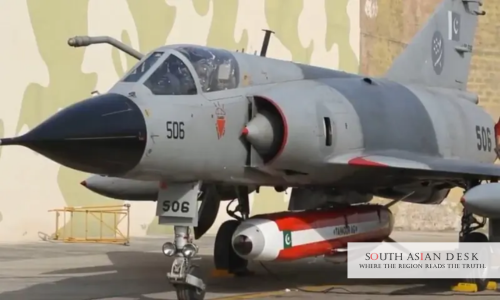
Pakistan’s Air Force showcases advanced precision with indigenously developed Taimoor missile in recent trial.
The Pakistan Air Force successfully tested the Taimoor air-launched cruise missile on January 3, 2026. The indigenously developed weapon hit targets at 600 kilometres with high precision. Senior officers, scientists, and engineers witnessed the event. The test highlights Pakistan’s defence advancements.
This Pakistan cruise missile test strengthens conventional deterrence in South Asia. It addresses regional security challenges and promotes strategic stability.
Details of the PAF Missile Test
The Pakistan Air Force carried out the PAF missile test of the Taimoor system. The Inter-Services Public Relations announced the success. The missile flew at low altitudes to avoid detection.
The ISPR stated: “Taimoor air-launched cruise missile is capable of engaging enemy land and sea targets with high precision at a range of 600 kilometres, carrying a conventional warhead.”
The statement added: “Equipped with state-of-the-art navigation and guidance system, Taimoor is designed to fly at very low altitudes, enabling it to effectively evade hostile air and missile defence systems.”
The ISPR noted: “Its precision-strike capability significantly enhances the conventional deterrence and operational flexibility of PAF, further strengthening the country’s overall defence posture.”
The test occurred amid efforts to boost self-reliance. Air Chief Marshal Zaheer Ahmed Baber Sidhu congratulated the team. He said: “The successful test of the Taimoor weapon system reflects Pakistan Air Force’s continued pursuit of operational readiness, technological superiority and national security objectives.”
Sidhu praised the professionalism and dedication. He reaffirmed commitment to technological self-sufficiency.
President Asif Ali Zardari commended the achievement. He stated: “The preparation of modern weapons at the local level is a clear reflection of national capability, resolve, and institutional expertise.”
Zardari added: “The success of the test has further strengthened national defence and bolstered Pakistan’s responsible defence policy for ensuring stability in the region.”
The President highlighted the milestone in self-reliance. He paid tribute to scientists and engineers.
The PAF missile test involved rigorous preparations. It demonstrated the indigenously developed missile Pakistan’s reliability.
Features of Indigenously Developed Missile Pakistan
The Taimoor represents the indigenously developed missile Pakistan programme’s progress. It features a 600 kilometres range. The missile carries a conventional warhead. Its guidance system ensures accuracy. Low-altitude flight evades radars. It targets land and sea assets.
The ISPR described: “The successful flight test underscores the technical maturity, innovation and self-reliance achieved by Pakistan’s defence industry.” This PAF missile test boosts operational flexibility. It integrates with existing aircraft.
The missile’s design focuses on precision. It enhances strike options in complex scenarios.
Background
Pakistan’s cruise missile development dates back to the early 2000s. The Babur missile, also known as Hatf VII, entered service in 2010. It offers ground-launched capabilities with ranges up to 700 kilometres.
The Ra’ad series, or Hatf VIII, provides air-launched options. First tested in 2007, Ra’ad has a 350 kilometres range. An extended version, Ra’ad II, reaches 600 kilometres.
The Taimoor builds on this foundation. It incorporates advanced stealth features. Wikipedia notes Taimoor as a next-generation stealthy air-launched cruise missile developed by the Air Weapons Complex. Pakistan has conducted multiple tests. In 2012, Babur variants improved accuracy. The 2017 naval version expanded capabilities.
These efforts stem from strategic needs. South Asia’s dynamics drive indigenous production. The indigenously developed missile Pakistan initiative reduces foreign dependence.
In 2025, Pakistan tested Fatah-4, a ground-launched cruise missile with 750 kilometres range. It enhanced conventional strike options. The Pakistan cruise missile test of Taimoor aligns with this trajectory. It reflects ongoing investments in defence technology.
Official data shows steady progress. The Army’s rocket force, established in 2025, consolidates missile assets.
What’s Next
Future integrations may include fleet-wide deployment. Additional tests could refine systems. Pakistan may pursue longer ranges or hypersonic variants. This would address evolving threats.
The indigenously developed missile Pakistan programme likely expands. Collaborations with local industries continue. The Pakistan cruise missile test sets the stage for enhanced readiness. This successful Pakistan cruise missile test advances self-reliance in defence.
Published in SouthAsianDesk, January 3rd, 2026
Follow SouthAsianDesk on X, Instagram and Facebook for insights on business and current affairs from across South Asia.