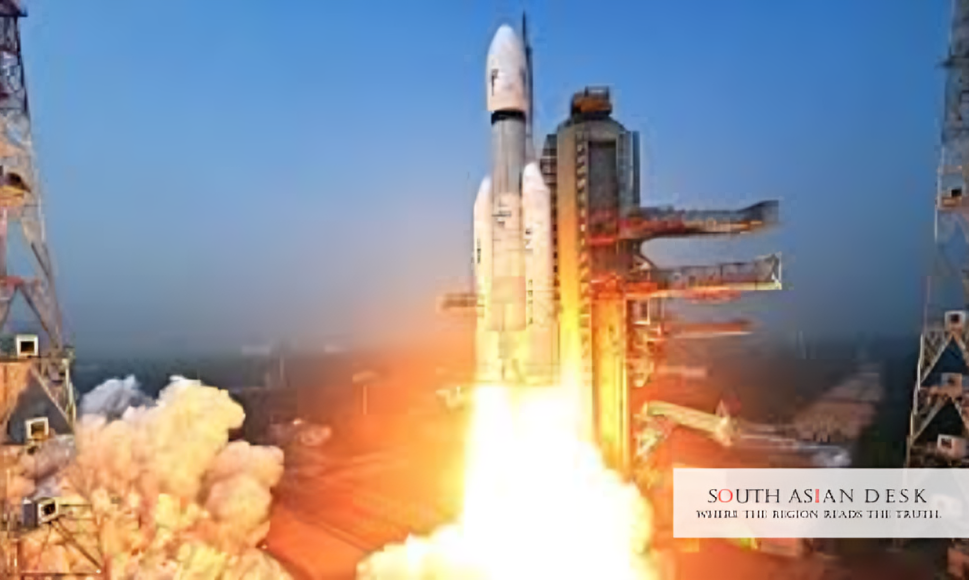
The Indian Space Research Organisation (ISRO) will conduct its first launch of 2026 on Monday, January 12, at 10:17 AM from Sriharikota. The PSLV C62 mission carries the EOS N1 satellite, code-named Anvesha satellite, along with 15 co-passengers. This deployment strengthens surveillance capabilities.
The ISRO first launch 2026 holds significance for South Asia. It bolsters defence and environmental monitoring in a region marked by border tensions and climate vulnerabilities. The Anvesha satellite’s advanced imaging could aid in resource management across shared ecosystems.
PSLV C62 Mission Overview
ISRO’s PSLV C62 lifts off from the First Launch Pad at Satish Dhawan Space Centre in Sriharikota. The vehicle stands 44.4 metres tall with a lift-off mass of 260 tonnes. It features four stages and uses the PSLV-DL variant with two solid strap-on motors.
This marks the 64th flight of the Polar Satellite Launch Vehicle series. PSLV has a proven track record with 63 prior missions. Notable successes include the 2008 Chandrayaan-1 lunar probe, the 2013 Mars Orbiter Mission, the 2023 Aditya-L1 solar observatory, and the 2015 Astrosat space telescope. In 2017, PSLV set a world record by deploying 104 satellites in one go.
The mission integrates the primary EOS N1 satellite and 15 secondary payloads. Pre-launch checks are complete. Live streaming starts at 9:48 AM on January 12 via ISRO’s YouTube channel.
EOS N1 Satellite Details
The EOS N1 satellite serves as the main payload. Built by NewSpace India Limited, it functions as an earth observation platform. The satellite employs hyperspectral imaging technology. This allows detection in hundreds of wavelengths to identify ground materials precisely.
Developed for the Defence Research and Development Organisation (DRDO), the Anvesha satellite targets strategic defence applications. It enhances surveillance for border security. Additional uses include agriculture monitoring, urban mapping, and environmental assessment.
It will enter a polar orbit. This position enables global coverage with a focus on South Asian territories.
Anvesha Satellite’s Role in Defence
The Anvesha satellite, also known as EOS N1 satellite, provides unique capabilities. Hyperspectral sensors detect hidden objects and materials. This aids in spotting concealed military assets or environmental changes.
In South Asia, where territorial disputes persist, such technology supports national security. It can monitor agricultural yields in shared river basins or track deforestation in border areas. The Anvesha satellite represents a collaboration between ISRO and DRDO.
No prior hyperspectral satellites from ISRO match this profile. The mission underscores India’s growing self-reliance in space-based defence tools.
Co-Passenger Satellites
PSLV C62 carries 15 co-passenger satellites from Indian and foreign entities. These include cubesats from startups and universities.
One key secondary payload is the Kestrel Initial Demonstrator from a Spanish startup. This small re-entry vehicle tests atmospheric return technology. It will be the last injected into orbit. The capsule aims for splashdown in the South Pacific Ocean after demonstration.
Other payloads feature Indian innovations. Dhruva Space contributes DA-1 for orbital services. Space Kidz India sends SR-2 for educational outreach. Assam Don Bosco University’s Lachit-1 focuses on regional tech. Akshath Aerospace’s Solaras-S4 tests solar panels. Dayanand Sagar University’s DSAT-1 explores communications. OrbitAID Aerospace’s AayulSAT demonstrates on-orbit refuelling.
CV Raman Global University’s CGUSAT-1 supports student research. Additional satellites from foreign agencies remain unspecified in official releases. These rideshares highlight ISRO’s commercial launch services through NewSpace India Limited.
The total payload count aligns with ISRO’s strategy to maximise mission efficiency. PSLV’s reliability makes it ideal for multiple satellite deployments.
Background
ISRO has evolved since its 1969 founding. It now ranks among global space leaders. The organisation operates from Bengaluru with facilities like Sriharikota for launches.
PSLV debuted in 1993. Early flights faced challenges but achieved consistency. By 2026, it has launched over 300 satellites for 30 countries. The series includes variants like PSLV-XL for heavier loads.
DRDO, established in 1958, focuses on military tech. Its space involvement includes anti-satellite tests in 2019. The Anvesha satellite extends this to persistent surveillance.
South Asia’s space sector grows. Neighbours like Pakistan and Bangladesh pursue satellite programmes. India’s advancements influence regional dynamics through data sharing or competition.
What’s Next in ISRO First Launch 2026
ISRO plans more launches in 2026. These include Gaganyaan crewed mission preparations and commercial ventures. The ISRO first launch 2026 paves the way for enhanced earth observation networks.
Success of PSLV C62 could accelerate DRDO’s satellite constellation. Regional applications may expand to disaster response in flood-prone areas.
The mission’s outcome will inform future hyperspectral projects. ISRO aims to sustain its launch cadence amid global space race pressures.
This ISRO first launch 2026 reinforces India’s orbital prowess.
Published in SouthAsianDesk, January 11th, 2026
Follow SouthAsianDesk on X, Instagram and Facebook for insights on business and current affairs from across South Asia.