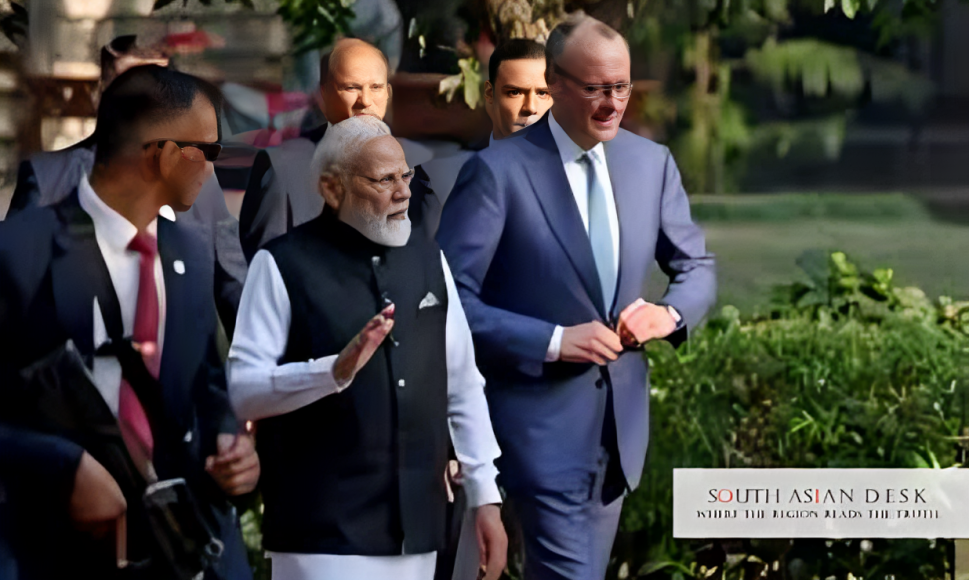
German Chancellor Friedrich Merz’s Bengaluru visit on January 13, 2026, highlighted key collaborations in technology and innovation during his two-day India tour.
German Chancellor Friedrich Merz arrived in Bengaluru on Tuesday, January 13, 2026, visiting the Bosch campus and IISc to underscore Germany India tech ties. The engagements focused on mobility, AI, and sustainable energy, part of his maiden official trip invited by Indian Prime Minister Narendra Modi.
The visit to India’s tech hub comes amid growing Indo-German partnerships, vital for South Asia’s economic landscape. With Germany as a major investor in the region, such interactions foster innovation ecosystems that could benefit cross-border trade and technology sharing, enhancing stability in a competitive global market.
Friedrich Merz Bosch Visit Highlights Innovation
During the Friedrich Merz Bosch visit, the Chancellor toured the Bosch campus at Adugodi. He was introduced to software solutions like AIShield, an AI security system for protecting AI reliability. The delegation also viewed the H2ICE demonstrator truck, featuring a hydrogen internal combustion engine with integrated powertrain and telematics.
Bosch India, alongside its German counterpart, is advancing hydrogen transformation for zero-emission mobility. Guruprasad Mudlapur, President of the Bosch Group in India and Managing Director of Bosch Limited, stated: “We feel honoured to welcome the esteemed Federal Chancellor Friedrich Merz to the Bosch India campus. His presence not only affirms Bosch’s enduring legacy but also reinstates India’s position in the world as a hub of technological innovation and economic growth.” He added: “This is a moment of immense pride for Bosch and a testament to the partnership between our nations.”
The Friedrich Merz Bosch visit emphasised deep economic links. Bosch employs over 40000 in India, contributing to manufacturing and R&D. Merz remarked at the site: “Impressive expertise is concentrated here,” according to reports. This aligns with Germany India tech ties, where German firms like Bosch, Siemens, and SAP maintain strong presences in Bengaluru.
Merz IISc Visit Focuses on Nano Science
Following the Bosch engagement, the Merz IISc visit took place at the Centre for Nano Science and Engineering (CeNSE). The Chancellor explored facilities dedicated to nano science research, highlighting mutual interests in scientific advancement.
IISc, a premier institute, collaborates internationally on engineering and innovation. The Merz IISc visit underscored potential for joint projects in areas like AI and sustainable technologies. No media access was granted, maintaining focus on bilateral discussions.
This segment of the German Chancellor Bengaluru itinerary reinforced academic-industrial synergies. With 250000 Indians learning German, such visits promote skilled workforce exchanges, crucial for Germany India tech ties.
Background on Indo-German Relations
Germany and India share robust diplomatic relations since 1951. Trade volumes reached EUR 30 billion in 2025, with Germany as India’s largest EU trading partner. Over 1800 German companies operate in India, investing USD 15 billion in the past decade.
The German Chancellor Bengaluru stop followed meetings in Ahmedabad on January 12, 2026, where 19 MoUs were signed, covering defence, AI, and green energy. Key announcements included visa-free transit for Indian passport holders in Germany and a work plan for the India-Germany Digital Dialogue (2025-2027).
In defence, discussions advanced an EUR 8 billion submarine deal with Thyssenkrupp. Merz arrived in Bengaluru at 10:20 AM, toured Bosch at 11:20 AM, and IISc at 1:30 PM, departing later that afternoon. Karnataka Minister M B Patil welcomed him at Kempegowda International Airport.
These developments build on the India-EU free trade negotiations, stalled but now progressing. For South Asia, stronger Germany India tech ties could spur regional investments, as seen in German engagements with Pakistan and Bangladesh on energy and textiles.
However, Details on joint research initiatives remain limited in public records.
The visit also addressed sensitive issues like the Baby Ariha custody case, raised by India.
Merz led a delegation of 23 CEOs, bringing EUR 1.2 billion in clean energy commitments. This includes green hydrogen collaborations, vital for India’s net-zero goals by 2070.
Bengaluru, often called India’s Silicon Valley, hosts numerous German entities. The German consulate there facilitates cultural and business ties. Merz’s tour aligns with India’s push for foreign investment, attracting USD 100 billion in FDI in 2025.
Economists note that such high-level visits boost confidence. Indo-German partnerships have created 600000 jobs in India, with potential spillover to South Asian supply chains.
Available data from 2024 indicates around 500000, but updates post-visit may vary.
The German Chancellor Bengaluru engagements reflect a strategic pivot. With US relations complex, Europe seeks independence, as Merz stated in his New Year’s address: “We must defend our interests much more strongly on our own.”
For India, this means enhanced access to advanced tech, aiding Make in India. Hydrogen tech from Bosch could accelerate sustainable mobility, reducing oil imports by 20 percent by 2030.
What’s Next
Future collaborations may include an AI innovation centre and expanded defence ties. The India-AI Impact Summit in February 2026 could see follow-up invitations. Ongoing EU-India trade talks aim for resolution by mid-2026.
The German Chancellor Bengaluru visit sets a precedent for deeper Germany India tech ties, promising sustained growth in innovation and economic cooperation.
Published in SouthAsianDesk, January 15th, 2026
Follow SouthAsianDesk on X, Instagram and Facebook for insights on business and current affairs from across South Asia.