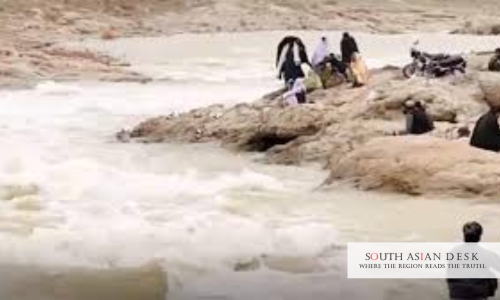
The Federal Flood Commission issued a Kabul River flood warning on 20 January 2026. This alert targets rising water levels in the Kabul River and its tributaries from 22 to 23 January amid a strong westerly wave. Authorities in Khyber Pakhtunkhwa urge precautions to safeguard lives and infrastructure in affected districts.
This Kabul River flood warning underscores vulnerabilities in Pakistan’s northern river systems. Frequent flash floods in the region disrupt communities, agriculture, and transport links across South Asia, where shared waterways like the Kabul River connect Afghanistan and Pakistan, amplifying risks during monsoon-like weather events.
Pakistan Flash Flood Alert Details
The National Disaster Management Authority (NDMA) released an advisory highlighting a strong westerly wave set to impact upper Pakistan from the evening of 21 January to 24 January 2026. This system will trigger moderate to isolated heavy rainfall and snowfall in key areas, leading to potential flash floods.
According to the Pakistan Meteorological Department (PMD), the wave affects tributaries including the Panjkora, Swat, and Kalpani streams. Districts at risk include Dir, Chitral, Swat, and Kohistan in Khyber Pakhtunkhwa (KP). Low to medium flows are expected in the Kabul River at Nowshera and downstream of Tarbela Dam.
The Provincial Disaster Management Authority (PDMA) in KP echoed the Kabul River flood warning, advising district administrations and irrigation departments to monitor river levels closely. Precautionary measures include early evacuations in low-lying areas and securing flood protection structures.
This Pakistan flash flood alert builds on PMD’s forecasts, which predict heavy rainfall in Swat, Upper and Lower Dir, Mohmand, Bajaur, Malakand, Mardan, and Swabi. Such conditions heighten the danger of sudden water surges in nullahs and streams.
KP Rainfall Snowfall Impacts
KP rainfall snowfall is central to the January 2026 weather forecast Pakistan. The upper parts of KP, including Swat, Chitral, Buner, Shangla, Lower and Upper Dir, Malakand, Bajaur, Mardan, Swabi, Abbottabad, Mansehra, Battagram, Torghar, Haripur, Kolai-Palas, and Kohistan, face snowfall in higher elevations and rain below.
These weather patterns could lead to landslides in hilly terrains, complicating rescue efforts during the Kabul River flood warning period. In Kashmir, similar conditions apply, with risks extending to associated drainage channels.
Historical data shows KP rainfall snowfall often exacerbates flash floods. For instance, previous westerly waves have caused significant inundation in riverine areas.
The NDMA’s National Emergencies Operation Center (NEOC) classified this as a medium-level alert, focusing on northern areas. This aligns with the broader January 2026 weather forecast Pakistan, which anticipates colder temperatures influenced by regional climate events.
Residents in vulnerable zones should stock essentials and heed evacuation orders under the Pakistan flash flood alert. Infrastructure like roads and bridges in Chitral and Swat may face closures due to heavy precipitation.
Background
The Kabul River originates in Afghanistan and flows into Pakistan, making cross-border weather coordination vital. Recent advisories from Afghanistan’s Ministry of Energy and Water noted potential floods in upstream basins, including Kabul and Panjshir, from 21 to 23 January 2026. This upstream activity directly feeds into Pakistan’s Kabul River flood warning.
Pakistan has experienced recurrent floods along the Kabul River, with past events in 2022 and 2025 causing widespread damage. The river’s catchment areas are prone to rapid runoff during westerly waves, a common winter phenomenon in South Asia.
Climate change intensifies these risks, with erratic snowfall patterns in the Hindu Kush region affecting water flows. The January 2026 weather forecast Pakistan indicates a polar vortex extension, contributing to extreme cold and precipitation.
Government bodies like the FFC monitor river levels through the Flood Forecasting Division. Current dashboards show all major rivers below low flood levels as of 20 January 2026, but projections warn of spikes.
What’s Next
Authorities plan enhanced monitoring through 24 January 2026. PDMA KP will deploy rapid response teams in high-risk districts. The public should follow updates from PMD and NDMA for the latest January 2026 weather forecast Pakistan.
If conditions worsen, emergency aid distributions may commence, focusing on food and shelter in affected KP areas. Long-term, investments in flood barriers could mitigate future Pakistan flash flood alerts.
This Kabul River flood warning serves as a reminder for preparedness in South Asia’s volatile weather landscape.
Published in SouthAsianDesk, January 21st, 2026
Follow SouthAsianDesk on X, Instagram and Facebook for insights on business and current affairs from across South Asia.