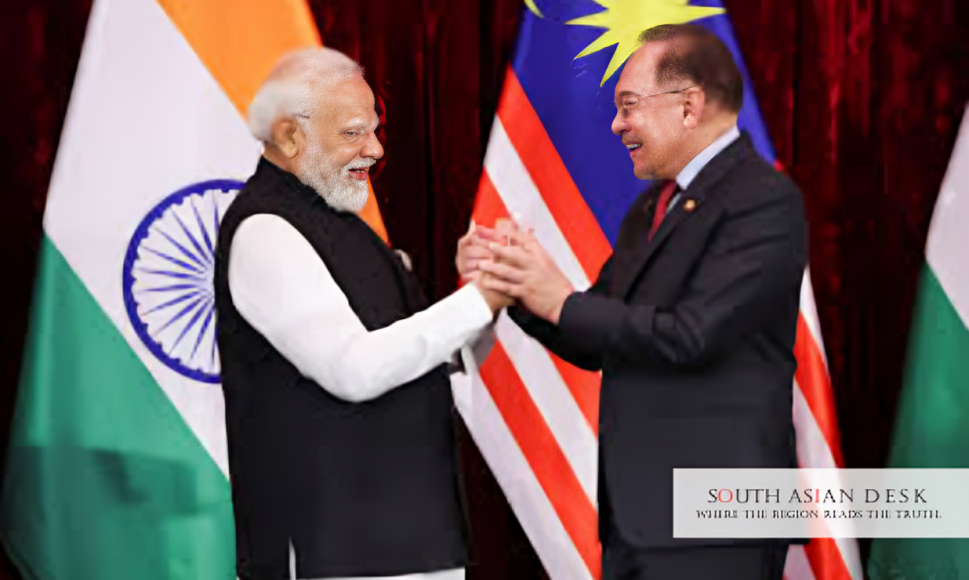
Indian Prime Ministers Narendra Modi and Anwar Ibrahim signed agreements on trade, defence, and technology during two-day talks in Kuala Lumpur, elevating bilateral ties.
Indian Prime Minister Narendra Modi arrived in Kuala Lumpur on 7 February 2026 for a two-day official visit at the invitation of Malaysian Prime Minister Anwar Ibrahim. During Modi Malaysia visit, he met Anwar on 8 February 2026 in Putrajaya to discuss bilateral relations, resulting in 10 agreements on sectors including security, semiconductors, and health. The visit aimed to reinforce the Comprehensive Strategic Partnership established in 2024.
This Modi Malaysia visit holds significance for South Asia by deepening India’s engagement with ASEAN nations. It promotes economic integration, maritime security, and counter-terrorism efforts in the Indo-Pacific region, benefiting stability and trade flows across neighbouring countries like Pakistan, Bangladesh, and Sri Lanka.
Modi Anwar Meeting Outcomes
Prime Minister Modi received a ceremonial welcome at the Perdana Putra complex on 8 February 2026. The leaders held restricted and delegation-level talks at Seri Perdana, Anwar’s official residence. They reviewed progress in the Comprehensive Strategic Partnership, covering trade, investment, defence, security, maritime cooperation, clean energy, infrastructure, start-ups, agriculture, education, health, Ayurveda, tourism, and cultural linkages.
The Modi Anwar meeting focused on emerging areas such as semiconductors and artificial intelligence. They appreciated digital cooperation through the bilateral Digital Council and welcomed an agreement between India’s UPI and Malaysia’s PayNet for fintech collaboration. Modi emphasised youth exchanges via parliamentary and university linkages, noting ongoing ties between Nalanda University and Universiti Malaya, as well as IIT Madras and Malaysia’s Advanced Semiconductor Academy.
Regional issues featured prominently in the Modi Anwar meeting. The leaders discussed Indo-Pacific developments and India’s ASEAN partnership. Modi urged early completion of the ASEAN-India Trade in Goods Agreement review. Anwar congratulated Modi on India’s upcoming BRICS Presidency in 2026, while Modi praised Malaysia’s 2025 ASEAN Chairship. Anwar condemned recent terror incidents in Pahalgam and at the Red Fort, pledging continued counter-terrorism cooperation.
Enhancing India Malaysia Trade Ties
The 10th India-Malaysia CEO Forum convened on 7 February 2026 alongside the Modi Malaysia visit. Leaders received the forum’s outcome document, which outlined strategies to boost bilateral trade. Government data shows India Malaysia trade ties reached USD 18.6 billion in the previous year, with Malaysian exports of palm oil, electrical, and electronic goods, and Indian imports of agricultural, petroleum, and chemical products.
During the Modi Anwar meeting, both sides committed to expanding investment in infrastructure, energy, IT, and biotechnology. The agreements include pacts on digital payments and technical education, expected to facilitate smoother business operations. Modi highlighted Malaysia’s role in India’s Act East Policy, positioning the country as a gateway for South Asian markets.
India Malaysia trade ties stand to gain from these steps, with potential growth in start-ups and clean energy. The CEO Forum identified opportunities in renewable sectors, aligning with both nations’ sustainability goals.
Strengthening India Malaysia Defence Cooperation
Defence emerged as a core focus in the Modi Malaysia visit. The leaders agreed to enhance India Malaysia defence cooperation through security pacts and maritime collaboration. Discussions included potential sales of Dornier aircraft to Malaysia, alongside servicing and upgrades for Scorpene-class submarines and Sukhoi Su-30 fighter jets.
An agreement on UN peacekeeping cooperation was exchanged, underscoring joint commitments to global security. The Modi Anwar meeting also covered disaster management and combating corruption, reinforcing defence ties.
India Malaysia defence cooperation extends to counter-terrorism, with Anwar’s condemnation of recent attacks signalling aligned priorities. These measures aim to secure maritime routes in the Indo-Pacific, vital for South Asian trade.
Semiconductor and Tech Collaboration
A key highlight of the Modi Malaysia visit was the emphasis on semiconductors. The leaders discussed a multi-layered arrangement for cooperation in this sector, building on agreements exchanged during talks. This aligns with India’s push for tech self-reliance and Malaysia’s semiconductor expertise.
Agreements on artificial intelligence and digital technologies were part of the package, promising innovation in bilateral projects. The Modi Anwar meeting noted progress in fintech, with UPI-PayNet linkage set to ease cross-border transactions.
Background
India and Malaysia share historical ties dating back centuries, with formal diplomatic relations established in 1957. The relationship upgraded to an Enhanced Strategic Partnership in 2015 and further to Comprehensive Strategic Partnership in August 2024 during Anwar’s visit to India. This Modi Malaysia visit marks Modi’s third to the country since 2015, following engagements at BRICS and ASEAN forums.
Malaysia hosts a significant Indian diaspora of over 2.9 million, contributing to cultural and economic bonds. Trade has grown steadily, from USD 10 billion in 2015 to USD 18.6 billion recently. Defence ties include joint exercises and equipment maintenance, while recent focus on semiconductors reflects global supply chain shifts.
What’s Next
Implementation of the 10 agreements will be monitored through joint working groups. Anwar accepted Modi’s invitation to visit India, potentially in 2027. The leaders aim to convene the next CEO Forum within a year to track progress on India Malaysia trade ties and India Malaysia defence cooperation.
The Modi Malaysia visit concludes with prospects for deeper integration, including potential consulate openings and expanded university collaborations. Future steps may involve joint ventures in semiconductors, enhancing South Asian tech ecosystems.
Published in SouthAsianDesk, February 8th, 2026
Follow SouthAsianDesk on X, Instagram and Facebook for insights on business and current affairs from across South Asia.