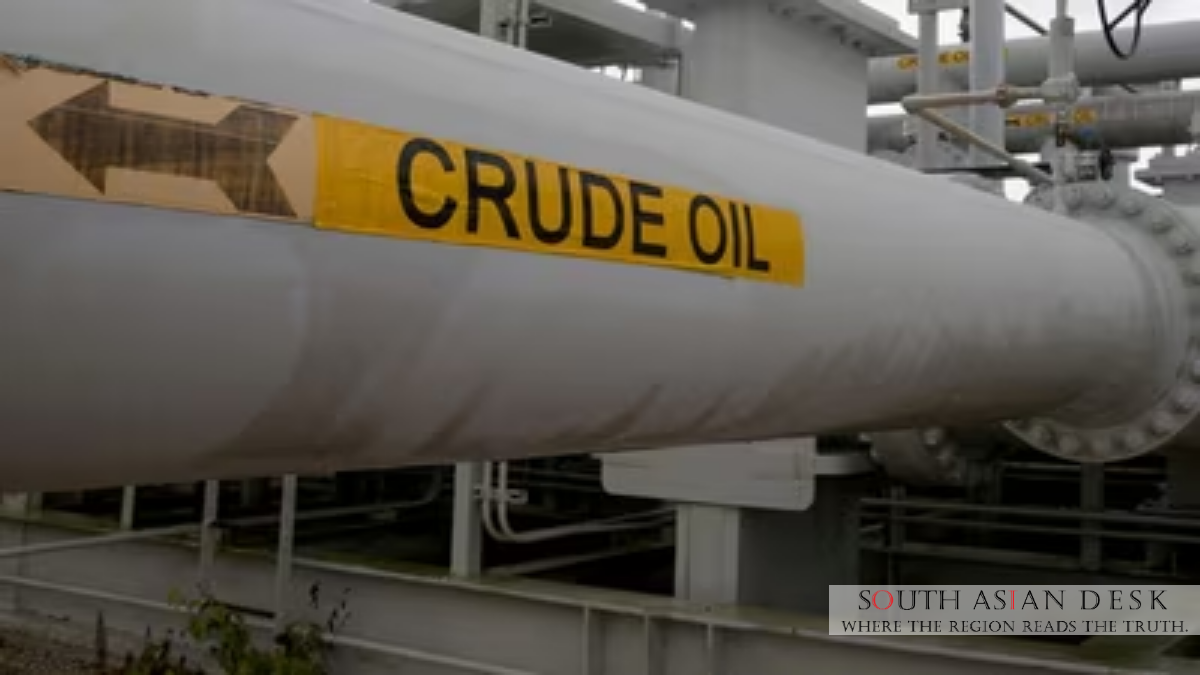
Oil India Ltd has significantly increased its crude production from Rajasthan’s Thar desert, achieving a record output of 1,202 barrels per day from the Jodhpur sandstone formation as of April 2026. This marks a substantial 70% increase from the previous year’s 705 barrels per day, highlighting a major milestone in India’s efforts to boost domestic oil production and enhance energy security.
The crude oil extracted from the Baghewala field in Jaisalmer is transported by tankers to ONGC facilities in Mehsana, Gujarat, before being piped to the Koyali refinery operated by Indian Oil Corporation Ltd. In the financial year 2025-26, the Rajasthan field recorded an annual production of 43,773 metric tonnes of crude oil, compared to 32,787 metric tonnes in the previous year. This growth is driven by technological advancements and efficient operations.
Oil India’s success is largely attributed to the deployment of advanced recovery techniques, including Cyclic Steam Stimulation (CSS), which is a thermal enhanced oil recovery method used for extracting high-viscosity crude. Officials have noted that this achievement underscores the potential of unconventional resources in contributing to India’s energy needs.
The Baghewala oil field, located in the Bikaner-Nagaur sub-basin of the Rajasthan basin, is among the few onshore heavy oil fields in India. The company has completed CSS operations in 19 wells, a 72% increase from last year, and drilled 13 new wells, up from nine previously. Advanced drilling and production technologies, such as fishbone drilling and barefoot completion, are being used for the first time in India’s heavy oil reserves, along with electric downhole heaters and hydraulic sucker rod pumps to enhance production efficiency.
Due to the high viscosity of crude in the region, conventional extraction methods were not viable, prompting the adoption of innovative approaches like diluent injection and artificial lift systems. Since 2017, Oil India has been producing heavy crude from the Baghewala field, which was discovered in 1991 and spans over 200.26 square kilometers with 52 wells, of which 33 are operational. The successful implementation of CSS technology, first piloted in 2018, has been transformative, enabling large-scale extraction and setting new benchmarks in thermal enhanced oil recovery in India.
Officials believe this achievement will play a crucial role in reducing India’s reliance on imported crude and enhancing long-term energy resilience.
Published in SouthAsianDesk, April 6, 2026
Follow SouthAsianDesk on X, Instagram and Facebook for insights on business and current affairs from across South Asia.