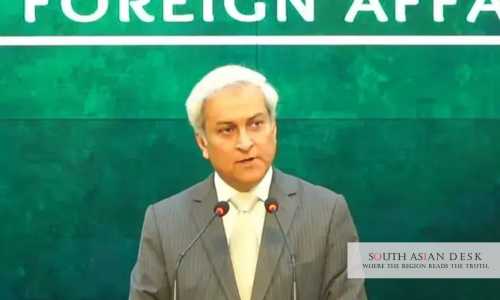
Pakistan FO on Thursday, June 4, 2026, rejected reports that Deputy Prime Minister and Foreign Minister Ishaq Dar shared information on Iran’s nuclear programme during his meeting with US Secretary of State Marco Rubio in Washington, calling the claims incorrect during a weekly media briefing.
Pakistan FO rejects Iran nuclear programme reports
Foreign Office Spokesperson Tahir Andrabi said Pakistan rejected reports that Dar had exchanged any information about Iran’s nuclear programme during his meeting with Rubio.
“No such information was shared,” Andrabi said, according to the reported remarks from the briefing.
The comments came after claims circulated that Dar had allegedly conveyed details or a message linked to Iran’s nuclear position during his talks with Rubio. The Foreign Office response sought to distance Pakistan from those reports and underline that Islamabad had not passed on any such information.
Dar met Rubio in Washington DC on Friday, May 29, 2026, during a visit focused on Pakistan-US relations and regional issues. According to Pakistan’s Ministry of Foreign Affairs, the meeting covered bilateral relations, economic and trade ties, cultural cooperation, counter-terrorism, security cooperation and regional peace efforts.
The Ministry said both sides exchanged views on the evolving regional and global situation. It also said Rubio acknowledged Pakistan’s diplomatic and mediatory efforts and commended continued coordination between Pakistan’s leadership and the US administration.
Dar-Rubio meeting focused on bilateral and regional issues
The official Pakistani readout of the May 29 meeting did not say that Dar shared information about Iran’s nuclear programme. Instead, it said the two sides discussed regional peace, security and economic prosperity, as well as Pakistan’s concerns over the use of Afghan territory by terrorist groups against Pakistan.
The US State Department also confirmed that Rubio met Dar in Washington DC on May 29. The department’s public schedule listed the meeting for 10:00 AM at the State Department, while the department’s readout said Rubio met the Pakistani deputy prime minister and foreign minister in Washington.
The meeting came as Pakistan had been presenting itself as a facilitator in efforts linked to Middle East and Gulf de-escalation. In earlier official briefings, the Foreign Office said Pakistan remained committed to supporting restraint, dialogue and diplomacy as the path to peace in the region.
Pakistan’s Ministry of Foreign Affairs said in a May 29 statement that Dar expressed confidence that Pakistan’s efforts for peace and stability, with support from friendly countries, would yield positive results.
Rubio also denies receiving alleged Iran message
Rubio was separately asked about the reported claim during a US congressional hearing on Wednesday, June 3, 2026.
US Congressman Scott Perry asked whether Dar had delivered a message that Iran was prepared to demonstrate a nuclear weapon if the current escalation continued. Rubio said he had not seen that reporting and was not aware of any such message.
When the issue was raised again, Rubio said no such message had been delivered to him, according to reports of the exchange.
The Foreign Office’s rejection and Rubio’s response both indicate that the alleged communication has not been substantiated by official statements from either Islamabad or Washington.
Background
Pakistan has maintained close ties with Iran while also engaging the United States on regional security matters. Islamabad has repeatedly said that dialogue and diplomacy are necessary to prevent further escalation in the Middle East and the Gulf.
In May 2026, the Foreign Office said Prime Minister Shehbaz Sharif and Dar had held contacts with regional counterparts as part of Pakistan’s peace and de-escalation efforts. The ministry also said Pakistan and China had maintained coordination on the Middle East and Gulf situation.
The Dar-Rubio meeting followed a period of heightened diplomatic activity involving Pakistan, the United States and regional actors. Pakistan’s official position has emphasised restraint, peaceful resolution of disputes and continued diplomatic engagement.
However, the Foreign Office has also avoided publicly discussing the details of mediation efforts. In a May 22 briefing, the spokesperson said Pakistan, as a mediator and facilitator, does not discuss individual positions or the specifics of the process.
What’s next
The Pakistan FO denial is likely to keep attention on Islamabad’s role in regional diplomacy, particularly as Pakistan continues to balance relations with Iran, the United States and other partners involved in Middle East de-escalation efforts.
Published in SouthAsianDesk, June 4, 2026
Follow SouthAsianDesk on X, Instagram and Facebook for insights on business and current affairs from across South Asia.