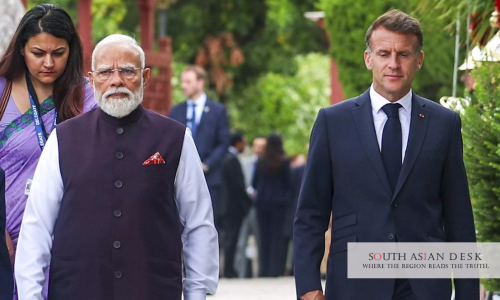
The India France technology partnership was formally reaffirmed on Sunday as Prime Minister Narendra Modi and French President Emmanuel Macron co-inaugurated the Bharat Innovates event in Nice, with Modi using the occasion to argue that India has completed a transition from consumer to contributor of global technological solutions — a claim grounded in demonstrable achievements in digital infrastructure but which analysts note remains aspirational in key advanced technology sectors.
The event, held on the sidelines of Modi’s broader visit to France for the G7 summit at Évian-les-Bains, brought together Indian and European innovation communities and was framed by the Indian government as a showcase for what it describes as India’s human-centric approach to technology development. Macron’s participation, and his public endorsement of India’s Make in India initiative, lent diplomatic weight to the India France technology partnership at a moment when both countries are deepening defence and nuclear cooperation.
India France Technology Partnership: What Modi Said at Bharat Innovates
Modi positioned India’s innovation model as a response to what he called a decade of both disruption and development, defined by escalating global conflicts, climate pressures, and rapid technological change. “India has emerged not as a consumer of solutions but as a contributor to solutions in the world,” he said. He argued that technological advancement and social inclusion are complementary rather than competing goals. “India has demonstrated that innovation and inclusion are not contradictory but complementary. The greatness of any innovation lies not merely in its evaluation, but in its human impact,” he added.
Modi identified artificial intelligence, quantum computing, biotechnology, space technologies, and advanced materials as the defining areas of the next phase of human civilisation, and said India’s reform agenda across all of these sectors would continue. “This momentum of reform will not stop; it will continue. And the number of startups emerging from India will also continue to multiply manifold,” he said.
He closed by framing Bharat Innovates as a standing invitation to international partners. “Bharat Innovates is an invitation to the world to co-create the next chapter of global innovation with India,” he said.
Macron’s Endorsement and the Bilateral Relationship
Macron’s remarks broadly affirmed the Indian government’s framing of the India France technology partnership. He described India as a “country of innovation” and said France has been a participant in the Make in India initiative across diverse sectors. He identified artificial intelligence and climate technology as areas of genuine shared interest, and flagged scope for expanding the India France technology partnership in civil nuclear energy, including through Small Modular Reactor technology.
The civil nuclear dimension of the bilateral relationship has a long and complicated history. France’s EDF has been involved in the proposed Jaitapur nuclear power project in Maharashtra for well over a decade, but the project has faced protracted delays over cost negotiations, land acquisition, and disputes over nuclear liability frameworks. Small Modular Reactors represent a newer and commercially less mature area of potential cooperation, and a formal framework for joint development remains at an early stage in India.
Modi described the broader bilateral relationship as resting on “connection, conviction, innovation, inspiration and a shared vision.” The two countries’ defence relationship, anchored by India’s procurement of Rafale combat aircraft from Dassault Aviation, represents one of the most significant bilateral transactions in either country’s recent history, and the India France technology partnership in defence has been one of its more substantive components.
India’s Technology Claims: What the Record Shows
India’s claim to have shifted from technology consumer to provider has credible foundations in several areas. The Unified Payments Interface, developed by the National Payments Corporation of India, has been adopted or studied by more than a dozen countries and processed over 18 billion transactions in a single month in 2024. The Aadhaar biometric identity system covers over 1.3 billion residents and has been cited by international development institutions as a model for digital public infrastructure. India’s space agency ISRO achieved a cost-efficient soft landing on the Moon’s south pole in 2023 and has developed a commercial satellite launch business serving international clients.
At the same time, India remains a net importer of semiconductors, advanced manufacturing equipment, and critical electronic components. Its domestic semiconductor fabrication capacity is limited, and a government-backed initiative to build domestic chip manufacturing, launched in 2021, has progressed more slowly than initially envisaged. The startup ecosystem, while large in volume, has faced significant contraction in valuations and funding since 2022, with many high-profile Indian unicorns under profitability pressure.
The India France technology partnership, while politically warm and symbolically well-developed, has yet to produce major joint commercial projects in AI or quantum computing of the scale that Modi’s Nice address implies is imminent.
G7 Context and Wider Diplomatic Stakes
The Bharat Innovates event formed part of a wider diplomatic visit timed around the G7 summit at Évian-les-Bains, where Modi is confirmed to hold a bilateral meeting with US President Donald Trump. That meeting is expected to address, among other matters, the ongoing tension between India and the United States over the US naval blockade of the Strait of Hormuz and the killing of three Indian seafarers in American military strikes off the Oman coast last week.
India attends G7 summits as an invited partner rather than a full member, and Modi’s appearance alongside Macron in Nice served the secondary purpose of demonstrating India’s standing in Europe at a moment when New Delhi is managing simultaneous friction with Washington while deepening engagement with Gulf states, France, and other partners.
Whether the India France technology partnership produces concrete collaborative projects in AI, quantum computing, or nuclear energy in the months following the summit will be the clearest test of whether the political enthusiasm on display at Nice translates into deliverables.
Published in SouthAsianDesk, June 15, 2026
Follow SouthAsianDesk on X, Instagram and Facebook for insights on business and current affairs from across South Asia.