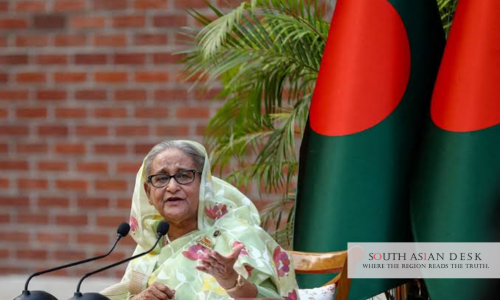
The Sheikh Hasina virtual address delivered from New Delhi has become a fresh flashpoint in India Bangladesh relations, with New Delhi moving quickly to distance itself from the event after Dhaka demanded an explanation.
On Tuesday, India’s Ministry of External Affairs said the government played no part in organizing the appearance by Bangladesh’s ousted former prime minister. Spokesperson Randhir Jaiswal told reporters in New Delhi that the interaction was arranged by a private media entity and that the government had no involvement whatsoever in it, nor did it endorse any views expressed at the forum. The clarification came a day after Bangladesh formally asked India to explain its position on the event, warning that allowing political activity by Hasina and her Awami League party could damage the recent improvement in ties between the two countries.
Why the Sheikh Hasina Virtual Address Drew Attention
The address, hosted by the Foreign Correspondents’ Club of South Asia, marked the second anniversary of the student-led uprising that forced Hasina from power in August 2024. It was also her first public appearance, even by video link, since she fled Dhaka. The 78-year-old spoke alongside her son, Sajeeb Wazed Joy, and other speakers, timing her remarks to a date already heavy with symbolism for both governments.
Sheikh Hasina’s exile in India has remained a sensitive subject since the uprising that ended her fifteen-year rule, a period marked by allegations of rights violations, including crackdowns on opposition figures and dissenters. She was sentenced to death in 2025 for crimes against humanity connected to her handling of the 2024 protests, a verdict she has dismissed as legally void.
Bangladesh’s Objections and the Push for Hasina Extradition From India
Ahead of the address, Bangladesh’s response was sharp. M Humayun Kabir, foreign affairs adviser to Prime Minister Tarique Rahman, met the Indian high commissioner in Dhaka to lodge a protest, and Bangladesh’s foreign ministry said it expected India’s cooperation in preventing individuals from banned organizations, including Hasina, from using Indian territory for political statements or activity aimed at destabilizing Bangladesh.
Dhaka has separately barred domestic media from airing or publicizing Hasina’s remarks. Information Adviser Zahed Ur Rahman cited a December 2024 order from Bangladesh’s International Crimes Tribunal that prohibits outlets and social media platforms from broadcasting her speeches, statements, interviews, or video messages. Aides to Hasina said the event would proceed regardless, and her Awami League party accused the current government of paying public relations firms to spread false claims that the press conference would not happen.
The episode has renewed pressure around the long-running push for Hasina’s extradition from India, a request Bangladesh has raised repeatedly since 2024 without success. Once a close ally of New Delhi, Hasina’s continued presence in India has been a persistent source of friction as relations between the two governments have shifted since her removal from office.
Fallout After the Address
Once the event took place, Bangladesh’s foreign ministry issued a strongly worded statement saying it was surprised and shocked that Hasina had been allowed to speak publicly from Indian soil. The ministry said she used the platform to call for the removal of the interim government and to issue what it described as incitements to supporters to carry out acts of unrest ahead of the country’s upcoming election. Officials in Dhaka warned that the address set a troubling precedent that could further strain India Bangladesh relations at a delicate moment, with the country’s leading parties preparing for a closely watched vote.
For now, India has held to its position that the Sheikh Hasina virtual address was a private engagement outside government control, even as Dhaka continues to press the case that her continued presence and political activity from Indian territory carry direct consequences for bilateral ties.
Published in SouthAsianDesk, August 5th, 2026
Follow SouthAsianDesk on X, Instagram and Facebook for insights on business and current affairs from across South Asia.