US-Iran Peace Deal: Foreign Minister Ishaq Dar held back-to-back telephone conversations with his Turkish, Egyptian, and Saudi counterparts as Pakistan moved to consolidate broad regional backing for the Islamabad Memorandum of Understanding — even as Iran signaled the long-anticipated electronic signing may still be a few days away.
ISLAMABAD — Pakistan’s US-Iran peace deal diplomacy entered an intensive new phase on Saturday, as Deputy Prime Minister and Foreign Minister Ishaq Dar held separate telephone conversations with the foreign ministers of Turkey, Egypt and Saudi Arabia, working to secure regional alignment ahead of the anticipated signing of the Islamabad Memorandum of Understanding (MOU) that would establish a framework for ending months of conflict between Washington and Tehran.
The diplomatic outreach came as Prime Minister Shehbaz Sharif said the two warring sides had agreed on the final text of a peace framework and that Pakistan was preparing for an electronic signing — only for Iran’s Foreign Ministry to signal that the process may require additional days, despite US President Donald Trump announcing the deal would be concluded on Sunday, June 14.
Pakistan US-Iran Peace Deal Outreach Spans Turkey, Egypt and Saudi Arabia
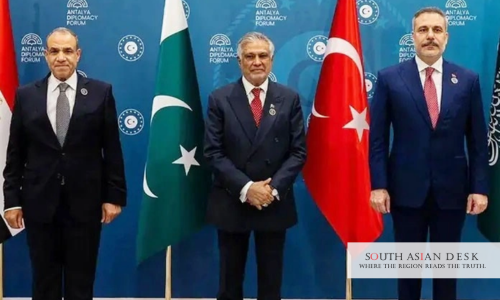
In his call with Turkish Foreign Minister Hakan Fidan, held on Saturday night, Dar and his counterpart exchanged views on the evolving regional situation, according to the Ministry of Foreign Affairs (MoFA). Both sides welcomed what the Foreign Office described as encouraging progress towards an understanding between Washington and Tehran and expressed hope that the positive momentum would advance lasting peace and stability. The two leaders agreed to stay in close contact on further developments, the Foreign Office said in a post on X.
In a separate conversation the same night, Dar spoke with Egyptian Foreign Minister Dr Badr Abdelatty. The two sides reviewed the latest regional developments, including progress towards a US-Iran understanding, and expressed shared hope that ongoing efforts would contribute to lasting peace, security and stability across the region. Both leaders agreed to maintain close coordination and consultation in the days ahead, according to a Foreign Office readout.
Earlier on Saturday, Dar had also spoken with Saudi Foreign Minister Prince Faisal bin Farhan. Both sides welcomed the negotiations entering what the Foreign Office described as their final stage, with the electronic signing ceremony expected to follow. According to the Foreign Office, the Saudi foreign minister acknowledged Pakistan’s “consistent and sustained efforts in support of mediation and dialogue throughout the process.”
Shehbaz Says Signing Imminent; Iran and the United States Send Mixed Signals
On Saturday, Prime Minister Shehbaz Sharif declared on X that Pakistan was preparing for the electronic signing of the peace deal within the next 24 hours, to be followed by technical-level talks the following week. “We are closer to a peace deal than ever before,” the Prime Minister wrote. Trump reposted the statement on Truth Social. On Saturday, Trump separately posted on Truth Social that a deal with Iran would be signed on Sunday, June 14 — his 80th birthday — and that the Strait of Hormuz would automatically reopen upon signing.
The announcement followed the Prime Minister’s statement on Friday, June 12, that both sides had agreed on a “final, agreed-upon” text, with Islamabad working to finalise remaining procedural arrangements. Iran’s Foreign Minister Abbas Araqchi had similarly said on Friday that the Islamabad Memorandum of Understanding had “never been closer,” urging media to avoid speculation about its content ahead of finalisation.
Hours after the Pakistani and American announcements, Iran’s Foreign Ministry Spokesperson Esmaeil Baghaei tempered expectations in remarks to state media, saying a signing of the memorandum would not take place on Sunday. Baghaei said the possibility of the signing occurring in the coming days could not be ruled out, but cited what he described as “the hesitation of the other side” as a basis for caution over any specific timeline. A senior United States official had said a day earlier that the deal was “not quite at the finish line yet, but we are very close.”
Qatar Commends Pakistan’s Mediation; Field Marshal Munir’s Role Highlighted
Prime Minister Shehbaz also received a telephone call on Saturday from Qatar’s Prime Minister and Foreign Minister Sheikh Mohammed bin Abdulrahman bin Jassim Al Thani, who paid tribute to both the Prime Minister and Chief of Army Staff Field Marshal Asim Munir for their instrumental role in advancing diplomatic efforts throughout the Gulf crisis, according to a statement from the Prime Minister’s Office.
Sharif expressed deep appreciation for Qatar’s steadfast support for Pakistan’s peace efforts and confirmed that a peace deal was ready for signing by the relevant parties shortly. According to the PMO statement, Sheikh Mohammed assured PM Shehbaz that Qatar was proud to support Pakistan’s peace initiative and expressed hope that the agreement would contribute to lasting regional peace.
Qatar and Pakistan have worked closely throughout the crisis as co-mediating parties, maintaining parallel diplomatic channels between Tehran and Washington.
Key Elements of the Draft Islamabad Memorandum
A senior Iranian official outlined to Reuters what the draft memorandum reportedly covers across several key areas.
On the Strait of Hormuz, Iran would reopen the waterway to all commercial vessels, while the United States would lift its naval blockade on Iranian ports. Iran’s Foreign Minister Araqchi separately indicated the Strait would operate under a system of “service fees,” a formulation the United States and international shipping groups have disputed. Trump said the Strait would “automatically” reopen after signing.
On financial matters, the United States would refrain from imposing new sanctions on Iran until a final comprehensive agreement is concluded. Washington would grant waivers on Iranian oil export sanctions for a specified period, enabling Tehran to export oil and access related revenues. The United States has also agreed to release USD 25 billion in frozen Iranian assets through a combination of direct cash transfers, regional financial cooperation and credit facilities.
On nuclear matters, Tehran has agreed not to produce or acquire nuclear weapons and to maintain the existing nuclear status quo during a 60-day follow-on negotiation period, including refraining from further uranium enrichment or expansion of its nuclear facilities. The United States has agreed that Iran would dilute its stockpile of highly enriched uranium within the country, with the specific mechanism to be established during subsequent 60-day talks.
Separately, Israeli Prime Minister Benjamin Netanyahu said Israel was not a party to the negotiated framework, but stated that he and Trump were in “full agreement” that Iran must not obtain nuclear weapons.
Background
Pakistan has served as the principal mediator in the US-Iran peace process following the conflict between the United States and Israel against Iran, which began in early 2026. Prime Minister Shehbaz Sharif and Field Marshal Asim Munir led Islamabad’s diplomatic effort, hosting the first round of high-level US-Iran talks since 1979 at the Islamabad Serena Hotel on Saturday, April 11, and Sunday, April 12, 2026 — a set of negotiations that ended without a formal agreement, particularly over the status of the Strait of Hormuz and Iran’s nuclear programme. Field Marshal Munir is reported to have played a pivotal role in brokering the initial ceasefire on April 5, conducting a flurry of calls with US leadership against a deadline set by President Trump.
Pakistan subsequently maintained intensive shuttle diplomacy between Tehran and Washington, working in tandem with Qatar as co-mediating parties. The framework now under discussion is informally referred to as the Islamabad Declaration, named in recognition of Pakistan’s mediation role. The Council on Foreign Relations has described Pakistan as having emerged as an “unlikely but indispensable mediator” in the negotiations. Chatham House has noted that Pakistan’s emergence as a peacemaker represents a significant reinvention of the country’s international standing, given its relationship with the Trump administration in prior years.
What’s Next
The electronic signing of the Islamabad Memorandum of Understanding remains pending as of Sunday, June 14, 2026. Iran’s Foreign Ministry has ruled out a Sunday signing while leaving the door open for the coming days. If and when the MOU is signed, it would launch a 60-day technical negotiation period intended to resolve remaining questions on Iran’s nuclear programme, the precise terms governing the Strait of Hormuz, and the sequencing of sanctions relief. Islamabad has indicated it is prepared to host technical-level talks in the following week. Pakistan’s US-Iran peace deal mediation has drawn recognition from all key parties — Washington, Tehran, Riyadh, Doha, Ankara and Cairo — and Islamabad’s position as the central facilitator of what would be a landmark strategic realignment will depend on whether the signing can be brought to conclusion in the days ahead.
Published in SouthAsianDesk, June 15, 2026
Follow SouthAsianDesk on X, Instagram and Facebook for insights on business and current affairs from across South Asia.