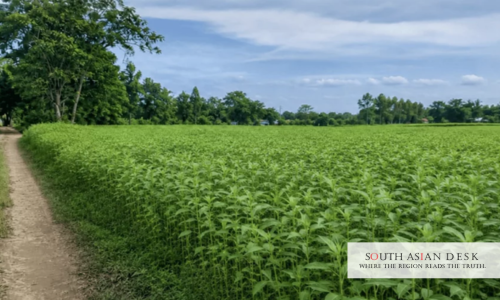
jute cultivation in Rajshahi: Production in the district has risen by nearly 23,000 metric tons over 10 years as sustained good prices, government-backed agricultural support and a nationwide polythene ban combine to revive interest in Bangladesh’s historically prized golden fibre.
RAJSHAHI — Jute cultivation in Rajshahi has expanded significantly this season, with farmers bringing approximately 7,000 additional bighas under cultivation beyond the official target, as prices that have nearly tripled over the past decade continue to attract growers back to the crop long regarded as Bangladesh’s golden fibre.
According to data from the Department of Agricultural Extension (DAE), Rajshahi, jute has now been cultivated on 18,305 hectares across the district in the current season — roughly 7,000 bighas above the set target. Agricultural officials say favourable weather conditions have kept the standing crop in good shape so far, raising expectations of a strong yield.
Jute Cultivation in Rajshahi Doubled Over a Decade, Data Show
The growth in this season’s acreage reflects a broader and sustained expansion in jute farming in the district. DAE data covering the decade from 2016 to 2026 show that jute production in Rajshahi has increased by 22,946 metric tons over the period, supported by both rising prices and improved agricultural guidance to farmers.
In 2016, jute was cultivated on 11,260 hectares of land in the district, yielding 22,836 metric tons. By 2025, cultivation had expanded to 17,305 hectares, producing 45,782 metric tons — a near-doubling of both area and output over the same period.
Department officials attributed the expansion to a combination of sustained price signals over the last four years, consistent technical advisory support to growers and the introduction of higher-yielding varieties. Mohammad Nasir Uddin, Deputy Director of DAE Rajshahi, said seeds, fertilisers and pesticides are being distributed among farmers alongside regular technical advice to sustain their interest in the crop. He said the government’s nationwide ban on polythene bags had increased demand for jute bags and sacks, which is directly benefiting cultivators.
Rising Prices Drive Farmer Profitability in Paba and Beyond
Farmers in the district say sustained good prices over the past four years have meaningfully improved the economics of jute cultivation. According to the DAE Rajshahi, jute prices in the district have nearly tripled over the past 10 years as demand from both domestic jute mills and export markets has grown.
A farmer from the Duary area of Paba Upazila said that, including land lease, seeds, fertiliser, labour, irrigation and other associated costs, total expenditure amounts to approximately BDT 20,000 per bigha. With a typical yield of nine to 10 maunds of raw jute per bigha, the farmer reported earning a profit of BDT 16,000 to 18,000 per bigha last year after deducting all costs — a return that has prompted many cultivators in the area to bring additional land under jute this season.
The improved profitability stands in contrast to previous cycles when low and volatile prices discouraged farmers from expanding cultivation. Both farmers and traders in the district say that if current price levels are sustained, acreage is likely to expand further in coming seasons.
Seven Jute Mills Create Local Value Chain, Purchase Directly from Farmers
Rajshahi district hosts seven jute mills that purchase raw jute directly from farmers at competitive rates, providing an important alternative to open-market traders and reducing farmers’ exposure to middlemen.
The largest of these is Rahman Jute Spinners, located in Puthia Upazila, with a production capacity of 100 metric tons. Other operating mills in the district include Rahman Jute Mill (20 metric tons capacity), Hasan Jute Mill (18 metric tons) and both Nowhata Jute Mill and Aman Jute Fibers, each with a capacity of 15 metric tons. Rajshahi Jute Mills is also among the seven facilities operating in the district.
The presence of multiple local processing facilities means that a portion of Rajshahi’s raw jute output enters value-added manufacturing within the district, with direct price discovery advantages for growers.
Polythene Ban and Packaging Law Boost Domestic Jute Demand
Government policy has emerged as an important secondary driver of the jute sector’s recovery. The Department of Agricultural Marketing said it is monitoring markets regularly to ensure farmers receive fair prices, with market committees instructed to protect growers’ earnings and curb the influence of middlemen in the supply chain.
Officials emphasised the need to strengthen the market system for what they described as Bangladesh’s traditional export crop. They noted that the government is working to enforce the Mandatory Jute Packaging Act 2010, under which jute-based packaging is compulsory for a range of commodities, as a means of deepening domestic demand for jute products.
The government’s ban on polythene bags — introduced in a phased manner from late 2024 — has further expanded market opportunities for jute bags and sacking, both at the wholesale and retail level. Agricultural officials in Rajshahi said the polythene ban’s effect on demand has been one of the primary motivations cited by farmers who expanded their jute acreage this season.
A raw jute export policy has also supported price stability at the farm level, with officials noting that the export framework helps farmers secure fair prices in the domestic market rather than see supply diverted primarily to international buyers at the expense of local mills.
Background
Jute occupies a foundational place in Bangladesh’s agricultural and economic history. During the mid-twentieth century, Bangladesh — as part of undivided Bengal — was the world’s dominant producer and exporter of raw jute, a position that gave rise to its enduring designation as the golden fibre. Export revenues from jute and jute goods once constituted the largest share of the country’s foreign exchange earnings.
The sector’s fortunes declined sharply from the 1980s onwards as synthetic packaging materials displaced natural fibre in global markets and domestic policy support weakened. By the early 2000s, many state-owned jute mills had shut or were operating at reduced capacity, and cultivation area contracted significantly.
The partial recovery now underway reflects a global shift in sentiment toward natural, biodegradable materials as an alternative to single-use plastics, combined with tightening environmental regulations in Bangladesh’s major export markets. According to Bangladesh Economic Review data, jute and jute goods account for around three per cent of the country’s total export earnings, though this share has declined from historical peaks. Jute exports, which had reached USD 1.16 billion in the 2020-21 fiscal year, fell to USD 820 million by the 2024-25 fiscal year amid falling global demand for jute goods and pressures from middlemen and Indian anti-dumping duties on jute products. Against this backdrop, the expansion of domestic demand — driven by the polythene ban and enforcement of packaging laws — has become increasingly important for sustaining the cultivator base.
Rajshahi is historically a significant jute-producing district in the northern belt of Bangladesh. The district’s performance broadly mirrors national trends, with the DAE’s decade-long data serving as one of the more comprehensive district-level records available on cultivation expansion.
What’s Next
Agricultural officials in Rajshahi say they expect the current season’s crop — which is described as being in good condition at the time of reporting — to yield a strong output if weather conditions remain favourable through the remainder of the growing and retting period. Both farmers and traders say that sustained price stability will be essential to locking in the cultivation gains of recent seasons and encouraging further expansion in subsequent years. The Department of Agricultural Marketing has committed to continued market monitoring to prevent price depression from middlemen, while the government’s enforcement of the Mandatory Jute Packaging Act 2010 remains a key policy lever for maintaining domestic demand. For jute cultivation in Rajshahi to continue its decade-long upward trajectory, stakeholders say that consistent price support, access to inputs and reliable local processing capacity will need to remain in place through the harvest and marketing season ahead.
Published in SouthAsianDesk, June 15, 2026
Follow SouthAsianDesk on X, Instagram and Facebook for insights on business and current affairs from across South Asia.