

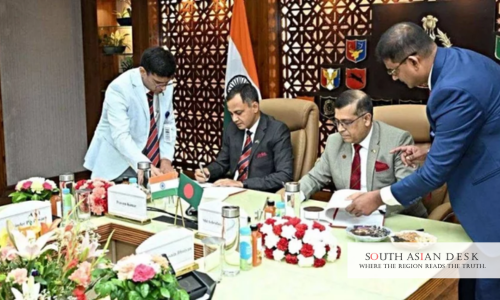
India Bangladesh push-in border dispute: The 57th BGB-BSF Director General-level Border Coordination Conference concluded in New Delhi after four days without resolving the increasingly contentious issue of alleged forced movements of people from India into Bangladesh, exposing fundamental disagreements over immigration enforcement, nationality verification and the terms of existing bilateral procedures.
DHAKA/NEW DELHI — The India Bangladesh push-in border dispute remained unresolved after four days of Director General-level talks between the Border Guard Bangladesh (BGB) and India’s Border Security Force (BSF) in New Delhi, with both sides maintaining irreconcilable positions on a practice that has become one of the sharpest friction points in the bilateral relationship since the BJP’s victory in the West Bengal assembly elections in May 2026.
The 57th Director General-level Border Coordination Conference was held at BSF Headquarters in New Delhi from Monday, June 8, to Thursday, June 11, 2026. Bangladesh’s delegation of 15 members was led by BGB Director General Major General Mohammad Ashrafuzzaman Siddiqui, while India’s delegation was led by BSF Director General Praveen Kumar. A Joint Record of Discussions was signed on June 11, and the next conference has been proposed for Dhaka in November 2026.
Yet the conference’s publicly diplomatic tone was undercut by two highly visible signals of unresolved tension: the two sides did not hold the customary joint press briefing at the end of the meeting, a departure from longstanding practice, and when the joint press release was eventually issued the following morning on Friday, June 12, it contained no reference to the push-in controversy — the very issue that had dominated the talks.
India Bangladesh Push-In Border Dispute Deadlocks the DG-Level Conference
Officials familiar with the discussions said the talks reached an impasse over fundamentally opposing positions on what should happen when individuals identified as undocumented migrants are detected in India.
Bangladesh’s position, presented through a written statement by BGB Director General Siddiqui, was that a mutually agreed Standard Operating Procedure (SOP) already exists for the repatriation of persons claiming Bangladeshi citizenship, and that any attempt to force individuals across the border without prior verification is a violation of bilateral understandings and international norms. The BGB insisted that individuals must undergo nationality verification through diplomatic and border channels and then be formally handed over at designated crossing points, not pushed across unfenced or informal border stretches.
Bangladeshi officials also cited cases in which the BGB said it had foiled attempted push-ins involving people it could not identify as Bangladeshi nationals, including at least one instance that raised concerns about Indian nationals being sent across the border. Bangladesh’s Foreign Affairs Adviser Shama Obaid separately stated that Bangladesh had dispatched between 12 and 13 formal letters to New Delhi over the push-in issue before the conference began.
India presented a contrasting account. The BSF delegation asserted that many of the individuals being moved toward the border had identified themselves as Bangladeshi nationals residing in India without documentation, and that enforcement actions — particularly in West Bengal — were being carried out in accordance with domestic laws and established bilateral procedures. Indian officials also raised the question of Bangladesh’s pace of nationality verification, arguing that delays in processing requests had created a practical backlog and forced authorities to resort to alternative methods in some cases. India had formally communicated a list of 2,369 undocumented individuals pending nationality verification and urged Dhaka to expedite the process.
Opposing Positions on Verification and the Existing SOP
At the heart of the dispute is a procedural disagreement about what constitutes a valid repatriation and who bears responsibility for the delays.
Bangladesh maintains that documentary proof, biometric data and citizenship verification must be provided by India before any person is accepted across the border. Without such confirmation, Dhaka argues it cannot determine whether those individuals are in fact Bangladeshi nationals, or whether they are Indian citizens, third-country nationals or stateless persons who happen to have been detained in India. The BGB’s position throughout the conference was that the agreed SOP is not discretionary — it is the binding framework, and deviations from it are legally and diplomatically impermissible.
India’s position, which mirrors the Ministry of External Affairs’ official line, is that individuals staying illegally in the country — regardless of nationality — are subject to deportation under domestic law, and that the process of repatriation is being conducted through existing bilateral mechanisms. Indian officials argued that Bangladesh’s slow responses to verification requests are the proximate cause of the difficulties.
During the talks, BGB Deputy Director General Colonel Abul Hasnat Mohammad Mahmud Azam stated publicly that the BGB had recorded no verified instances of push-ins in the preceding month. West Bengal Chief Minister Suvendu Adhikari had publicly claimed a figure of 4,800 deportations and 836 individuals in custody ahead of the conference. The two sides were unable to reconcile even on the basic factual record of what had occurred.
The West Bengal Context: BJP’s ‘Detect, Delete and Deport’ Drive
The push-in dispute did not emerge in a vacuum. It escalated sharply following the BJP’s sweeping victory in the West Bengal state assembly elections on Monday, May 4, 2026, which brought the party to power in the state for the first time. Immigration enforcement had been a central theme of the BJP’s election campaign, and the new state government moved quickly to implement what it called a “detect, delete and deport” policy targeting individuals it described as undocumented Bangladeshi migrants.
Within weeks of the new administration taking office, holding centres were established in districts across West Bengal to accommodate individuals detained pending deportation. Hundreds of suspected undocumented migrants gathered at border crossings, including the Hakimpur crossing in North 24 Parganas, seeking to cross into Bangladesh voluntarily or under duress. The scenes of men, women and children waiting in cramped, makeshift facilities near the border drew international media coverage and prompted formal diplomatic protests from Dhaka.
The BGB reported that it had thwarted at least 18 BSF attempts to push approximately 180 migrants into Bangladesh between Thursday, June 4, and the opening of the DG-level conference on June 8, a figure disputed by India. Human rights organisations raised concern about the conditions in which detained individuals were being held, the absence of proper documentation review and the risk of individuals being sent to a country they may not in fact belong to.
A New Push-In Attempt the Day the Talks Ended
The gap between the conference’s official language and on-the-ground realities was starkly illustrated when, on the day the conference concluded, the BGB reported a fresh alleged push-in attempt.
According to the BGB, the BSF allegedly attempted on Friday, June 12 — the day the press statements were issued — to push 12 individuals, including women and children, into Bangladesh through the Pragpur border area in Kushtia district, near border pillar 148/3-S. The BGB said it foiled the attempt, leaving the group stranded in the no-man’s land between the two countries. India’s position on this specific incident was not immediately available. The incident underscored the wide distance between the official language of the joint communiqué and the situation being experienced on the border.
A Symbolic Omission: No Joint Press Conference, No Mention of Push-ins
The decision not to hold a joint press briefing was, in itself, a departure from the format that has defined these conferences across decades of biennial engagement. The separate statements issued by BGB and BSF — the BGB’s on Friday, June 12, and BSF’s on June 12 — both described the conference as having been held in a “cordial, positive and forward-looking atmosphere.” The BSF’s statement said both sides had expressed “satisfaction with the outcome” and reaffirmed commitment to bilateral cooperation.
The joint press release, issued separately by the BSF, described detailed discussions on preventing cross-border smuggling of narcotics, arms, counterfeit currency and gold, as well as human trafficking, illegal border crossings and border deaths — the last of which, officials noted, was the BSF’s formulation for the range of incidents covered, stopping short of characterising them as push-ins or forced expulsions. The push-in dispute, which both delegations discussed at length throughout the four-day conference, received no mention in the public communiqué.
Delhi-based political analyst Sukalyan Goswami, speaking to Bangla Tribune, said the failure to reach a resolution at the border force level was structural rather than procedural. “The border forces are executing political decisions. Unless there is a political understanding between Dhaka and New Delhi on this issue, the stalemate is likely to continue,” he said. The analyst added that expecting a breakthrough from a border force-level conference alone, when the dispute is fundamentally shaped by political decisions in both capitals, was always unrealistic.
Background
The BGB-BSF Director General-level Border Coordination Conference has been held bi-annually since 1993 — twice a year, alternating between New Delhi and Dhaka. The June 2026 conference was the 57th such meeting. The two forces share responsibility for managing the 4,096-kilometre India-Bangladesh border, one of the world’s longest, which runs through West Bengal, Assam, Meghalaya, Tripura and Mizoram on India’s side and multiple districts on Bangladesh’s side.
The push-in issue pre-dates the BJP’s West Bengal election victory, though it accelerated sharply afterwards. Earlier instances of cross-border deportation movements were reported during India’s Special Intensive Revision (SIR) of voter rolls in West Bengal in late 2025, which triggered an initial wave of departures among undocumented migrants. The new administration’s formalisation of a deportation infrastructure — including holding centres and a “detect, delete and deport” policy — represented a significant escalation in the scale and speed of enforcement. Bangladesh-India relations have operated in a complicated regional context since the political transition in Dhaka in August 2024, with the new interim government seeking to reset bilateral ties on terms it describes as more equitable while managing continuing sensitivities on trade, water, connectivity and border management.
What’s Next
The 58th DG-level Border Coordination Conference is proposed for Dhaka in November 2026. With the push-in dispute now a matter of formal diplomatic correspondence and unresolved DG-level discussion, the expectation among analysts is that progress will require engagement at a political or diplomatic level above the border force layer — either through the foreign ministries or through direct political engagement between the two governments. Bangladesh has signalled clearly that it will continue to resist push-in attempts through the BGB, while India has made equally clear that its enforcement posture will continue under both central and West Bengal state direction. The India Bangladesh push-in border dispute is therefore likely to remain a defining irritant in bilateral relations through the second half of 2026 and into the lead-up to the next scheduled conference.
Published in SouthAsianDesk, June 15, 2026
Follow SouthAsianDesk on X, Instagram and Facebook for insights on business and current affairs from across South Asia.
