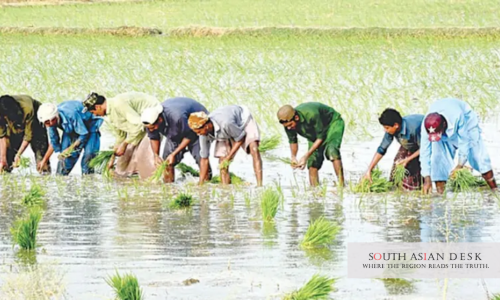
Hyderabad, 18 June 2026 — The Sindh budget 2026-27 agriculture allocation has been set at Rs6.12 billion, representing approximately 1.66 percent of the province’s total Annual Development Programme for the fiscal year, with the government opting to prioritise the completion of ongoing schemes rather than launch any new projects.
How the Sindh Budget 2026-27 Agriculture Funds Are Divided
Of the total Sindh Budget 2026-27 outlay, Rs4.714 billion has been earmarked for seven components of the agriculture department, while Rs1.4129 billion has been allocated to the livestock sector. The livestock component is additionally expected to receive Rs4.76 billion in foreign project assistance.
The agriculture department’s Rs4.714 billion breaks down across its operational areas as follows: water management receives the largest share at Rs1.796 billion, followed by marketing at Rs1.319 billion, mechanisation at Rs612.059 million, extension services at Rs656.700 million, research at Rs255.250 million, training and research at Rs43.750 million, and supply, prices and measures at Rs30.680 million.
The budget covers nine ongoing agriculture extension schemes, three marketing schemes, four mechanisation schemes and five research schemes. The government has made an explicit decision to include no new schemes, directing available resources instead toward bringing current projects to completion.
Murad Ali Shah Highlights Sindh’s Outsized Agricultural Role
Chief Minister Syed Murad Ali Shah, presenting the budget, drew attention to Sindh’s central importance to Pakistan’s national food supply. He stated that the province contributes 35 to 40 percent of the country’s rice production, 30 to 35 percent of cotton, 25 to 30 percent of sugarcane, and 12 to 15 percent of wheat.
He noted that 306,709 Benazir Hari Cards had been issued to farmers during the current year, and that the Sindh Wheat Growers Support Programme 2025 had delivered cash subsidies to 300,000 wheat growers through the card mechanism for the purchase of agricultural inputs.
For FY2026-27, the Chief Minister announced that the provincial government would provide Rs20 billion for the wheat sector. In the preceding fiscal year, a support price of Rs8,750 per 100 kilograms was applied to the procurement of one million tonnes of wheat. He acknowledged that this intervention was taken despite an International Monetary Fund precondition under the National Fiscal Pact requiring governments to progressively withdraw from direct commodity market operations. He also cited a rise of 50 to 100 percent in input costs across some categories since 2021 as a key justification for the intervention.
Key Schemes Receiving Allocations
Several ongoing schemes have received specific allocations for the coming year. The Bio-saline Agriculture Research and Development Phase-II scheme, being executed in Khairpur, Tharparkar and Umerkot districts, had achieved 76.1 percent financial progress by June 2026 and will receive Rs47.850 million in FY2026-27. The upgradation of the Horticulture Research Centre in Mirpurkhas has been allocated Rs130 million.
A wheat varietal development initiative using speed breeding technology, being carried out in Hyderabad and Shaheed Benazirabad districts at a total approved cost of Rs100 million, had spent 98 percent of its funding by June 2026. It will receive Rs1.5 million for final completion. A separate scheme for the production of early-category seeds of climate-resilient crops, approved at Rs50 million in total, had utilised Rs24.7 million by June 2026, with the remaining Rs25.3 million now earmarked for the year ahead.
On the water side, the improvement of new watercourses scheme has been allocated Rs416.822 million, having achieved 36.5 percent financial progress against an approved cost of Rs2 billion. A water conservation scheme approved last year at Rs1.02 billion will receive Rs510 million in 2026-27, with half of its total funding already disbursed.
Published in SouthAsianDesk, June 19, 2026
Follow SouthAsianDesk on X, Instagram and Facebook for insights on business and current affairs from across South Asia.