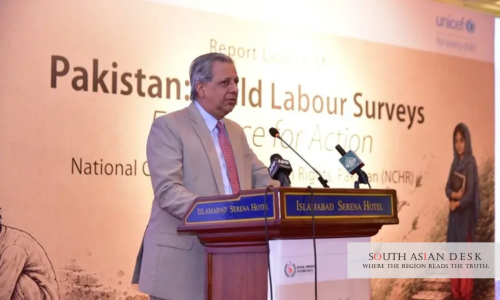
Child labour in Pakistan remains a widespread challenge, with around 8.6 million children engaged in child labour and 6.6 million involved in hazardous work, according to a new national report launched by the National Commission for Human Rights in collaboration with UNICEF.
The report, titled Pakistan: Child Labour Surveys – Evidence for Action, brings together findings from child labour surveys conducted across Punjab, Sindh, Khyber Pakhtunkhwa, Balochistan and Islamabad Capital Territory. It is described as the most comprehensive child labour dataset for Pakistan in nearly three decades.
The findings show that hazardous child labour remains a serious concern across the country, affecting children’s health, safety, schooling and future opportunities. The report says the figures are combined estimates from surveys carried out at different times between 2019 and 2024, with reporting completed in 2025. It also notes that the numbers should not be treated as a single point-in-time national total.
Child labour in Pakistan concentrated in Punjab, Sindh and KP
According to the Pakistan child labour report, Punjab carries the largest burden, with about 6.04 million children in child labour and 4.64 million in hazardous work. Sindh follows with 1.61 million children in child labour, including 1.16 million in hazardous work.
Khyber Pakhtunkhwa recorded 745,200 children in child labour, of whom 631,500 were exposed to hazardous conditions. Balochistan recorded 201,400 children in child labour and 165,400 in hazardous work, while Islamabad Capital Territory had 15,200 children in child labour and 14,500 in hazardous work.
The report says the surveys covered children aged five to 17 and examined their economic activities, unpaid household work, hours worked, schooling status and exposure to risks affecting health, safety and protection.
Poverty and child labour remain closely linked
The NCHR UNICEF report identifies poverty as the strongest driver of child labour in Pakistan. It says child labour is consistently concentrated among the poorest households and families where parents or household heads have low levels of education.
The report also highlights a gendered pattern. Boys are more likely to be involved in work and hazardous child labour, while girls are more likely to be out of school or to have never attended school. Girls also carry a heavier burden of household chores, which can remain less visible in conventional labour inspections.
The findings show that child labour is closely linked to education. Children engaged in labour are more likely to have dropped out of school or never enrolled, while also working longer hours. The report warns that poverty and low education can reinforce each other, trapping families and children in long-term vulnerability.
Agriculture dominates hazardous child labour
Agriculture, forestry and fishing are the leading sectors for children in child labour across most provinces, particularly Punjab, Sindh and Khyber Pakhtunkhwa. The report says more than half of children in child labour in these provinces are engaged in these activities.
Other sectors include water and firewood collection, retail trade, domestic work, construction and small-scale manufacturing. In Islamabad Capital Territory, wholesale and retail trade is the leading sector for children in child labour, reflecting its more urban labour profile.
The report also says many children work as unpaid family workers on family farms, in family workshops or inside homes. This makes child labour harder to detect through ordinary labour inspections and requires stronger community-level monitoring, social protection and child protection systems.
Children in hazardous work face health and education risks
The report links hazardous child labour with physical injuries, illness, fatigue, poor school performance and mental health concerns. It says children in hazardous forms of work may face serious harm, including extreme tiredness, difficulty concentrating and symptoms of depression.
Speakers at the report’s launch said child labour in Pakistan could not be addressed by a single ministry or one isolated intervention. They called for coordinated action across education, labour, social protection, child protection, health and justice systems.
The report recommends expanding access to quality education, strengthening labour inspections, improving child protection units, increasing social protection support, and developing referral pathways for children withdrawn from hazardous work.
It also calls for targeted interventions in districts and sectors where children in hazardous work are most at risk, alongside stronger data systems to track progress.
Pakistan’s Constitution prohibits the employment of children under 14 in hazardous occupations and guarantees free and compulsory education for children aged five to 16. The report says the new evidence should help policymakers design better interventions to reduce child labour in Pakistan and protect children from harmful work.
Published in SouthAsianDesk, June 20, 2026
Follow SouthAsianDesk on X, Instagram and Facebook for insights on business and current affairs from across South Asia.