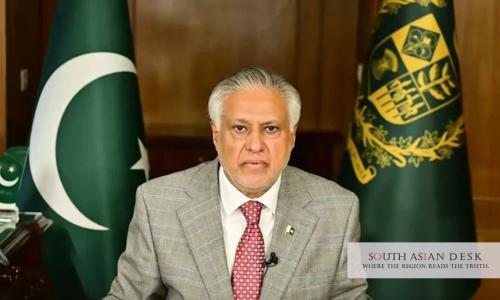
Indus Waters Treaty tensions have deepened after Deputy Prime Minister and Foreign Minister Ishaq Dar warned that India’s planned reservoir expansion and river diversion projects could alter the Indus river system and strengthen what he called “hydro-hegemony”.
Dar made the remarks in a recorded keynote address to a seminar titled “Transboundary Water Resources: A Weaponised Global Common” in Brussels on Thursday, June 18, 2026.
Indus Waters Treaty Concerns Raised At Brussels Seminar
Dar said Pakistan’s concerns were not limited to political statements from India, but also related to projects involving reservoirs, expansion of existing structures and diversion schemes on the Indus river system.
He referred to at least 17 projects, including reservoir-related works such as Sawalkot, Kirthai and Kwar, expansion of existing structures including Baglihar and Salal, and diversion projects on the Indus, Chenab and Ravi rivers.
According to Dar, such measures could “drastically alter” the river system and create conditions for hydro-hegemony. He also said water should not be treated as an instrument of coercion.
The Ministry of Foreign Affairs said Dar reaffirmed Pakistan’s commitment to dialogue, diplomacy and international law, while calling for stronger international cooperation on water security.
Pakistan Warns Against Water Weaponisation
The seminar was organised by Pakistan’s Embassy to Belgium, Luxembourg, the European Union and NATO in collaboration with the Centre for European Policy Studies.
The Foreign Office said the event examined the growing importance of transboundary water resources at the intersection of climate change, regional security and international law.
Pakistan’s ambassador to the EU said more than 250 million Pakistanis depend on the Indus Basin and described the treaty as a globally respected framework for transboundary water cooperation.
Dar said the Indus Waters Treaty, signed in 1960, had survived three major conflicts and several other crises, adding that treaty obligations and legal mechanisms should remain central to dispute resolution.
India’s Position On The Treaty
India announced on Wednesday, April 23, 2025, that the Indus Waters Treaty would be held in abeyance with immediate effect, following a deadly attack in Pahalgam in Indian-administered Kashmir. New Delhi blamed Pakistan for cross-border terrorism, a charge Islamabad has denied.
India has also rejected proceedings before the Court of Arbitration related to the treaty, describing the body as illegally constituted and maintaining that its treaty position remains unchanged.
Pakistan has rejected India’s decision to place the treaty in abeyance, saying the agreement has no provision for unilateral suspension. Islamabad says any attempt to weaponise water would threaten Pakistan’s water, food and economic security.
Background
The Indus Waters Treaty was signed in 1960 after negotiations between Pakistan and India with the assistance of the World Bank, which is also a signatory.
The treaty broadly allocates the eastern rivers, Ravi, Beas and Sutlej, to India, while the western rivers, Indus, Jhelum and Chenab, are largely allocated to Pakistan. India is allowed certain uses on the western rivers, including limited non-consumptive uses and hydropower development within treaty conditions.
In recent years, Pakistan and India have remained locked in disputes over hydropower projects and design features on the western rivers. The Permanent Court of Arbitration’s public case docket shows continuing proceedings in the Indus Waters Western Rivers Arbitration, including a May 2026 award concerning maximum pondage.
What’s Next
The dispute is likely to remain active in diplomatic and legal forums as Pakistan continues to argue that India must comply with the Indus Waters Treaty and its dispute-resolution mechanisms.
India, meanwhile, has maintained that the treaty remains in abeyance. The gap between the two positions could further strain regional diplomacy unless both sides return to a mutually accepted legal or diplomatic process.
For Pakistan, the Indus Waters Treaty remains central to national water security, agriculture and regional stability, making Dar’s warning part of a broader diplomatic effort to internationalise concerns over India water projects and transboundary water governance.
Published in SouthAsianDesk, June 20, 2026
Follow SouthAsianDesk on X, Instagram and Facebook for insights on business and current affairs from across South Asia.