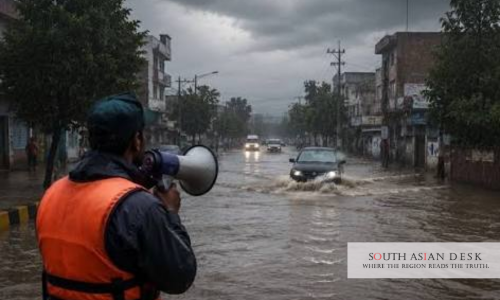
Pakistan flood alert warnings have been issued nationwide as authorities brace for heavy rains, thunderstorms, urban flooding and possible glacial lake outburst floods in vulnerable northern regions.
The National Disaster Management Authority (NDMA) issued a nationwide weather alert, warning that Pakistan had entered a “critical” weather window, with severe weather expected across parts of the country over the next 12 to 24 hours.
According to the NDMA’s National Emergencies Operation Centre, thunderstorms, heavy rainfall, strong winds and dust storms could affect several regions, while mountainous areas face an increased risk of Glacial Lake Outburst Floods, commonly known as GLOFs.
Pakistan Flood Alert Covers Cities And Northern Regions
The Pakistan flood alert identifies both urban and mountainous areas as vulnerable. Islamabad, Rawalpindi and adjoining urban centres have been warned of possible flooding, particularly in low-lying areas where drainage systems may be overwhelmed by intense rainfall.
Rainfall is also expected across parts of Punjab, including Lahore, Faisalabad, Gujranwala, Sialkot, Multan, Bahawalpur, Dera Ghazi Khan and Rahim Yar Khan, according to local reporting based on the NDMA alert.
In Khyber Pakhtunkhwa, rain and thunderstorms are forecast for areas including Chitral, Dir, Swat, Mansehra, Abbottabad, Haripur, Peshawar, Kohat, Bannu, Dera Ismail Khan and Waziristan. Parts of Balochistan and Sindh may also see rainfall, strong winds or dust storms.
The NDMA has directed provincial and district administrations to remain on high alert, clear drainage systems and keep rescue teams ready for any emergency response.
GLOF Risk Pakistan Faces In Gilgit-Baltistan And KP
The most serious concern is in Pakistan’s northern mountain belt, where high temperatures and glacial melt have increased the risk of sudden floods.
The NDMA warned of GLOF risk in Gilgit-Baltistan, Khyber Pakhtunkhwa and Azad Kashmir. Al Jazeera reported that Hunza and Skardu were among the areas identified as particularly vulnerable.
GLOFs occur when glacial lakes burst, releasing large volumes of water, debris and sediment downstream within a short period. Such events can destroy roads, bridges, homes, farms and power infrastructure, especially in narrow valleys.
Pakistan has one of the world’s largest concentrations of glaciers outside the polar regions. According to Al Jazeera, citing UNDP data, melting glaciers in the Hindu Kush, Himalayas and Karakoram ranges have formed more than 3,000 glacial lakes in Gilgit-Baltistan and Khyber Pakhtunkhwa, with 33 assessed as vulnerable to hazardous outbursts.
Monsoon Raises Flood Fears After Recent Disasters
The latest warning comes as Pakistan prepares for another difficult monsoon season. Al Jazeera reported that the country is bracing for what could be a fourth consecutive year of punishing monsoon rains.
Last year, monsoon rains killed more than 1,000 people in Pakistan, including 275 children, and displaced about three million people, according to Al Jazeera. The 2022 floods remain the country’s most devastating recent climate disaster, killing nearly 1,700 people and displacing more than 30 million.
Authorities have advised tourists and travellers to avoid unnecessary travel during heavy rainfall and to check weather and road conditions before visiting northern areas, where landslides, debris flows and road closures remain possible.
The NDMA has urged citizens to follow official alerts and contact local administration or rescue services in case of emergency.
Published in SouthAsianDesk, June 23, 2026
Follow SouthAsianDesk on X, Instagram and Facebook for insights on business and current affairs from across South Asia.