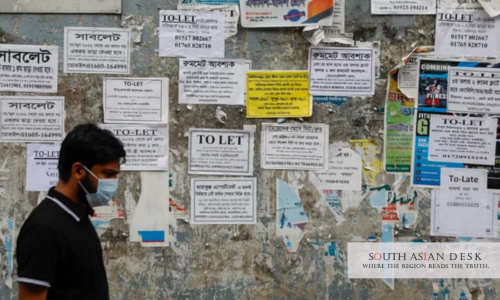
The Dhaka housing crisis is reshaping how the city’s youngest residents live, with rising rents and a chronic shortage of residential accommodation forcing many students and young workers into shared or sublet spaces. On the second floor of an old building in the Staff Quarters area near Chapra Mosque in Azimpur, four people, three university students and one employed woman, share a single small room fitted with four beds. Books and bags are tucked beneath the beds, clothes are stacked in a corner, and a few cooking pots sit near the window, a scene that has become increasingly common across the capital.
Some of the room’s occupants moved to Dhaka to pursue their studies, while others are still waiting for a place to open up in a university residential hall. With rents climbing and commuting from distant parts of the city becoming both expensive and time-consuming, many young people are opting for shared living arrangements simply to remain within reach of their institutions and workplaces.
Drivers Behind the Dhaka Housing Crisis
The Dhaka housing crisis has been fuelled by a combination of rapid urbanisation, sustained population growth and a rental market that has struggled to keep pace with demand. According to the Bangladesh Bureau of Statistics’ Household Income and Expenditure Survey 2023, about 45 percent of households in Dhaka Division were renting or subletting their dwellings, compared with a national average of 19.08 percent. The same data shows the House Rent Index for the division rose 6.20 percent year-on-year in the most recent available period, underscoring how quickly housing costs are climbing relative to incomes.
Rental Affordability and the Rising Cost of Living in Dhaka
Research on middle-income renters in Dhaka has consistently found that most spend more than 30 percent of their monthly income on rent, the widely used threshold for measuring housing affordability. A 2025 study focused on the Nayatola and Mogbazar areas found that households there frequently exceed this threshold. Earlier findings from a 2017 city survey, cited in the State of Cities 2017 report, showed that around 77 percent of households paid rent above the standard affordability limit. When utility costs were factored in, that figure rose to 82 percent of households facing unaffordable housing expenses.
This financial strain falls hardest on students and young workers, many of whom have limited and often irregular incomes and cannot afford the large advance payments or security deposits typically demanded by landlords in the city.
University Housing Shortfall Adds to the Pressure
The scale of the shortfall is evident at the University of Dhaka, one of the country’s largest public universities, which has around 41,000 students, including approximately 18,902 women. According to university sources, the institution’s five female residential halls together accommodate only 9,005 students, leaving roughly 9,897 female students without access to formal residential housing. For many of these students, informal sublet arrangements, like the shared room in Azimpur, have become the only practical alternative.
As Dhaka continues to expand and rental costs rise faster than incomes for many young residents, the housing crisis facing students and early-career workers shows little sign of easing in the near term. Without a significant expansion of affordable residential capacity, shared and sublet living arrangements are likely to remain the default option for a large share of the city’s young population.
Published in SouthAsianDesk, August 20th, 2026
Follow SouthAsianDesk on X, Instagram and Facebook for insights on business and current affairs from across South Asia.