Pakistan-Iran Transport Links Move Back Into Focus
Pakistan-Iran transport links are set to be strengthened after the two neighbours agreed to improve road and rail connectivity and revive a bilateral transport mechanism aimed at removing cross-border trade bottlenecks.
The understanding was reached during talks in Islamabad between Pakistan’s Communications Minister Abdul Aleem Khan and Iran’s Minister for Roads and Urban Development Farzaneh Sadegh. The meeting came days after Iranian President Masoud Pezeshkian visited Pakistan and thanked Islamabad for its role in recent ceasefire diplomacy involving Iran and the United States.
According to Pakistan’s communications ministry, both sides reviewed proposals to improve land connectivity and agreed to fully activate the Pakistan-Iran Joint Transport Committee. The committee is expected to focus on practical issues affecting cargo movement, logistics coordination and road and rail connectivity between the two countries.
The talks signal an effort by Islamabad and Tehran to turn recent diplomatic engagement into economic cooperation. Both countries have long spoken of expanding trade, but actual commercial flows have remained limited by sanctions, weak banking channels, border delays and underdeveloped transport infrastructure.
For Pakistan, better connectivity with Iran could support trade through Balochistan, improve access to regional markets and create new opportunities for border communities. For Iran, smoother road and rail links with Pakistan could help expand its eastern trade routes at a time when Tehran is trying to rebuild economic relationships after months of regional instability.
Joint Transport Committee Revived to Ease Border Bottlenecks
The revival of the Pakistan-Iran Joint Transport Committee is the most practical outcome of the latest talks. Such mechanisms matter because cross-border trade is often slowed not by high-level political disputes alone, but by day-to-day problems at the border.
These include delays in truck clearance, documentation issues, container movement, limited customs coordination, security checks and gaps in road and rail infrastructure. Iranian officials raised concerns related to truck and container clearance, while both sides agreed to take joint steps to resolve logistical hurdles.
Pakistan’s communications ministry said Abdul Aleem Khan assured the Iranian delegation that transport-related bottlenecks would be addressed on a priority basis. The statement also quoted him as saying that stronger road and rail connectivity was essential for unlocking trade opportunities between the two countries.
That emphasis is important. Pakistan and Iran share a border of nearly 900 kilometres, yet trade remains far below potential. Border markets and barter arrangements have helped create limited channels of commerce, but larger trade growth requires predictable transport routes, reliable customs procedures and functioning financial mechanisms.
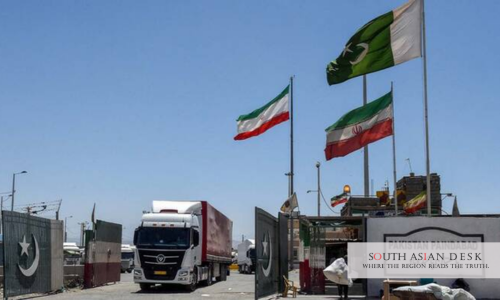
The Taftan border in Balochistan remains one of the most important crossing points for trade and travel between the two countries. Improvements in road access, cargo handling and clearance procedures could make a visible difference for traders who currently face delays and uncertainty.
Trade Potential Still Held Back by Sanctions and Banking Limits
The promise of Pakistan Iran trade has been discussed for years, but the structural constraints are serious. International sanctions on Iran have made normal banking difficult, limiting the ability of businesses to settle payments through formal channels. This has pushed some trade into barter, informal arrangements or smaller-scale transactions.
Transport improvements alone cannot remove those restrictions. However, better road and rail connectivity can still make existing trade more efficient and prepare both countries for a larger commercial opening if sanctions relief becomes more durable.
That is why the timing of the meeting matters. Iran is engaged in wider diplomatic talks after the recent ceasefire process, while Pakistan is trying to position itself as both a mediator and a beneficiary of regional de-escalation. If tensions continue to ease, Islamabad may see an opportunity to expand trade with Iran without triggering the same level of uncertainty that has previously held back investors and exporters.
For Pakistan’s economy, even modest improvements in cross-border trade could matter. Border provinces such as Balochistan often see limited formal economic activity despite their strategic location. Improved connectivity with Iran could support transport companies, traders, small manufacturers, fuel-related commerce, agriculture, food items and consumer goods.
For Iran, stronger access to Pakistan could support regional outreach at a time when Tehran wants to reduce isolation and diversify trade routes.
Road and Rail Connectivity Could Support Regional Trade
The renewed focus on road and rail connectivity also fits into a wider regional picture. Pakistan sits between South Asia, Central Asia, the Middle East and China. Iran connects South Asia to the Gulf, Turkiye and wider Eurasian routes. Better land connectivity between the two countries could therefore carry strategic value beyond bilateral trade.
Rail links, in particular, have long been discussed as a way to move cargo more efficiently across long distances. However, rail cooperation has often struggled because of infrastructure gaps, technical limitations, customs issues and inconsistent commercial demand. Reviving the transport committee may help identify which projects are realistic and which require longer-term financing.
Road connectivity is more immediately practical. Trucking routes can be improved faster than railway corridors, especially if both governments focus on customs coordination, border operating hours, container handling and safety along transport routes.
However, security will remain a concern. Cross-border movement through Balochistan has often been affected by militancy, smuggling, weak infrastructure and administrative delays. Any serious transport plan will need coordination between customs, border forces, transport ministries and provincial authorities.
Diplomacy Opens a Narrow Economic Window
The transport talks followed a period of high-profile diplomacy. Pezeshkian’s visit to Pakistan highlighted Tehran’s appreciation for Islamabad’s role in efforts to reduce tensions with Washington. Pakistan has tried to present itself as a useful diplomatic bridge, while also seeking economic gains from a calmer regional environment.
That does not mean a trade breakthrough is guaranteed. The obstacles are still significant: sanctions, limited banking channels, infrastructure weaknesses, border security and the absence of a predictable payment system. But the latest agreement suggests both governments want to use the diplomatic opening to push practical cooperation.
For Islamabad, this is part of a broader question: can Pakistan turn diplomatic relevance into economic advantage? Improved transport links with Iran would be one tangible way to do so. Unlike broad political statements, border logistics and road connectivity can produce measurable outcomes if implemented properly.
For Tehran, closer economic ties with Pakistan offer both commercial and political benefits. Pakistan is a large neighbouring market, and stronger land links could help Iran expand trade despite pressure elsewhere.
Implementation Will Decide the Outcome
The real test will be whether the Joint Transport Committee moves beyond meetings and produces visible changes at the border. Traders will look for shorter clearance times, fewer procedural delays, better cargo facilities, safer road movement and clearer rules for trucks and containers.
Both sides will also need to coordinate across multiple agencies. Transport ministries can set the agenda, but customs, border authorities, rail operators, provincial governments and security agencies will determine how smoothly goods actually move.
There is also a need for transparency. Businesses will need clear information on routes, documentation, tariffs, permitted goods, payment arrangements and dispute-resolution mechanisms. Without that, trade will remain limited to those already familiar with difficult border procedures.
The latest Pakistan-Iran agreement is therefore best seen as an opening rather than a breakthrough. It shows political intent and creates a platform for technical work. Whether it becomes economically meaningful depends on follow-through.
If Islamabad and Tehran can reduce border delays, improve cargo movement and gradually expand formal trade channels, Pakistan-Iran transport links could become a serious driver of regional commerce. If not, the announcement risks becoming another familiar statement of goodwill in a relationship that has often promised more than it has delivered.
For now, the message from both capitals is clear: after ceasefire diplomacy, Pakistan and Iran want connectivity to carry the next phase of engagement.
Published in SouthAsianDesk, June 26, 2026
Follow SouthAsianDesk on X, Instagram and Facebook for insights on business and current affairs from across South Asia.