India-US Trade Deal Talks Enter Decisive Phase
India-US trade deal talks are close to conclusion, India’s Commerce and Industry Minister Piyush Goyal said, as New Delhi and Washington try to settle the tariff and market-access terms of an interim pact that could reset a tense but commercially vital relationship.
Goyal’s comments came after US Trade Representative Jamieson Greer completed two days of negotiations in New Delhi this week. The latest round followed a June 17 meeting between Indian Prime Minister Narendra Modi and US President Donald Trump on the sidelines of the G7 summit, where trade was again placed at the centre of the bilateral agenda.
Speaking at an event in London, Goyal said the two sides were “very close” to finalising a deal, but made clear that India’s central demand remains unresolved: Washington must find a legally workable way to give Indian exports a tariff advantage over competing Asian economies. “The day that happens, the deal is on,” he said.
The statement captures both the progress and the fragility of the negotiations. India wants a deal that protects the competitiveness of its exporters in the US market. The United States wants India to lower trade barriers and buy more American goods. Both governments are presenting the talks as constructive, but the final bargain depends on whether Washington can offer tariff relief that survives legal and political scrutiny.
Tariff Advantage Sits at the Heart of the India-US Trade Deal
The proposed agreement is not a traditional full free trade agreement. It is being discussed as an interim trade arrangement designed to stabilise commercial ties, reduce uncertainty and create room for a broader bilateral trade agreement later.
Under an initial understanding reached in February, Indian goods would face an 18% tariff in return for New Delhi lowering trade barriers and increasing imports of American products. At that stage, the 18% figure was attractive for India because it would have placed Indian exports in a better position than competitors such as Bangladesh and Vietnam.
That arrangement was disrupted after the US Supreme Court invalidated Trump’s sweeping global tariffs, weakening Washington’s ability to deliver the earlier tariff structure. The ruling effectively removed the promised reduction from 25% to 18%, while India was still being asked to make long-term commitments on market access.
This is why New Delhi is insisting on a comparative tariff advantage before signing. For India, the deal is only commercially meaningful if its exporters receive a real edge in the US market rather than merely accepting new obligations without corresponding benefits.
What Washington Wants From New Delhi
The US position is focused on reciprocity, market access and increased American exports to India. The US Embassy in India said Washington was seeking a fair and reciprocal agreement that opens markets for American exporters while benefiting both countries. Greer met Goyal in New Delhi on Tuesday to advance the interim agreement.
For Washington, India’s large consumer market and growing manufacturing ambitions make it an important trade partner. American negotiators are expected to push for easier access in sectors such as energy, agriculture, technology, defence-related goods and industrial products.
India, however, has traditionally approached market access cautiously, particularly in sectors where domestic producers, farmers or small businesses could face pressure from cheaper imports. That makes the negotiations politically sensitive inside India, even as the government seeks to improve export competitiveness abroad.
The deal therefore involves a difficult exchange: India may have to open parts of its market further, but it wants measurable tariff relief in return.
Section 301 Probe Adds Pressure
The negotiations are also being complicated by a US Section 301 investigation into alleged excess industrial capacity and forced-labour concerns involving around 60 economies, including India. Reuters reported that the probe has added uncertainty to the talks and may allow Washington to retain leverage while the tariff structure remains unsettled.
Earlier this month, Greer proposed additional tariffs of 12.5% on imports from India and 53 other economies under a forced-labour probe, although no final decision has been made. For Indian exporters, that creates a serious risk: even if an interim deal is reached, future US trade actions could still affect market access.
That is why India is seeking not only a lower tariff rate, but also greater predictability. Exporters need to know whether a deal will protect them from sudden tariff increases or whether new investigations could quickly dilute its value.
Why the Deal Matters for Indian Exporters
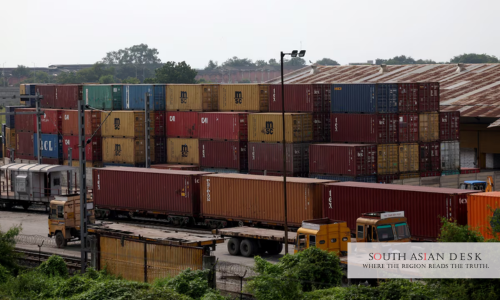
The United States is one of India’s most important export markets, especially for sectors such as pharmaceuticals, textiles, gems and jewellery, machinery, chemicals, engineering goods and technology-linked services. Even small tariff differences can matter in price-sensitive industries where Indian companies compete with producers from Vietnam, Bangladesh, Thailand, China, Sri Lanka and other Asian economies.
Reuters reported that Indian exports to the US rose marginally to $17.29 billion in April-May from $17.21 billion a year earlier, despite uncertainty over future US tariffs. That limited increase shows that trade has remained resilient, but also that exporters are operating under a cloud of policy uncertainty.
A favourable interim deal could give Indian exporters greater confidence, particularly in labour-intensive sectors such as textiles, garments, leather and light manufacturing. It could also support India’s wider ambition to position itself as an alternative manufacturing base as companies diversify supply chains beyond China.
But if the agreement fails to provide a meaningful tariff edge, its impact may be limited. Indian exporters would still face strong competition from countries with established access to the US market and lower production costs in some sectors.
A Deal With Strategic Weight
The India-US trade deal is about more than tariffs. It is also part of a broader effort to repair and deepen a relationship that has been strained by diplomatic disagreements, tariff disputes and differing positions on global issues.
Trade has often been the most difficult part of the India-US relationship. Defence, technology and strategic cooperation have expanded significantly over the past decade, but commercial negotiations have repeatedly run into disputes over tariffs, agriculture, digital rules, medical devices, intellectual property and market access.
A successful interim deal would send a signal that both governments can still manage difficult economic issues despite political tensions. It would also help revive confidence in the broader partnership at a time when both countries see each other as important players in the Indo-Pacific and global supply chains.
For Trump, the deal would support his argument that his administration can secure better terms for American exporters. For Modi, it would help show that India can negotiate hard with Washington while protecting its economic interests.
Final Agreement Still Depends on Legal Clarity
Despite the optimistic language, the final hurdle remains legal and technical. Goyal’s remarks suggest that India is waiting for Washington to identify the tools and legal backing needed to deliver the tariff advantage New Delhi wants.
That may be the central issue over the coming days. If the US can offer a durable tariff structure, the agreement could move quickly. If it cannot, the talks may remain stuck between political intent and legal constraint.
The outcome will matter for exporters, investors and policymakers in both countries. A deal could reduce uncertainty, support trade flows and provide a platform for a larger bilateral agreement. A delay, however, would keep businesses exposed to tariff volatility and prolong a period of uncertainty in one of the world’s most important commercial relationships.
For now, India and the US appear closer than they have been in months. But “very close” is not the same as concluded. The deal will only be signed when both sides can show that the political bargain has been matched by enforceable tariff terms.
Published in SouthAsianDesk, June 26, 2026
Follow SouthAsianDesk on X, Instagram and Facebook for insights on business and current affairs from across South Asia.