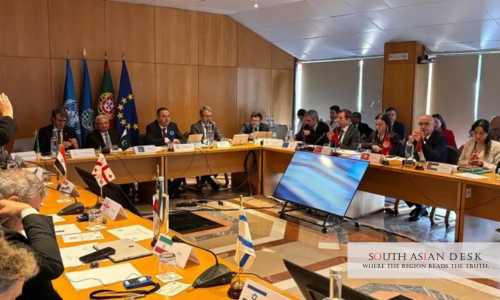
Pakistan joins International Olive Council as a permanent member for the first time, marking an important milestone for the country’s emerging olive sector and its ambition to build a stronger presence in the global olive oil market.
Pakistan formally took its seat at the 123rd Session of the International Olive Council, held in Lisbon, Portugal. The Pakistani delegation was led by Federal Minister for National Food Security and Research Rana Tanveer Hussain, who briefed council members on the country’s expanding olive cultivation, production infrastructure and long-term plans for sustainable growth.
The development follows Pakistan’s accession to the International Olive Council in May 2026. With its new membership, Pakistan is expected to gain greater access to technical cooperation, quality standards, research support, market information and international expertise in olive oil and table olives.
Pakistan joins International Olive Council after years of sector growth
Pakistan’s International Olive Council membership comes after several years of efforts to develop olive cultivation in Pakistan, particularly in areas with suitable climatic and soil conditions. Officials say the country has planted more than seven million olive trees across 55,669 acres, while olive clusters are expanding in different regions.
The government has also highlighted the establishment of a complete farm-to-fork olive value chain. This includes 51 olive oil extraction units, modern processing facilities, nurseries, weather stations and four quality laboratories aligned with International Olive Council standards.
Pakistan has also achieved self-sufficiency in the domestic production of certified olive saplings, a major step for reducing dependence on imported planting material and supporting the long-term expansion of the Pakistan olive sector.
The country’s olive oil industry has already begun gaining international attention. Officials said Pakistani olive oil received recognition at the New York International Olive Oil Competition last year, reflecting improvement in quality and competitiveness.
What International Olive Council membership means for Pakistan
The International Olive Council is the world’s only intergovernmental organisation dedicated to olive oil and table olives. Established in 1959 under the United Nations system, it works on quality standards, scientific research, technical cooperation, sustainability, market transparency and promotion of olive products.
For Pakistan, membership provides a route into a specialised international forum that shapes standards and cooperation in the olive economy. This matters because the Pakistan olive oil industry is still developing and requires technical support in areas such as quality testing, post-harvest handling, branding, certification and export readiness.
Through International Olive Council membership, Pakistan can benefit from global knowledge on olive varieties, cultivation techniques, irrigation, processing, storage and marketing. It also gives the country a stronger platform to present its progress and attract cooperation from established olive-producing nations.
This is particularly important because olive oil production in Pakistan remains small compared with major producing countries, but local demand and cultivation potential have been rising. International Olive Council estimates for the 2024/25 crop year placed Pakistan’s olive oil production at around 1,500 tonnes, imports at around 3,500 tonnes and consumption at about 5,000 tonnes.
Pakistan olive sector eyes climate-resilient agriculture
Pakistan’s push into olive cultivation is also linked to climate-resilient agriculture. Olive trees are known for their ability to grow in dry and semi-arid conditions, making them suitable for parts of Pakistan where conventional crops face water stress and changing weather patterns.
At the Lisbon IOC session, Rana Tanveer Hussain said Pakistan wanted to play a cooperative role in the sustainable and climate-resilient development of the global olive oil and table olive sectors. This reflects the government’s broader view that olive cultivation can help diversify agriculture, create rural income opportunities and reduce reliance on imported edible oils over time.
However, the long-term success of the Pakistan olive sector will depend on more than planting trees. Farmers and processors will need consistent access to technical training, reliable nurseries, modern extraction facilities, quality control laboratories and market linkages. Proper harvesting, milling and storage will be central to producing high-quality olive oil that can compete with international brands.
Why the Lisbon IOC session matters
Pakistan’s participation in the Lisbon IOC session as a permanent member was symbolically and practically significant. It marked the country’s entry into a council whose member states account for the overwhelming majority of global olive oil production.
The Pakistani delegation used the session to present the country’s progress in olive cultivation, processing and quality infrastructure. Officials said Pakistan was warmly welcomed by the IOC leadership and member countries, while the minister reaffirmed Pakistan’s commitment to the council’s objectives.
The session also gave Pakistan an opportunity to position itself as a new player in the international olive market. While the country is not yet a major producer, its growing acreage, expanding extraction capacity and focus on certified saplings suggest that the sector is being developed with long-term ambitions.
Challenges ahead for Pakistan olive oil industry
Despite the milestone, Pakistan’s olive oil industry still faces several challenges. Local brands must build consumer trust, improve packaging and certification, and compete with imported olive oils that already dominate premium shelves. Farmers also need continued support to manage orchards until trees reach mature production levels.
Quality consistency will be another major test. Olive oil is a sensitive product, and poor harvesting or delayed extraction can quickly reduce quality. That makes the expansion of olive oil extraction units, laboratories and trained technicians essential for the sector’s credibility.
Market development will also be crucial. Pakistan will need stronger domestic branding, consumer awareness campaigns and export strategies if it wants to turn olive cultivation into a commercially sustainable industry. International Olive Council membership can support this process, but domestic implementation will determine the outcome.
A step towards global recognition
Pakistan joins International Olive Council at a time when the country is trying to diversify agriculture and reduce pressure from its edible oil import bill. Olive cultivation alone cannot immediately transform the sector, but it can become an important part of a broader strategy involving local production, value addition and climate-smart farming.
The membership gives Pakistan access to a global platform, but the real opportunity lies in how effectively it uses that platform. If the country can maintain quality standards, support farmers, improve processing and build market confidence, the Pakistan olive sector could move from a promising experiment to a recognised part of the global olive economy.
For now, Pakistan’s permanent seat at the International Olive Council is a major diplomatic and agricultural achievement. It signals that the country’s olive oil ambitions are no longer limited to domestic development programmes, but are now connected to international standards, cooperation and market recognition.
Published in SouthAsianDesk, July 1, 2026
Follow SouthAsianDesk on X, Instagram and Facebook for insights on business and current affairs from across South Asia.