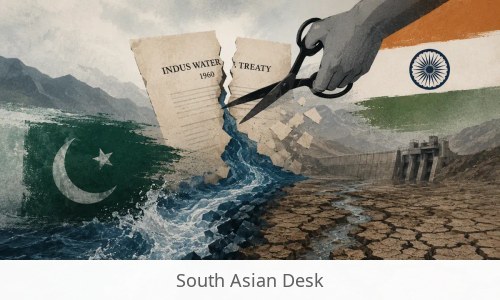
Pakistan has warned India regarding the Indus Water Treaty, indicating rising tensions over water resources. The dispute centers on the allocation of waters from the Indus River system, a lifeline for both nations, with recent developments suggesting a precarious standoff between Islamabad and New Delhi.
Historical Context of the Indus Water Treaty
The Indus Water Treaty, signed in 1960 under the aegis of the World Bank, governs the distribution of waters from the Indus River and its tributaries. It divides the six rivers of the Indus basin, allocating three eastern rivers (Ravi, Beas, Sutlej) to India and three western rivers (Indus, Jhelum, Chenab) to Pakistan. The treaty was negotiated during a period of heightened regional tensions, with India and Pakistan engaged in a series of conflicts over territorial disputes. The World Bank facilitated the agreement to ensure equitable water distribution, which was critical for agricultural and industrial development in both nations. Over the decades, the treaty has been a cornerstone of bilateral relations, though its provisions have faced periodic scrutiny as water scarcity intensifies across South Asia. The treaty includes mechanisms for dispute resolution, including a neutral expert and a court of arbitration, which have been invoked sparingly but remain a legal safeguard for both parties.
Legal Arguments and Regional Stability
Ahmar Bilal Soofi, a prominent Pakistani jurist, has criticized India’s recent claims over the Indus basin waters, asserting that such assertions contradict the treaty’s framework. Soofi’s analysis, cited in Dawn, highlights concerns that India’s position could destabilize the region by undermining the treaty’s legal foundation. Pakistan has reiterated its stance that the treaty remains binding, while Indian officials have not publicly refuted these claims, creating a vacuum of clarity that risks escalation. The treaty’s legal architecture is rooted in international law, with provisions that explicitly define the rights and obligations of both signatories. Any deviation from these terms, whether through unilateral actions or misinterpretations, could trigger a cascade of legal and diplomatic challenges. The absence of a clear Indian response has heightened uncertainty, with analysts noting that ambiguity in treaty interpretation often precedes more overt conflict.
Broader Implications of Water Scarcity
Water scarcity, exacerbated by climate change and population growth, has transformed the Indus Water Treaty into a potential flashpoint for geopolitical tensions. The South Asian region, home to 1.8 billion people, faces mounting pressure on shared water resources. The Indus River system, which supports agriculture in both nations, is increasingly vulnerable to glacial melt, erratic monsoons, and over-extraction. Analysts warn that unilateral actions or misinterpretations of the treaty’s terms could trigger diplomatic friction, with implications for trade, energy, and cross-border cooperation. The situation underscores the fragility of regional stability in an era of competing developmental needs and environmental constraints. For instance, India’s growing energy demands, including its reliance on hydropower projects in the Himalayan region, could further strain the river’s flow, potentially affecting downstream users in Pakistan. Conversely, Pakistan’s reliance on the Indus for irrigation and hydroelectric power makes it particularly sensitive to upstream activities. The interplay of these factors highlights the treaty’s role not just as a legal instrument but as a critical component of regional security.
The Role of International Institutions and Regional Dynamics
The Indus Water Treaty’s longevity has been supported by the involvement of international institutions such as the World Bank, which continues to monitor compliance and mediate disputes. However, the absence of a similar multilateral framework for other transboundary water systems in South Asia has left the region’s water governance fragmented. The treaty’s success in maintaining stability for over six decades contrasts with the lack of comparable agreements for other rivers, such as the Ganges and Brahmaputra, which are also sources of contention between India and Bangladesh. The situation with the Indus underscores the need for regional cooperation, yet the absence of a unified South Asian water governance mechanism complicates efforts to address shared challenges. The recent tensions between Islamabad and New Delhi have also been influenced by broader geopolitical dynamics, including India’s strategic partnerships with countries like the United States and its assertive posture in the Indian Ocean. Pakistan’s concerns are further compounded by its reliance on China for economic and military support, which has introduced new layers of complexity into the regional power balance.
Follow SouthAsianDesk on X, Instagram and Facebook for insights on business and current affairs from across South Asia.
Image: i.dawn.com