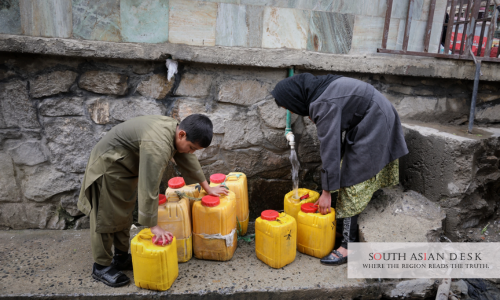
Afghanistan aid crisis is worsening as two senior United Nations officials urged Western countries not to turn away from the country, warning that renewed instability could have consequences beyond Afghanistan’s borders.
UN High Commissioner for Refugees Barham Salih and UN Development Programme Administrator Alexander De Croo made the appeal during a joint visit to Afghanistan, where they warned that aid cuts, mass refugee returns, poverty and Taliban restrictions on women are placing the country under severe strain.
Their message was carefully framed. The officials did not call for Western recognition of the Taliban government. Instead, they argued that continued engagement is necessary to prevent Afghanistan from sliding further into instability, which could fuel refugee movements, drug trafficking, extremism and criminal activity.
Afghanistan aid crisis worsens as refugee returns rise
Afghanistan aid crisis has been intensified by the return of nearly six million people since 2023, mostly from Pakistan and Iran after both countries tightened policies towards Afghan migrants. UN officials said another roughly two million people are expected to return this year.
The scale of returns has placed heavy pressure on communities that already have limited jobs, housing, healthcare and food supplies. Many returnees are arriving in areas where poverty is widespread and malnutrition continues to threaten vulnerable families.
De Croo said Afghanistan is facing “crisis on top of crisis”, pointing to the combined effect of displacement, natural disasters, climate stress and cuts to international assistance.
The warning comes as Afghanistan remains largely isolated diplomatically. No Western country has formally recognised the Taliban government since it returned to power in August 2021. Russia became the first country to formally recognise the Taliban government in 2025.
Taliban restrictions on women remain major obstacle
The UN officials acknowledged that Taliban restrictions on women and girls remain one of the biggest barriers between Afghanistan and the international community.
Since taking power, the Taliban have barred girls from education beyond primary school and restricted women from most forms of employment. These policies have drawn international condemnation and remain a central reason Western governments have refused to normalise relations with Kabul.
Salih and De Croo said they raised the issue during meetings with Afghan officials. Salih said constructive engagement could help encourage reforms and move Afghanistan towards a more inclusive system.
The issue remains difficult for donors. Western governments face pressure to avoid legitimising the Taliban while also preventing ordinary Afghans from paying the price for international isolation.
Aid cuts close hundreds of medical centres
The Afghanistan aid crisis has already had measurable effects on basic services. De Croo said 422 medical centres had closed in Afghanistan within a year because funding had disappeared, cutting off access to basic healthcare for more than three million people.
The impact is especially severe in rural and poor communities, where public services are already limited and families often depend on aid-funded clinics.
Food assistance has also been sharply reduced. Earlier this year, the World Food Programme said funding shortages had forced it to turn away three out of four acutely malnourished children seeking help.
UN officials warned that the collapse of assistance could reverse fragile gains. They said Afghanistan has made progress in some areas, including security, anti-corruption efforts and a major reduction in drug production, but those improvements could weaken without continued support.
UN officials warn instability could spread
De Croo said the consequences of abandoning Afghanistan would not remain confined to the country. He argued that Western countries cannot secure stability only through domestic policy if neighbouring regions are unstable.
Salih made a similar argument, saying the recent past showed that ignoring Afghanistan was not a wise approach. He warned that instability could lead to wider risks, including drugs, extremism, criminal networks and renewed refugee movements.
Their appeal reflects a practical policy dilemma. Western governments do not want to grant legitimacy to the Taliban while women and girls remain excluded from education and public life. At the same time, aid agencies warn that disengagement could deepen poverty, weaken basic services and worsen regional instability.
Drug production gains could be at risk
The UN officials also pointed to Afghanistan’s sharp decline in drug production as an example of progress that could be lost if international support disappears.
De Croo said drug production was down by 95 percent in a country that had long been one of the world’s major producers of opium and heroin. He said the reduction was partly linked to the Taliban’s poppy eradication campaign, but also to programmes that helped farmers shift to alternative crops.
Those programmes are now under pressure because of aid cuts. De Croo warned that if farmers are not supported with viable alternatives, drug cultivation could return.
The warning is significant because narcotics production has long been tied to insecurity, organised crime and cross-border smuggling. A collapse in alternative livelihood support could undermine one of the few areas where Afghanistan has shown measurable improvement.
Engagement without recognition may shape Western approach
The central question for Western governments is whether they can engage with Afghanistan without formally recognising the Taliban government.
The UN officials appeared to argue for that middle ground. Their position suggests that humanitarian support, technical cooperation and diplomatic contact can continue while pressure remains on the Taliban over women’s rights and political inclusion.
That approach would allow donors to support healthcare, food assistance, refugee reintegration and anti-drug programmes without granting full political legitimacy to Kabul.
Afghanistan’s diplomatic isolation has already shown signs of limited technical engagement. Last month, a Taliban delegation travelled to Brussels for talks with European Union staff on diplomatic services and the return of Afghans from Europe.
Afghanistan cannot be ignored, UN officials say
The message from the UN visit was direct: Afghanistan cannot be ignored without consequences.
The country is facing mass returns, deep poverty, reduced aid, weak services and continued restrictions on women and girls. These pressures are unfolding in a state that remains diplomatically isolated and heavily dependent on external assistance.
For Western donors, the policy choice is difficult. Cutting off engagement may avoid political discomfort, but it could also accelerate humanitarian decline and increase the very security risks governments want to prevent.
The UN officials did not suggest that concerns over Taliban policies should be set aside. Their argument was that those concerns make engagement more necessary, not less.
As Afghanistan aid crisis deepens, the challenge for the international community is to support ordinary Afghans while maintaining pressure for reforms. The cost of disengagement, UN officials warned, could be felt far beyond Afghanistan.
Published in SouthAsianDesk, July 9, 2026
Follow SouthAsianDesk on X, Instagram and Facebook for insights on business and current affairs from across South Asia.