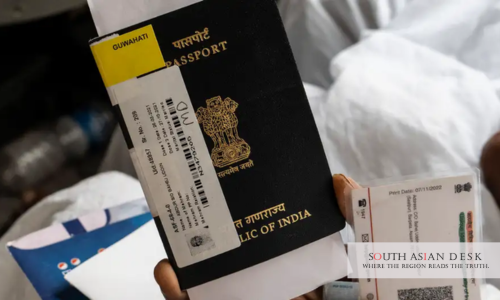
Indian passport ranking has slipped one place in the Global Passport Index 2026, placing India at 125th out of 197 countries and keeping it outside the world’s top 100 passports.
The latest ranking shows that Indian passport holders have visa-free or visa-on-arrival access to 26 destinations. While India’s overall passport score has improved to 45.1, its highest level in five years, the country’s position has still fallen from 124th in 2025 to 125th in 2026.
The result highlights a familiar contradiction. India is one of the world’s largest economies, has a fast-growing outbound travel market and carries rising diplomatic weight, yet its passport continues to offer limited mobility compared with many countries of similar or smaller economic size.
Indian Passport Ranking and What the 2026 Index Shows
The Global Passport Index 2026 places India behind Namibia, which ranks 124th, and ahead of Azerbaijan at 126th. India had earlier moved from 127th in the 2021 to 2023 period to 124th in 2025, but the latest index shows a slight reversal.
Indian passport holders can travel without a prior visa, or obtain visa-on-arrival access, in destinations such as Bhutan, Nepal, Jamaica, Macau, Palestine, Tunisia, Angola and Barbados. However, they still require visas for around 88 countries, including major economies and popular travel destinations such as the United States, the United Kingdom, Germany, France, China and the United Arab Emirates.
This means that for Indian travellers, access to several key global destinations still depends on lengthy visa procedures, documentation, financial checks and processing timelines.
Why the Global Passport Index Is Different
The Global Passport Index is not the same as the Henley Passport Index, which is more widely quoted in travel and immigration reporting.
The Henley Passport Index mainly ranks passports by the number of destinations their holders can enter without a prior visa. In that ranking, India has generally appeared much higher, with access to more than 50 visa-free or visa-on-arrival destinations depending on the year and methodology used.
The Global Passport Index takes a broader view. It measures passport strength across three pillars: enhanced mobility, investment potential and quality of life. This means the ranking is not only about how many countries a citizen can enter without a visa. It also considers the wider value attached to a passport, including the opportunities and protections citizenship may provide.
That is why India’s position in the Global Passport Index appears lower than in some other passport rankings. The difference is methodological, not necessarily a contradiction.
What the Fall Means for Indian Travellers
For ordinary Indian travellers, the one-place fall does not drastically change day-to-day travel options. The same major visa requirements remain in place for destinations such as the US, UK, Schengen countries, China and the UAE.
However, the ranking is still significant because it reflects the limited visa-free reach of the Indian passport. A stronger passport usually means easier business travel, smoother tourism, lower administrative costs and greater flexibility for students, professionals and families.
For Indian citizens, travel to many high-demand destinations still requires proof of income, employment documents, bank statements, invitation letters, accommodation details, travel history and evidence of intent to return. These requirements can make international travel more expensive and less predictable.
The ranking also matters symbolically. Passport strength is often read as a marker of global trust, diplomatic reach and migration confidence. Countries with stronger passports typically benefit from broader visa waiver agreements, lower perceived overstay risks and deeper reciprocal travel arrangements.
Europe Dominates the Top of the Index
The Global Passport Index 2026 is led by Sweden, followed by Switzerland and Finland. European countries dominate the top tier, while Singapore is the only non-European country in the top 10.
This reflects the continued advantage held by European passports, which combine strong visa-free travel access with high scores on quality of life, stability and investment conditions. Citizens of these countries generally enjoy easier access across North America, Europe, Asia-Pacific and other major travel markets.
The contrast with India is sharp. India’s economic and geopolitical profile has grown substantially, but passport mobility has not expanded at the same pace. That gap shows how passport power depends not only on a country’s size, but also on bilateral visa arrangements, migration patterns, security assessments and reciprocity.
India Compared With the Region
India still performs better than several South Asian neighbours in the Global Passport Index. Reports place Nepal, Bangladesh and Pakistan below India, with Pakistan among the lowest-ranked passports in the index.
China, however, ranks higher than India, reflecting stronger mobility access in this particular index. This comparison is notable because both India and China are major Asian economies with large populations, expanding middle classes and significant outbound travel markets.
For India, improving passport power would likely require more bilateral visa waiver agreements, stronger migration compliance records, digital travel arrangements and sustained diplomatic negotiations with key destinations.
Why Passport Power Matters
Passport power has practical consequences. It affects how easily citizens can attend conferences, explore business opportunities, pursue education, visit family, seek medical care or travel for tourism.
For businesses, limited passport access can create friction. Entrepreneurs, executives and professionals may need to plan trips weeks or months in advance. For students and workers, visa hurdles can affect timelines for admissions, interviews, training and relocation.
Tourism is also affected. Countries that offer visa-free or visa-on-arrival access often become more attractive to Indian travellers because they reduce uncertainty and paperwork. This is one reason destinations in Southeast Asia, the Middle East and parts of Africa have tried to simplify entry procedures for Indian citizens.
A Modest Slip, But a Larger Signal
India’s fall from 124th to 125th is small, but the broader message is more important: the Indian passport remains relatively weak in global mobility terms despite India’s growing international profile.
The improvement in India’s overall score to 45.1 suggests some progress, but not enough to push the passport into a stronger global bracket. The country remains outside the top 100, and Indian citizens still face visa requirements for many of the world’s most important economic and travel destinations.
For India, the challenge is not simply to improve its rank in one index. It is to expand practical travel access for citizens through stronger agreements, better consular engagement and policies that build confidence among destination countries.
The Indian passport ranking in 2026 therefore tells a mixed story. The score has improved, but mobility remains limited. India’s global role is expanding, but its citizens still do not enjoy the level of travel freedom that usually accompanies top-tier passport power.
Published in SouthAsianDesk, July 6, 2026
Follow SouthAsianDesk on X, Instagram and Facebook for insights on business and current affairs from across South Asia.