Pakistan Turkiye trade target of $5 billion has been reaffirmed as Prime Minister Shehbaz Sharif and Turkish President Recep Tayyip Erdogan pledged to deepen economic cooperation, expand investment links and give new momentum to one of Pakistan’s closest diplomatic partnerships.
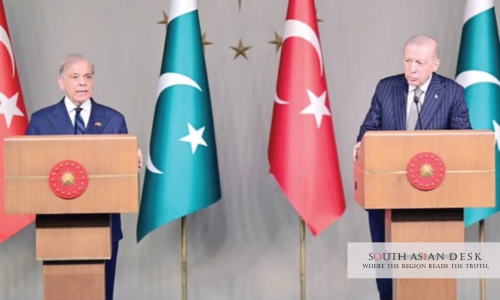
The commitment was made in Istanbul after high-level talks between the two leaders, followed by a joint press conference. Both sides said they wanted to move beyond symbolic friendship and turn longstanding political and cultural ties into stronger commercial, industrial and technology cooperation.
The renewed push comes as Pakistan seeks foreign investment, export growth and industrial partnerships, while Turkiye looks to expand its economic footprint across South Asia through energy, transport, defence, technology and private-sector engagement.
Pakistan Turkiye Trade Target and Key Areas of Cooperation
The $5 billion bilateral trade goal is not new, but both governments are now trying to give it more practical direction. The two sides discussed increasing trade and investment in special economic zones, expanding the scope of their preferential trade agreement and encouraging business-to-business partnerships.
President Erdogan said the relevant ministries were working on a special economic zone for businesspeople in Karachi. He also said negotiations were continuing to expand the Pakistan-Turkiye preferential trade agreement, which could help reduce barriers and create more room for bilateral commerce.
The sectors identified for deeper cooperation include energy, transport, critical minerals, information technology and defence. These areas reflect the changing nature of the relationship. Pakistan and Turkiye have long had strong defence and diplomatic ties, but both governments now want economic cooperation to become a central pillar of the partnership.
Why the $5 Billion Trade Target Matters
Pakistan and Turkiye share strong political goodwill, but trade has often remained below potential. The $5 billion trade target is meant to address that gap by encouraging more structured business engagement.
For Pakistan, stronger trade with Turkiye could support export diversification, industrial cooperation and technology transfer. It could also attract Turkish firms into manufacturing, energy, infrastructure and digital services. For Turkiye, Pakistan offers a large consumer market, strategic location and opportunities in sectors where Turkish companies already have experience.
The business forum in Istanbul was part of this effort. Officials and private-sector representatives from both countries discussed investment opportunities, particularly in Pakistan’s energy sector and digital economy. Turkish Energy Minister Alparslan Bayraktar said Turkish firms wanted to contribute to projects in Pakistan and share expertise as the country transforms its electricity sector.
Special Economic Zones and Preferential Trade
Special economic zones could become an important part of the Pakistan Turkiye trade target. If implemented effectively, a dedicated zone or structured investment platform could help Turkish businesses enter Pakistan with clearer regulatory support, infrastructure access and industrial incentives.
However, the success of such plans will depend on execution. Pakistan has announced several investment and SEZ-related initiatives in recent years, but investors often look for policy consistency, reliable energy supply, contract enforcement, tax clarity and ease of doing business.
The proposed expansion of the preferential trade agreement could also be important. A wider agreement may help reduce tariffs, open new product categories and make bilateral trade more competitive. Without such practical measures, the $5 billion goal may remain aspirational.
Digital Corridor and Turkcell Talks
Digital cooperation was another major part of the visit. Prime Minister Shehbaz Sharif met Turkcell CEO Ali Taha Koc and invited the company to explore long-term collaboration in Pakistan’s telecom and technology sectors.
The prime minister shared Pakistan’s vision for a Pakistan-Turkiye Digital Corridor, which would aim to strengthen regional digital connectivity, support secure cross-border data flows and improve digital infrastructure integration.
Pakistan also invited Turkcell to look at possible partnerships in 5G deployment, network optimisation, spectrum management, telecom equipment manufacturing, software development, digital skills and technology transfer.
This is significant because Pakistan’s digital economy is growing, but it still needs investment in infrastructure, skills, connectivity and local technology manufacturing. Turkish participation could help build capacity if partnerships move beyond exploratory talks.
Defence, Energy and Critical Minerals
Defence cooperation remains one of the strongest parts of Pakistan Turkiye relations. Erdogan described defence industries as a cornerstone of economic relations and said cooperation in this area continued to grow stronger.
Pakistan and Turkiye have collaborated on defence projects for years, and both countries see this area as strategic as well as commercial. Defence production, technology sharing and joint development projects could contribute to the broader economic relationship if linked with industrial capacity and exports.
Energy is another priority. Pakistan’s power sector is undergoing structural pressure due to high costs, circular debt and the need for cleaner, more reliable supply. Turkish companies have experience in power generation, transmission, renewables and infrastructure, making energy cooperation a potentially useful area if projects are commercially viable.
Critical minerals were also mentioned as a future cooperation area. This is notable because countries are increasingly competing for minerals needed in batteries, renewable energy systems, electronics and advanced manufacturing.
Regional Issues Also Feature in Talks
While the economic agenda was central, the meeting also covered regional and global issues. Erdogan said Middle East peace efforts could not succeed without regional support and criticised Israeli actions, warning against attempts to undermine the US-Iran peace process.
He praised Pakistan’s role in the Islamabad memorandum of understanding and said Turkiye would support steps aimed at reducing regional tensions through diplomacy.
Prime Minister Shehbaz thanked Turkiye for its position on Kashmir and reaffirmed Pakistan’s support for Turkiye on the Cyprus issue. Both leaders framed the relationship as one rooted in shared history, faith, culture and mutual support during crises.
A Strong Political Bond Seeking Economic Depth
Pakistan and Turkiye have often described their relationship in emotional and historical terms. Shehbaz referred to the two countries as sharing a deep bond, recalling support from Muslims of the subcontinent during Turkiye’s war of independence and Turkiye’s assistance to Pakistan during natural disasters.
That political warmth remains important, but the central challenge is economic delivery. The two countries already have goodwill, diplomatic alignment and defence cooperation. What they now need is measurable trade expansion, private-sector confidence and viable investment projects.
The $5 billion trade target will require more than speeches. It will need trade facilitation, banking channels, logistics support, tariff improvements, sector-specific investment plans and regular follow-up between ministries and businesses.
Can the Target Be Achieved?
The target is ambitious but not impossible. Pakistan and Turkiye have complementary strengths in some sectors. Turkiye has industrial, construction, defence and energy capabilities, while Pakistan offers market size, strategic geography, textiles, agriculture, IT talent and investment opportunities in infrastructure and manufacturing.
However, both countries face economic pressures. Pakistan continues to seek investment stability and export growth, while Turkiye has dealt with inflation, currency volatility and external financing challenges. These realities may slow progress unless projects are carefully structured.
The key will be whether both governments can convert political intent into commercial contracts. If the Karachi SEZ plan, preferential trade agreement expansion and digital corridor discussions move forward, the $5 billion trade goal could become more credible.
Pakistan Turkiye Trade Target Signals a Broader Shift
The renewed Pakistan Turkiye trade target reflects a wider attempt to modernise the bilateral relationship. Instead of relying only on defence ties and diplomatic support, both countries are trying to build a broader economic partnership covering trade, technology, energy, investment and industrial cooperation.
For Pakistan, the visit offers another opportunity to attract serious foreign investment and build links with a country that has advanced industrial and defence capabilities. For Turkiye, Pakistan offers access to a major South Asian market and a partner with strong political alignment.
The ambition is clear. The test will be implementation. If both sides follow through on special economic zones, trade facilitation, digital cooperation and sector-specific investment, the $5 billion target could become a meaningful step in transforming Pakistan-Turkiye relations from emotional closeness into deeper economic interdependence.
Published in SouthAsianDesk, July 6, 2026
Follow SouthAsianDesk on X, Instagram and Facebook for insights on business and current affairs from across South Asia.