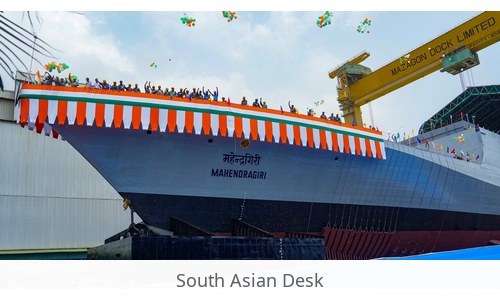
The INS Mahendragiri commissioning marks a significant milestone in India’s naval history, as the sixth ship of the Nilgiri-class under Project 17A is set to join the Indian Navy on July 11, 2026. This event underscores India’s strategic focus on maritime security, which has grown in importance as global trade routes and regional geopolitics increasingly intersect with the Indian Ocean. The vessel, named after the Mahendragiri hills in Tamil Nadu, is the first warship to bear this name, reflecting a deliberate effort to integrate regional symbolism into India’s naval nomenclature.
INS Mahendragiri commissioning: Implications for Regional Naval Power
The addition of INS Mahendragiri to the Indian Navy’s fleet enhances its operational reach and technological edge in the Indian Ocean region. As a stealth frigate, the vessel is designed to operate in contested waters with reduced radar and thermal signatures, enabling it to conduct surveillance, anti-submarine warfare, and surface combat missions with greater discretion. This aligns with India’s broader maritime strategy, which emphasizes the protection of critical sea lanes of communication (SLOCs) that carry over 70% of global trade through the Indian Ocean. The ship’s capabilities are particularly relevant in the context of growing regional challenges, including the need to safeguard India’s Exclusive Economic Zone (EEZ) and counter potential threats from adversarial naval postures.
The INS Mahendragiri commissioning also reinforces India’s role as a key maritime power in South Asia, complementing its strategic partnerships with nations such as the United States, Japan, and Australia under frameworks like the Quad. While the dossier does not specify direct geopolitical rivalries, the vessel’s advanced systems are likely to contribute to India’s ability to project power and maintain a balance of influence in the region. This development comes amid heightened regional competition for maritime dominance, with neighboring countries also investing in modernizing their naval forces.
Significance of Project 17A
Project 17A represents a pivotal shift in India’s defense manufacturing landscape, aiming to reduce reliance on foreign suppliers and bolster domestic capabilities. The initiative builds on the earlier Project 17, which produced the first five Nilgiri-class frigates, but introduces several technological upgrades, including enhanced stealth features, improved radar systems, and more advanced weaponry.
The INS Mahendragiri commissioning signals progress toward achieving these goals. By localizing the production of complex warships, India aims to develop a robust defense industrial base, create high-skilled jobs, and reduce the financial burden of importing military hardware. The project is part of India’s long-term strategy to enhance self-reliance in defense, a goal formalized in the 2014 “Strategic Partnership” model and the 2020 “Atmanirbhar Bharat” (Self-Reliant India) initiative. This shift is critical as global supply chains face disruptions, and geopolitical tensions complicate the procurement of advanced defense systems.
Technological Advancements in INS Mahendragiri
INS Mahendragiri incorporates cutting-edge technologies that position it as a versatile asset for the Indian Navy. The frigate is equipped with a state-of-the-art radar system, likely the EL/M-2248 MF-STAR from Israel, which provides 360-degree coverage and enhanced target discrimination capabilities. This system is crucial for detecting and tracking both aerial and surface threats in complex maritime environments. Additionally, the ship is armed with the BrahMos supersonic cruise missile, a joint venture between India and Russia, which offers a potent strike capability against surface targets and coastal infrastructure.
The stealth features of INS Mahendragiri are designed to minimize its radar cross-section, making it harder to detect and track. This includes radar-absorbing materials on the hull and a reduced superstructure profile. The ship’s multi-role design allows it to perform a range of missions, from anti-submarine warfare to air defense, making it a flexible addition to the fleet. These capabilities are particularly relevant in the context of India’s growing emphasis on asymmetric warfare and the need to counter emerging threats such as unmanned aerial vehicles (UAVs) and cyber-enabled attacks on naval systems.
The integration of advanced sensors and weapons systems also reflects India’s commitment to modernizing its naval forces in line with global standards. As the Indian Navy expands its fleet to include aircraft carriers, submarines, and corvettes, vessels like INS Mahendragiri play a critical role in ensuring interoperability and operational effectiveness across different platforms.
Follow SouthAsianDesk on X, Instagram and Facebook for insights on business and current affairs from across South Asia.
Sources
- INS Mahendragiri, India’s 6th Stealth Frigate, To Join Navy Fleet On July 11 – ndtv.com
- Navy to commission indigenous stealth frigate Mahendragiri this week – indianexpress.com
Image: images.indianexpress.com