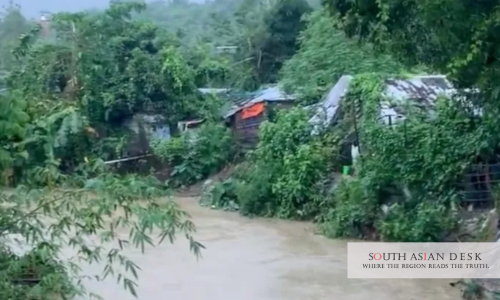
Rohingya camp landslides in southeastern Bangladesh have killed at least eight refugees, including women and children, after heavy monsoon rains triggered multiple slope collapses across the overcrowded settlements of Cox’s Bazar.
The landslides struck during the early hours of Monday, catching many families while they were asleep inside fragile shelters made of bamboo, tarpaulin and plastic sheeting. Local reports said the deaths occurred in Rohingya camps in Ukhiya, while another person was killed in a nearby landslide in Cox’s Bazar town, bringing the wider local death toll to nine.
Rescue teams, fire service personnel, police, camp volunteers and local authorities recovered bodies from beneath mud and debris as heavy rain continued to fall across the area. Several people were injured and taken to hospital.
The tragedy has again exposed the extreme vulnerability of the Rohingya refugee camps, where more than one million people live in dense settlements built across unstable, deforested hillsides.
Rohingya Camp Landslides Hit Families While They Slept
The landslides reportedly hit several locations across the camps, including Jamtoli, Kutupalong and Balukhali. In one incident, a shelter was buried after a hillside collapsed onto a family home. In another, several children were among those killed when mud and debris swept into camp blocks.
Officials said the landslides were caused by intense rainfall that weakened already unstable slopes. The camps are built on hilly terrain, and many shelters sit either on slopes or directly below them. During the monsoon season, even a short period of heavy rain can turn these areas into deadly risk zones.
For families who have already fled violence and persecution in Myanmar, the danger is painfully familiar. Every year, monsoon rains bring flooding, landslides, shelter collapses, disease risks and displacement inside the camps.
Why Cox’s Bazar Camps Are So Vulnerable
The Cox’s Bazar settlements are widely described as the world’s largest refugee camp complex. Most of the Rohingya living there fled Myanmar in 2017 after a military crackdown in Rakhine State. Years later, they remain in limbo, unable to safely return to Myanmar and largely dependent on humanitarian aid in Bangladesh.
The camps expanded rapidly after the refugee influx, often across forested hills that were cleared to make space for emergency shelters. Over time, overcrowding, soil erosion, deforestation and poor drainage have increased the risk of landslides.
Many shelters are not built to withstand extreme weather. Bamboo frames and plastic sheets offer limited protection during heavy rainfall, strong winds or slope movement. Families living at the foot of hills face the risk of being buried, while those living higher up face the danger of their shelters sliding downward.
The problem is not only natural. It is also structural. The camps were never designed as long-term urban settlements, yet they have effectively become one. Narrow paths, limited drainage, restricted space and funding shortages make large-scale safety improvements difficult.
Bangladesh Monsoon Rains Increase Disaster Risk
Bangladesh’s monsoon season regularly brings heavy rainfall between June and September. In Cox’s Bazar, the risk is especially severe because rain falls on steep, exposed slopes and densely packed shelters.
Officials warned that continued rainfall could trigger more landslides and flash floods. The Bangladesh Meteorological Department forecast further heavy rain in the region, prompting authorities and aid groups to remain on alert.
Local administrations have used loudspeakers and community networks to urge families in high-risk areas to move to safer locations. Some learning centres and other camp facilities have been prepared as temporary shelters for displaced families.
Authorities have also been relocating refugees from landslide-prone areas. However, relocation is complicated by limited land, overcrowding and the reluctance of some families to leave community networks, food distribution points, schools or familiar blocks.
Humanitarian Funding Pressures Add to the Crisis
The latest deaths come at a time when the Rohingya humanitarian response is already under pressure. Aid agencies have repeatedly warned that funding shortfalls are affecting food, shelter, healthcare, education and disaster preparedness inside the camps.
Slope stabilisation work, drainage improvements and shelter reinforcement require continuous funding. When budgets shrink, preventive work slows down. That leaves more families exposed when the monsoon arrives.
The camps also face wider pressures from insecurity, limited access to livelihoods, poor infrastructure and renewed conflict in Myanmar’s Rakhine State. Recent fighting across the border has raised fears of further displacement, while Bangladesh continues to carry the burden of hosting one of the world’s largest refugee populations.
A Recurring Disaster for Rohingya Refugees Bangladesh Hosts
The deaths in the latest landslides are not an isolated event. Flooding and landslides have repeatedly killed refugees and damaged shelters in Cox’s Bazar over the years.
For the Rohingya, the camps are both a place of refuge and a place of continuing danger. They escaped violence in Myanmar, but many now live in conditions where ordinary seasonal rains can become fatal.
The latest incident underlines the need for stronger disaster risk reduction in the camps. That includes safer relocation options, reinforced shelters, slope protection, improved drainage, early warning systems and sustained humanitarian funding.
It also highlights the need for a durable political solution. As long as Rohingya refugees remain confined to overcrowded camps without safe repatriation, legal status or long-term resettlement options, each monsoon season will bring another cycle of fear.
Landslides Show the Cost of a Prolonged Refugee Crisis
The Rohingya camp landslides are a reminder that humanitarian emergencies do not end when the first wave of violence passes. For many refugees in Bangladesh, displacement has become a long-term condition marked by fragile housing, restricted movement, uncertain futures and constant exposure to disaster.
The immediate priority is rescue, medical care, relocation and protection from further landslides. But the larger question remains unresolved: how to protect more than one million people living in one of the world’s most climate-vulnerable refugee settlements.
Without stronger support, the camps will remain dangerously exposed. And for families already carrying the trauma of displacement, the monsoon will continue to bring not relief, but fear.
Published in SouthAsianDesk, July 7, 2026
Follow SouthAsianDesk on X, Instagram and Facebook for insights on business and current affairs from across South Asia.