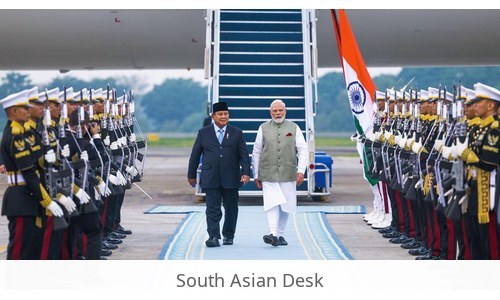
On July 6, 2026, Prime Minister Narendra Modi expressed gratitude for the welcome gesture from President Prabowo Subianto upon his arrival in Indonesia, marking the start of discussions aimed at enhancing India’s Act East Policy through bilateral partnerships.
India Act East Policy: Strengthening Bilateral Relations
PM Modi’s agenda during the visit includes deepening collaborations across sectors such as trade, infrastructure, and maritime security. Discussions with President Subianto are expected to focus on expanding economic ties and aligning strategic interests in Southeast Asia. Potential agreements may include joint ventures in renewable energy, digital connectivity, and defense cooperation, reflecting India’s commitment to regional integration. The Act East Policy, a successor to the earlier Look East Policy initiated in 1991, underscores India’s strategic pivot toward Southeast Asia, emphasizing economic corridors, cultural exchanges, and security partnerships. This visit builds on previous high-level engagements, including the 2023 India-Indonesia Joint Statement on Maritime Cooperation, which outlined shared interests in safeguarding freedom of navigation and countering illegal fishing in the South China Sea.
Historical Context of India-Indonesia Relations
India and Indonesia have shared historical ties dating back to pre-colonial times, with cultural and religious exchanges forming the foundation of their relationship. The spread of Hinduism and Buddhism from the Indian subcontinent to the Indonesian archipelago during the first millennium CE established early links between the two nations. Modern diplomatic engagement has accelerated since the 2010s, with both nations recognizing the importance of multilateralism in addressing regional challenges. The 2018 India-Indonesia Comprehensive Economic Partnership Agreement (CEPA) marked a milestone, aiming to boost bilateral trade to $100 billion by 2025 through reduced tariffs and streamlined customs procedures. However, trade volumes have lagged behind targets, with India’s exports to Indonesia primarily concentrated in pharmaceuticals, textiles, and IT services, while Indonesia’s exports to India include palm oil, coal, and nickel. This visit aims to build on past collaborations, such as the 2018 CEPA, to redefine future partnerships in a dynamic geopolitical landscape aligned with India’s Act East Policy.
Implications for Regional Security
Strengthening India-Indonesia ties aligns with New Delhi’s broader strategy to counterbalance China’s growing influence in Southeast Asia. By deepening defense and maritime cooperation, India seeks to reinforce its role as a key security partner in the Indo-Pacific. Analysts note that this visit could also influence ASEAN dynamics, as Indonesia’s leadership in the regional bloc provides a platform for India to advance its vision of a free and open Indo-Pacific. The two nations have already engaged in joint naval exercises, including the 2024 “Samudra Shakti” drills in the Bay of Bengal, which tested anti-submarine warfare and maritime domain awareness capabilities. Additionally, Indonesia’s strategic location as a gateway to the Malacca Strait—through which 30% of global maritime trade passes—makes it a critical node in India’s maritime security architecture. The visit may also explore avenues for joint infrastructure projects under the India-ASEAN Connectivity Vision 2025, including upgrades to ports and digital corridors.
Regional Economic Integration and Trade Prospects
The economic dimension of the visit is pivotal, as both nations seek to unlock untapped potential in trade and investment. Indonesia’s status as the world’s largest archipelago and a key player in the ASEAN Economic Community positions it as a strategic partner for India’s “Neighbourhood First” policy. Recent data from the Indian Ministry of Commerce indicates that bilateral trade reached $14.2 billion in 2025, a 12% increase from the previous year, though still below the CEPA’s aspirational targets. Key sectors for expansion include renewable energy, where India’s expertise in solar technology could complement Indonesia’s vast geothermal resources. Defense cooperation is another focal area, with India’s Make in India initiative offering opportunities for co-production of defense equipment, such as the BrahMos supersonic cruise missile. Additionally, the two nations are exploring digital connectivity projects, including the India-Indonesia Digital Corridor, which aims to enhance e-commerce and cross-border data flows.
Follow SouthAsianDesk on X, Instagram and Facebook for insights on business and current affairs from across South Asia.
Sources
- PM Modi begins Indonesia visit aimed at strengthening India’s Act East Policy – thehindu.com
- Video: F-16 And Sukhoi-30 Welcome PM Modi’s Aircraft In Indonesian Airspace – ndtv.com
Image: th-i.thgim.com