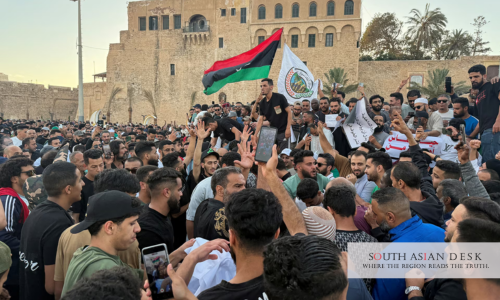
Pakistan Libya mediation has reportedly begun quietly as rival eastern and western power centres in Libya explore a possible deal to reunify the country after years of political fragmentation, foreign interference and failed transition efforts.
The reported initiative marks another attempt by Islamabad to position itself as a diplomatic intermediary beyond South Asia, following its recent role in mediation linked to US-Iran talks. Pakistani sources cited in reports said the effort began late last year and that both Libyan sides had requested Pakistan’s involvement.
The talks are said to be taking place against the backdrop of a broader US-backed diplomatic push to resolve Libya’s long-running split. Saudi Arabia is also reportedly supporting the initiative, while Qatar and Turkiye are said to have encouraged Pakistan’s involvement.
However, the process remains uncertain. Libyan politics has repeatedly frustrated international mediation, with disputes over elections, oil revenue, armed groups, foreign patrons and institutional control derailing previous attempts at unity.
Pakistan Libya Mediation and the Proposed Unity Framework
The reported Libya Reunification Plan would create a 36-month transitional arrangement under a new Government of National Consensus and Presidential Council.
Under the proposal, Abdulhamid Dbeibah, head of the western-based and UN-recognised Government of National Unity, would serve as prime minister. Saddam Haftar, deputy commander of the eastern-based Libyan National Army, would become chairman of the Presidential Council.
The plan would also give significant budget authority to the faction led by Saddam Haftar’s father, Khalifa Haftar, the commander of the Libyan National Army. Haftar’s eastern camp controls major oilfields and key infrastructure, giving it leverage in any national settlement.
One Pakistani source cautioned that the proposal was still being discussed in detail. That caveat matters because Libya’s unity talks have often produced frameworks that struggled to survive contact with political realities on the ground.
Why Libya Remains Divided
Libya has been divided between rival administrations since the years following the 2011 NATO-backed uprising that toppled Muammar Gaddafi. Instead of producing a stable national transition, the post-Gaddafi period led to competing governments, armed coalitions and foreign-backed power centres.
The western administration in Tripoli is internationally recognised, while the eastern camp is aligned with Khalifa Haftar’s Libyan National Army. Both sides have built political, military and financial networks that are difficult to merge.
The country’s oil wealth is central to the problem. Libya has some of Africa’s largest oil reserves, and control over oilfields, export terminals and revenue distribution remains one of the biggest obstacles to reunification.
Any national deal would have to settle who controls the budget, who commands security forces, how elections are organised and how rival institutions are merged. Those are not technical details. They are the core of Libya’s power struggle.
Why Pakistan Is Involved
Pakistan is not usually seen as a primary player in Libya, where the United States, Turkiye, the United Arab Emirates, Egypt and other regional actors have long competed for influence.
However, Pakistan may have one advantage: it has maintained lines of contact with both sides. That could make Islamabad useful as a secondary mediator or guarantor, particularly if larger powers struggle to speak credibly to all factions.
Pakistan’s recent diplomatic visibility has also grown. Its reported role in US-Iran mediation has been credited by US officials, and Islamabad appears keen to build on that momentum.
A Pakistani source reportedly said the United States was fully aware of and involved in Pakistan’s Libya role. The effort is also said to have Saudi backing, which is significant because Pakistan and Saudi Arabia strengthened defence ties last year and Riyadh has its own interests in Libya.
Asim Munir Meeting and Haftar Link
Pakistan’s army chief, Asim Munir, met Saddam Haftar in Rawalpindi last month. Days later, Haftar travelled to Washington and met US Secretary of State Marco Rubio.
The US State Department said at the time that Rubio welcomed efforts by Libyan leaders to overcome divisions and reaffirmed Washington’s support for Libyan unity.
The sequence of meetings suggests that Pakistan’s role may be connected to a wider diplomatic track involving Washington and regional partners. Still, the exact extent of coordination between Pakistan, the US, Saudi Arabia, Qatar, Turkiye and other stakeholders remains unclear.
Pakistani officials have also previously explored defence ties with the eastern-based Libyan National Army, including possible sales of JF-17 fighter jets and Super Mushshak trainer aircraft. Any such defence relationship would be sensitive because Libya remains subject to a UN arms embargo.
At the same time, the western-based Government of National Unity has also reportedly sought direct talks with Pakistan, which may explain why Islamabad is being treated as a possible bridge between rival camps.
The Role of Foreign Powers
Libya’s conflict has never been purely domestic. Foreign governments have backed rival factions, supplied political support, shaped military balances and competed for strategic influence.
Turkiye is one of the strongest backers of the Tripoli-based Government of National Unity. Egypt and the UAE have historically held influence with the eastern camp. The United States has tried to push for a political solution, while other regional players have sought to protect their own strategic and economic interests.
This makes any unity plan extremely difficult. A deal between Libyan factions must also be acceptable, or at least tolerable, to outside powers that have invested in the conflict.
Pakistan’s involvement could be useful if it is seen as less threatening than some of the bigger players. But it could also be limited by the fact that Islamabad does not hold the same level of direct leverage over Libya’s armed and political actors.
Why the 36-Month Plan Could Face Resistance
The proposed 36-month transition may offer a temporary compromise, but it could face several problems.
First, Libya has already seen transitional arrangements drag on without producing elections or stable governance. Many Libyans may be sceptical of another interim formula that delays final political settlement.
Second, the distribution of posts could be controversial. Giving Dbeibah the premiership and Saddam Haftar the Presidential Council chairmanship might balance the two camps on paper, but it could also provoke opposition from rival politicians, armed groups and civil society actors who feel excluded.
Third, control of the budget is explosive. If Khalifa Haftar’s camp receives major authority over national finances, opponents may see it as rewarding military leverage and control over oil infrastructure.
Fourth, Libya’s armed groups are not always fully controlled by formal political leaders. Even if senior figures agree, militias and local power brokers could disrupt implementation.
What Pakistan Could Gain
If Pakistan helps broker even a limited Libya deal, it would strengthen Islamabad’s diplomatic profile at a time when it is trying to present itself as a regional and international mediator.
Successful mediation would show that Pakistan can play a role in conflicts beyond its immediate neighbourhood and beyond traditional security alignments. It could also deepen Pakistan’s ties with the US, Saudi Arabia, Qatar and Turkiye, all of whom matter to Islamabad’s foreign policy and economic interests.
There may also be a strategic calculation. Pakistan has been trying to build defence, diplomatic and economic links across the Middle East and North Africa. Libya, with its oil wealth and reconstruction needs, could become a future market if stability improves.
But the risks are also real. If the process fails, Pakistan could be seen as overextending itself in a highly complex conflict. If it appears too close to one Libyan faction, it could damage its ability to act as a neutral intermediary.
Libya’s Unity Push Remains Fragile
Analysts have warned that there is no guarantee any signed agreement would hold. Libya has a long record of negotiated frameworks that collapsed because the underlying balance of power did not change.
A unity plan must do more than allocate titles. It must answer hard questions about security command, revenue sharing, institutional legitimacy, elections and foreign interference. Without those answers, a 36-month transition could simply postpone the next crisis.
There is also the issue of public legitimacy. Libyans have repeatedly protested against political elites who appear more interested in preserving power than delivering elections, services and stability. Any deal that looks like a closed-door bargain between entrenched figures could face resistance.
A Test for Pakistan’s New Diplomatic Ambition
Pakistan Libya mediation, if it advances, would be a notable development in Islamabad’s foreign policy. It would suggest that Pakistan is trying to move from reactive diplomacy to a more active role in conflict mediation across the Muslim world and beyond.
The opportunity is clear. Libya needs a political settlement, foreign powers need a workable formula, and Pakistan may have enough access to both camps to help keep talks alive.
But the challenge is equally clear. Libya’s divisions are deep, its institutions fractured and its foreign alignments complicated. Pakistan can help facilitate talks, but it cannot alone resolve the disputes that have kept Libya divided for more than a decade.
For now, the reported mediation effort should be treated as an early and uncertain diplomatic track. If it produces a credible transition framework, it could raise Pakistan’s profile and give Libya another chance at political reunification. If it fails, it will join a long list of attempts that underestimated how difficult Libya’s conflict remains.
Published in SouthAsianDesk, July 7, 2026
Follow SouthAsianDesk on X, Instagram and Facebook for insights on business and current affairs from across South Asia.