Lawrence Bishnoi indictment allegations have placed the jailed Indian gang leader and his alleged deputy, Satinderjeet Singh, also known as Goldy Brar, at the centre of a United States case over the 2023 killing of Canadian Sikh activist Hardeep Singh Nijjar.
A federal indictment unsealed in Los Angeles alleges that Bishnoi and Brar ordered the fatal shooting of Nijjar outside a Sikh temple in Surrey, British Columbia, on June 18, 2023. Nijjar, a Canadian citizen and Sikh separatist figure, had campaigned for Khalistan, a proposed independent Sikh homeland. India had designated him a terrorist, while his supporters described him as a political and religious activist.
The indictment does not allege any role by the Indian government in the killing. It instead frames the case as part of a wider investigation into India-based transnational organised crime groups accused of racketeering, extortion, drug trafficking, targeted violence and other offences across multiple countries.
Lawrence Bishnoi indictment alleges jail-based direction
The Lawrence Bishnoi indictment alleges that Bishnoi directed criminal activity from prison in India using contraband mobile phones and internet-based communication devices. Prosecutors say he presided over a criminal enterprise that operated across India, North America and other regions.
According to the indictment, Bishnoi allegedly provided a co-conspirator with a photograph of Nijjar and multiple addresses to facilitate the attack. Brar, described as Bishnoi’s childhood friend and North American leader of the alleged organisation, is accused of helping direct the group’s activities outside India.
The group is referred to by US authorities as the Lawrence Bishnoi Organized Crime Group. Prosecutors allege that it used violence, intimidation and high-profile attacks to create fear among Indian diaspora communities and to support extortion schemes.
Bishnoi is currently imprisoned in India. Brar has not been apprehended and is being treated as a fugitive. US authorities have also identified wider networks allegedly linked to Bishnoi and other India-based criminal syndicates.
Nijjar murder case widened diplomatic tensions
The Nijjar murder case triggered a major diplomatic crisis between Canada and India. Months after the killing, then Canadian Prime Minister Justin Trudeau said Canadian authorities were pursuing credible allegations of a potential link between Indian government agents and Nijjar’s death.
New Delhi strongly rejected the allegation. The dispute led to diplomatic expulsions, strained political ties and deepened tensions over Sikh separatist activism in Canada, which India has long viewed as a security concern.
The new US indictment is significant because it moves the case into a broader criminal prosecution framework. However, it does not support or repeat Canada’s earlier allegation of Indian state involvement. US officials at the Los Angeles press conference did not allege that the Indian government was involved in or aware of the killing.
Canadian authorities had previously arrested and charged four Indian nationals in connection with Nijjar’s killing. The US indictment does not name the alleged shooters as defendants, instead referring to them as co-conspirators.
Operation Hard Ball targets organised crime networks
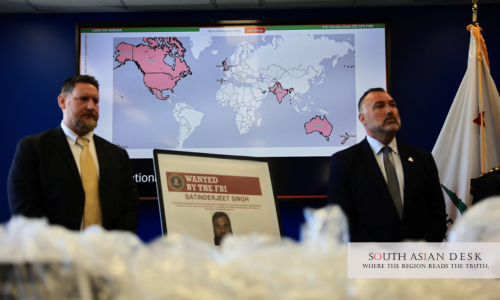
The charges against Bishnoi and Brar were part of a wider enforcement action known as Operation Hard Ball. US authorities said the operation targeted three India-based transnational organised crime groups and resulted in charges against 37 defendants across three indictments.
Officials said 24 people were arrested or were already in custody across the United States, Canada and Europe. Law enforcement was also searching for fugitives in the United States, India and Europe.
The Justice Department said the investigation involved allegations of racketeering, targeted killings, shootings, extortion, drug trafficking, firearms offences, human smuggling and other crimes. Authorities also said they seized about 1,000 kilograms of cocaine, one kilogram of heroin, cash and firearms.
US officials described the operation as an example of international cooperation among agencies in the United States, Canada, Europe and Asia. The investigation involved the FBI, Los Angeles police, the Royal Canadian Mounted Police and several other law enforcement partners.
Transnational organised crime concerns grow
The Lawrence Bishnoi indictment highlights growing concerns over transnational organised crime networks with links to South Asian diaspora communities. US prosecutors allege that the groups used violence and threats to target individuals in the United States, Canada and elsewhere.
The indictment claims the Bishnoi group routinely targeted prominent religious, social and political figures with violence. Authorities allege that such acts were used to intimidate communities and strengthen the group’s ability to extort money.
The case also includes allegations that criminal leaders continued to direct operations while incarcerated. Prosecutors say Bishnoi used smuggled communication devices from prison, while at least one other defendant in a related case allegedly attempted to organise criminal activity while in immigration detention.
These allegations raise difficult questions for law enforcement agencies across jurisdictions. Criminal networks that operate across borders can exploit gaps between legal systems, communication platforms and enforcement capabilities. The case also shows how diaspora communities can become targets of threats, extortion and political violence linked to overseas disputes.
India Canada relations remain sensitive
The indictment arrives at a delicate time for India Canada relations. Bilateral ties have shown signs of improvement under Canadian Prime Minister Mark Carney, who has sought to restore diplomatic engagement with New Delhi and reopen trade discussions.
That reset has drawn criticism from some Sikh groups, which argue that Canada should take a stronger stance on foreign interference and threats against Sikh activists. The Nijjar case remains a sensitive issue within Canada’s Sikh community, particularly in British Columbia, where Nijjar was active.
For India, the case touches on long-standing concerns about Khalistan activism abroad. Indian officials have repeatedly accused foreign governments of tolerating extremists and separatist activity, while diaspora groups have argued that peaceful political expression should not be conflated with terrorism.
The US indictment does not resolve those political disputes. It does, however, adds a criminal prosecution track to a case that has already affected diplomacy, diaspora politics and law enforcement cooperation.
Legal process now moves forward
The Lawrence Bishnoi indictment remains an allegation, and all defendants are presumed innocent unless proven guilty in court. Prosecutors will have to establish the charges through evidence, including communications, witness testimony, financial records and links between alleged conspirators.
If convicted, many of the defendants charged in the wider operation could face lengthy prison terms, including potential life sentences for some offences. The seriousness of the charges reflects the scale of the alleged criminal activity and the cross-border nature of the investigation.
The case is likely to be watched closely in India, Canada and the United States. It involves a high-profile killing, a jailed Indian gang leader, a fugitive alleged deputy, and a diplomatic dispute that strained relations between two major democracies.
For now, the indictment has shifted attention from broad political claims to specific criminal allegations. Its central claim is that Bishnoi and Brar allegedly ordered the killing of Hardeep Singh Nijjar as part of a wider pattern of organised criminal violence. Whether prosecutors can prove that case will now be tested in court.
Published in SouthAsianDesk, July 9, 2026
Follow SouthAsianDesk on X, Instagram and Facebook for insights on business and current affairs from across South Asia.