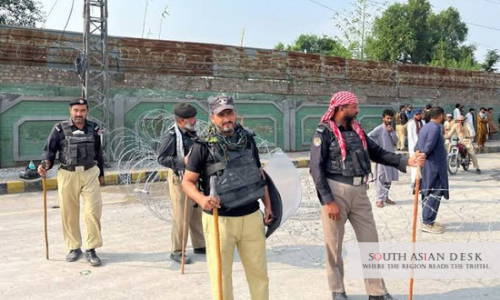
Balochistan attacks have killed 42 police and army personnel in three militant incidents since July 6, Pakistan’s military said on Wednesday, marking one of the deadliest recent escalations in the southwestern province.
The military said 54 militants were also killed during the incidents and subsequent operations. The attacks have again drawn attention to the deteriorating security environment in Balochistan, where separatist groups and other armed networks have repeatedly targeted security forces, public infrastructure and civilians.
The latest violence comes amid a wider rise in attacks across Pakistan’s western regions, including Balochistan and Khyber Pakhtunkhwa. Islamabad has blamed militant sanctuaries and hostile external support for the increase in violence, allegations denied by neighbouring governments.
Balochistan attacks deepen pressure on security forces
Balochistan attacks have placed renewed pressure on Pakistan’s security forces as the military conducts follow-up operations across difficult terrain. The province’s geography, long borders with Afghanistan and Iran, and scattered population centres make counterterrorism operations complex and resource intensive.
The military’s statement indicated that the latest attacks were not isolated incidents but part of a concentrated wave of violence over several days. Officials said the security response had resulted in the killing of 54 militants, although independent verification of battlefield claims in the region is often difficult.
Security personnel in Balochistan have faced repeated attacks on checkpoints, convoys and police posts. Militants have also targeted infrastructure linked to state authority and economic projects, including transport networks and installations associated with the China-Pakistan Economic Corridor.
The heavy toll reported this week is likely to intensify calls for stronger intelligence coordination, improved protection of isolated posts and a more sustained security presence in vulnerable districts.
Ziarat attack highlights abduction risk
One of the recent incidents involved police personnel in the Ziarat area, where militants attacked a police post and abducted officers, according to reports citing the military. The killing of abducted personnel has added to concerns about the vulnerability of police and levies units stationed in remote areas.
Police forces in Balochistan often operate with fewer resources than the army and paramilitary formations. Their posts can be exposed, especially in mountainous districts where militants may have the advantage of local terrain and mobility.
The Ziarat incident is particularly significant because abductions can be used to pressure authorities, extract propaganda value and demonstrate militant reach. Such tactics also create fear among local communities and complicate the state’s ability to maintain routine law enforcement.
For Pakistan, strengthening civilian policing in Balochistan remains essential. Reliance on military-led operations alone may contain immediate threats, but long-term stability requires better local policing, intelligence gathering and community trust.
Balochistan militants continue high-impact attacks
Balochistan militants have carried out increasingly high-impact attacks in recent years. The Balochistan Liberation Army and other separatist groups have claimed responsibility for several major operations, while the Pakistani Taliban and affiliated networks have also been active in parts of the province.
Separatist groups say they are fighting for greater autonomy and control over local resources. Pakistani authorities describe them as terrorist organisations and accuse them of receiving external support. India has repeatedly denied Pakistan’s allegations that it backs militant activity in Balochistan.
The province has long been affected by a mixture of separatist insurgency, sectarian violence, criminal networks and cross-border militancy. This has created a security landscape that is more complex than a single insurgent movement.
The latest Balochistan attacks show that militant groups remain capable of coordinated violence despite repeated security operations. They also suggest that the threat is not confined to one district or one type of target.
Counterterrorism operations likely to expand
Pakistan’s security response is likely to expand after the reported killing of 42 police and army personnel. Counterterrorism operations in Balochistan typically involve the army, Frontier Corps, police and intelligence agencies, with operations focused on suspected militant hideouts, supply routes and support networks.
The military has said it will continue pursuing those involved in the attacks. Such operations may produce further militant casualties, but they also carry risks for civilians if fighting moves into populated or contested areas.
Human rights concerns have long surrounded the security situation in Balochistan. Rights groups, local activists and political figures have repeatedly raised concerns about enforced disappearances, extrajudicial violence and restrictions on political activity. The state, meanwhile, argues that it is confronting armed groups responsible for killings, sabotage and attacks on civilians.
This tension complicates the security response. A purely coercive strategy may weaken militant capabilities in the short term, but it may not address the political grievances and local alienation that have helped sustain unrest in parts of the province.
Regional security concerns remain high
The latest Balochistan attacks also have regional implications. Pakistan has repeatedly said that militant groups operate from sanctuaries across the border in Afghanistan, an allegation denied by the Taliban administration in Kabul.
Relations between Pakistan and Afghanistan have remained tense over cross-border militancy, refugee policy and border security. These tensions have created additional pressure on Pakistan’s western security posture.
Balochistan’s location also gives the province strategic importance. It borders Iran and Afghanistan and includes Gwadar, a port city central to Pakistan’s regional connectivity ambitions. Persistent insecurity in the province can therefore affect not only law and order, but also investment, transport routes and regional trade.
The security situation is also relevant for China, which has significant interests in projects linked to the China-Pakistan Economic Corridor. Chinese nationals and projects have previously been targeted by militants, prompting Beijing to press Islamabad for stronger protection.
Latest violence tests Pakistan’s security policy
The latest Balochistan attacks will test Pakistan’s ability to combine immediate security operations with a wider political and administrative strategy. The killing of security personnel will almost certainly trigger intensified operations, but the durability of any response will depend on more than the number of militants killed.
Sustained stability will require better intelligence, stronger policing, protection of vulnerable communities and a political approach that addresses long-standing grievances in the province. Without those elements, militant groups may continue to exploit local resentment, difficult terrain and gaps in governance.
For now, Pakistan’s military is presenting the latest violence as part of a coordinated militant campaign that has been met with a forceful security response. The reported killing of 42 police and army personnel, alongside 54 militants, underscores the scale of the confrontation.
Balochistan has seen cycles of violence before, but the latest attacks show that the province remains one of Pakistan’s most serious internal security challenges. The coming days will indicate whether the state can contain the immediate threat while preventing a wider deterioration in the province’s security environment.
Published in SouthAsianDesk, July 9, 2026
Follow SouthAsianDesk on X, Instagram and Facebook for insights on business and current affairs from across South Asia.