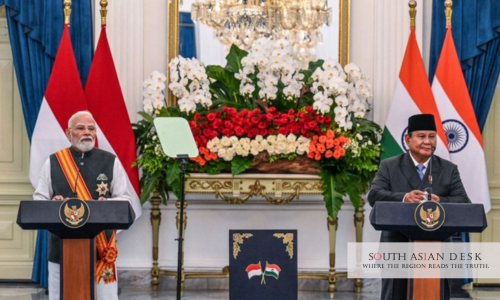
Ganga-Mahakam Vision has been presented by Indian Prime Minister Narendra Modi as a new framework for India-Indonesia relations, placing civilisational ties, shared development, maritime cooperation and the voice of the Global South at the centre of future engagement.
Modi outlined the proposal during his address to the Indonesian Parliament in Jakarta on Tuesday, becoming the first Indian Prime Minister to address the legislature. The speech formed part of his state visit to Indonesia, where he held talks with President Prabowo Subianto and sought to deepen cooperation across defence, trade, technology, culture and regional security.
The framework draws its name from the Ganga River in India and the Mahakam River in Indonesia. Modi used the symbolism of the two rivers to argue that the countries’ historical links should now be converted into a forward-looking strategic and developmental partnership.
Ganga-Mahakam Vision sets five-point roadmap
Ganga-Mahakam Vision is structured around five broad areas: civilisational connect, shared development, security and strategic trust, maritime prosperity, and a stronger voice for the Global South.
The first element focuses on cultural and historical links between India and Indonesia. Modi referred to the long interaction between the two societies through maritime routes, religious traditions, trade, language and shared heritage. He called for these ties to be brought closer to younger generations through structured engagement.
The second pillar, shared development, connects India’s Viksit Bharat 2047 vision with Indonesia’s Golden Indonesia 2045 ambition. Both countries are seeking to become advanced economies in the coming decades, and the proposed framework seeks to align their development goals through trade, investment, technology and capacity building.
Security and strategic trust form the third pillar. India and Indonesia are both major democracies with important maritime interests in the Indo-Pacific. Modi said the two sides should expand cooperation against terrorism, cyber threats, maritime challenges and emerging security risks.
The fourth area, maritime prosperity, reflects the importance of the Indian Ocean and Indo-Pacific sea lanes. The fifth pillar seeks closer coordination by India and Indonesia in representing the priorities of the Global South in international forums.
Modi Indonesia visit broadens strategic cooperation
Modi’s Indonesia visit came at a time when both countries are looking to give new momentum to their Comprehensive Strategic Partnership, which was elevated in 2018.
During the visit, India and Indonesia signed several agreements covering defence, critical minerals, agriculture, steel, digital cooperation and cultural engagement. These agreements indicate that the relationship is moving beyond symbolism and into areas with direct economic and strategic value.
Defence cooperation emerged as one of the most closely watched areas. Indonesia and India concluded arrangements linked to the BrahMos cruise missile system and air-to-air missile cooperation. The deals signal growing defence industrial engagement between the two countries and reflect wider efforts by India to expand strategic partnerships in Southeast Asia.
The two countries also agreed to strengthen supply chains in critical minerals and steel. This is important because both economies are seeking to secure access to raw materials required for industry, clean energy and advanced manufacturing.
Maritime security remains central to India Indonesia relations
Maritime security is a central part of India Indonesia relations because of geography. Indonesia sits astride some of the world’s most important sea lanes, including routes connected to the Strait of Malacca, while India’s Andaman and Nicobar Islands lie close to key maritime chokepoints.
Modi’s address placed the sea at the centre of the bilateral relationship, arguing that maritime geography should be transformed into shared prosperity. The focus on maritime cooperation includes connectivity, logistics, the blue economy, maritime security and trade resilience.
For India, stronger ties with Indonesia support its Act East policy and its wider Indo-Pacific approach. For Indonesia, the partnership offers another channel for defence, economic and maritime cooperation while maintaining its long-standing preference for strategic autonomy.
The two countries have also shown interest in cooperation around Sabang and the broader eastern Indian Ocean. Such connectivity projects could support trade, logistics and security coordination, although implementation will require sustained political and commercial follow-through.
Global South agenda gains prominence
The Ganga-Mahakam Vision also places the Global South at the centre of India-Indonesia cooperation. Modi highlighted Indonesia’s G20 presidency in 2022 and India’s G20 presidency in 2023 as examples of both countries seeking to amplify the priorities of developing economies.
This agenda is likely to remain important in forums such as the G20, ASEAN-linked platforms, BRICS and the United Nations. India has repeatedly called for reforms to global governance, including the United Nations Security Council, while Indonesia has traditionally played a prominent diplomatic role among developing countries.
Both countries are also large democracies with significant populations, growing economies and strategic weight in Asia. Their cooperation therefore carries significance beyond bilateral ties, particularly on issues such as trade resilience, climate finance, food security, technology access and maritime stability.
The Global South pillar also gives the partnership a wider political identity. It allows India and Indonesia to frame their cooperation not only as a regional arrangement, but also as part of a broader effort to make global institutions more representative.
Cultural diplomacy supports strategic message
Modi’s address also relied heavily on cultural diplomacy. He referred to shared civilisational links, the Ramayana tradition, Borobudur, Prambanan and centuries of maritime interaction between the two societies.
The visit included plans connected to the conservation and restoration of the Prambanan temple complex, a UNESCO World Heritage Site. This cultural component reinforced the message that India and Indonesia are seeking to build modern cooperation on the basis of older historical and civilisational links.
Cultural references are particularly important in India-Indonesia relations because the two countries share a long history of religious, artistic and linguistic exchange. Indonesia is the world’s largest Muslim-majority country, but its historical landscape includes deep Hindu and Buddhist influences, which remain visible in sites such as Borobudur and Prambanan.
By placing heritage alongside defence, technology and trade, Modi sought to present the partnership as both strategic and civilisational. This framing is likely to remain central to India’s outreach in Southeast Asia.
Trade and technology cooperation likely to expand
India and Indonesia are also expected to push for stronger trade and technology cooperation. The two economies have significant complementarities: Indonesia is a major supplier of commodities such as palm oil and coal, while India is looking to expand manufacturing, digital infrastructure, defence exports and technology partnerships.
During the visit, both sides signalled interest in accelerating preferential trade discussions. This could help address trade barriers and widen commercial ties, although negotiations will need to balance sensitive domestic sectors in both countries.
Technology cooperation is another promising area. Digital public infrastructure, artificial intelligence, startups, healthcare, agriculture and education were among the areas highlighted during the broader engagement. These sectors could give the relationship a wider economic base beyond traditional commodity trade.
Critical minerals cooperation is especially relevant. As both countries move towards electric mobility, clean energy, batteries and advanced industrial production, secure mineral supply chains will become increasingly important.
Ganga-Mahakam Vision gives partnership a long-term frame
Ganga-Mahakam Vision gives India and Indonesia a long-term diplomatic framework at a time when both countries are trying to raise the ambition of their partnership. The proposal combines heritage, development, defence, maritime security and multilateral diplomacy into a single narrative.
The challenge will be implementation. India and Indonesia have often been described as natural partners, but the relationship has not always matched its potential. Trade, defence cooperation, connectivity and institutional engagement will need sustained attention if the new framework is to become more than a statement of intent.
Still, Modi’s address to the Indonesian Parliament marked a significant diplomatic moment. It placed Indonesia at the centre of India’s Indo-Pacific and Global South outreach, while giving the bilateral relationship a new vocabulary through the Ganga and Mahakam rivers.
For now, the Ganga-Mahakam Vision signals that New Delhi and Jakarta want to move beyond routine diplomacy. If followed by concrete projects, regular political engagement and stronger economic integration, it could become a defining framework for India-Indonesia relations in the years ahead.
Published in SouthAsianDesk, July 9, 2026
Follow SouthAsianDesk on X, Instagram and Facebook for insights on business and current affairs from across South Asia.