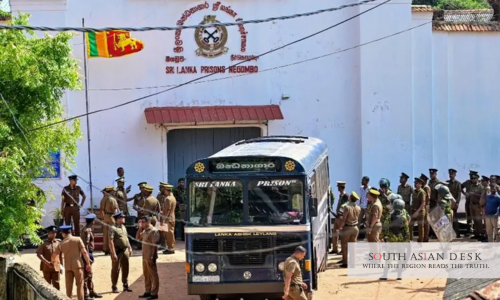
Sri Lanka prison overcrowding has pushed authorities to convert part of a disused hospital into a prison after a deadly riot at Negombo Prison exposed severe pressure inside the country’s detention system.
The Justice Ministry said a section of the unused Mahamodara hospital building in the southern Galle District would be taken over to house inmates transferred from other facilities. Justice Minister Harshana Nanayakkara ordered officials to prepare security arrangements and essential prison infrastructure at the site.
The decision follows one of Sri Lanka’s deadliest prison riots in years. The unrest at Negombo Prison, north of Colombo, began on Sunday and escalated on Monday, leaving dozens dead and more than 100 people wounded, according to official and media reports.
Sri Lanka prison overcrowding under renewed scrutiny
Sri Lanka prison overcrowding has become the central issue after the violence at Negombo. Official figures cited in reports show the country’s prison system is operating at several times its intended capacity, placing both inmates and guards under extreme strain.
The Negombo facility was especially overcrowded. Reuters reported that it held about 2,400 inmates despite having capacity for around 650. The Associated Press reported a similar figure, citing 2,600 prisoners at the facility, again against a capacity of 650.
The government’s decision to convert part of Mahamodara hospital into a prison is intended to ease pressure by creating additional space for inmate transfers. A ministry official said security measures and essential facilities must be established before the new prison can begin operating.
The move is a short-term response to a deeper structural problem. Sri Lanka’s prison population has risen sharply, while the capacity of the detention system has not kept pace. This has increased the risk of unrest, disease, poor sanitation and violence within overcrowded facilities.
Mahamodara hospital prison to receive transferred inmates
The planned Mahamodara hospital prison will be located in Galle District in southern Sri Lanka. Authorities have selected a disused section of the hospital building to accommodate inmates from other prisons.
Officials have not provided a specific timeline for opening the facility. Before it can be used, the building will need security infrastructure, prison staff, basic services, medical arrangements, accommodation areas and controls to prevent contraband and violence.
Using a former hospital building may offer immediate space, but it also raises implementation questions. A prison requires different infrastructure from a medical facility, including secure cells, controlled entry and exit points, surveillance systems, segregation areas and emergency response capacity.
The conversion may help reduce congestion in the short term, but it will not resolve the wider causes of prison overcrowding unless accompanied by broader reforms, including alternatives to imprisonment, faster case processing and better management of remand prisoners.
Negombo prison riot linked to drug smuggling dispute
The Negombo prison riot has been linked by Sri Lankan officials to a dispute over drug smuggling inside the jail. Nanayakkara told parliament that initial investigations suggested the clash began after some prisoners provided information to officials about attempts to smuggle drugs into the prison.
According to the minister, another group of inmates connected to the smuggling operation reacted violently, and the situation escalated when prison officers intervened. Reuters reported that inmates attacked guards with bricks and poles, while guards later opened fire in self-defence.
Authorities also said some inmates disabled CCTV cameras inside the prison. Investigators are examining how prisoners were able to obtain weapons and whether security lapses contributed to the scale of the violence.
The prison department transferred 734 inmates to other institutions after the riot in an effort to reduce congestion and restore order. Police, special forces and military personnel were deployed around the facility during and after the unrest.
Death toll reports differ after riot
Reports on the final death toll have varied. The Dhaka Tribune report, citing AFP, said the riot killed 20 inmates and eight guards. Reuters and the Associated Press reported a death toll of 26, including 19 inmates and seven prison officials.
The discrepancy reflects the difficulty of establishing casualty figures in the immediate aftermath of a major prison riot. What is clear is that the violence was among the deadliest prison incidents Sri Lanka has seen in recent years.
Dozens of injured inmates and prison staff were taken to hospital. Some reports said more than 100 people were wounded, while AP reported that 77 people were still being treated in hospitals after the clash.
The deaths of prison officers also prompted public mourning. Reuters reported that the bodies of seven prison officials were brought to Welikada Prison in Colombo, where colleagues and relatives gathered to pay their respects.
Prison reform debate intensifies
The riot has intensified debate over Sri Lanka prison reform. Human rights and prisoner welfare groups have long warned that overcrowded prisons, poor conditions and outdated detention practices create a dangerous environment.
The United Nations office in Colombo said after the riot that overcrowding, outdated practices and poor conditions have long been recognised as critical challenges in Sri Lanka’s prison system.
The issue has been worsened by drug enforcement operations and high levels of remand detention. EconomyNext reported that a Sri Lankan minister said the prison population had reached about 41,000, far above a system capacity of around 11,000.
This pressure affects all parts of the prison system. Overcrowding can make it harder to separate rival groups, prevent contraband, provide medical care and maintain order. It also increases the burden on guards, who must manage far more inmates than facilities were designed to hold.
House arrest and legal reforms under discussion
Sri Lanka is also considering legal reforms to reduce overcrowding. Reports indicate that the government plans to introduce measures such as a house arrest law, which could allow some offenders to serve sentences or restrictions outside prison under controlled conditions.
Such reforms could reduce pressure on detention facilities if applied carefully. Alternatives to imprisonment are often used for non-violent offenders, low-risk detainees or people awaiting trial, depending on the legal system.
However, alternative sentencing requires strong supervision, clear eligibility criteria and public confidence. Without proper safeguards, reforms may be criticised as weakening law enforcement. With proper safeguards, they can reduce congestion while allowing prisons to focus on higher-risk detainees.
The need for reform is urgent because simply creating more prison space may not be enough. If arrests continue to rise faster than capacity, new facilities may also become overcrowded.
Public safety and prisoner welfare both at stake
The Mahamodara hospital conversion shows the government is moving quickly to create additional space, but the wider challenge is balancing public safety with humane detention standards.
Prisons must protect society, but they must also protect inmates and staff. When facilities become severely overcrowded, the risk of violence rises for everyone inside. Guards become vulnerable, inmates become harder to manage and emergency response becomes more difficult.
The Negombo riot also shows how contraband networks can undermine prison security. Drug smuggling inside prisons can strengthen gangs, create internal conflicts and expose officers to intimidation or attack.
A credible response will require more than inmate transfers. It will require stronger contraband control, better surveillance, improved staff training, transparent investigations and reliable systems to separate rival groups.
Hospital conversion is only a temporary answer
Sri Lanka prison overcrowding cannot be solved only by converting a hospital into a prison. The move may provide immediate relief, but long-term stability will require a wider policy response.
Authorities will need to examine why the prison population has risen so sharply, whether remand prisoners are being held for too long, whether bail and case-management systems are functioning effectively, and whether drug-related arrests are overwhelming detention capacity.
The investigations into the Negombo riot will also be important. They must establish how the violence began, how it escalated, whether officers had adequate support, how inmates obtained weapons, and whether overcrowding made the clash harder to contain.
For now, the conversion of part of Mahamodara hospital into a prison signals that Sri Lanka is trying to respond quickly to a crisis. But the deeper lesson from Negombo is that overcrowding has become a security risk, a human rights concern and a governance failure.
Unless Sri Lanka combines emergency capacity with meaningful prison reform, the same conditions that helped make Negombo so dangerous could produce further unrest elsewhere.
Published in SouthAsianDesk, July 9, 2026
Follow SouthAsianDesk on X, Instagram and Facebook for insights on business and current affairs from across South Asia.