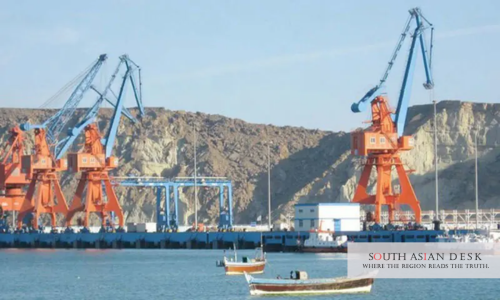
Gwadar Port bunkering operation has been completed successfully for the first time on a commercial basis, marking a significant step in Pakistan’s efforts to expand marine services and position the port as a more active regional trade and logistics hub.
The operation was carried out between July 9 and 11 through a joint effort involving the Gwadar Port Authority, National Logistics Cell, Gwadar International Terminals Limited and Vitol Asia. During the operation, the LNG carrier Enugu was supplied with 2,500 metric tonnes of very low sulphur fuel oil at Gwadar Port.
The vessel is jointly owned by QatarEnergy, Abu Dhabi National Oil Company and Vitol. The 285.4-metre-long carrier was refuelled by the bunker barge Marine Ista, with Pakistan Customs, port authorities and local shipping agent Pak Traders Gwadar involved in ensuring the operation was completed safely and efficiently.
Gwadar Port bunkering operation expands marine services
Gwadar Port bunkering operation is important because it expands the port’s role beyond cargo handling and vessel berthing. Bunkering, or ship refuelling, is a core maritime service at major ports because it allows international vessels to take on fuel during commercial voyages.
Until now, Gwadar has been promoted primarily for its strategic location, cargo potential and role under the China-Pakistan Economic Corridor. The successful commercial bunkering operation adds a practical service that can help attract more vessels, shipping agents and marine service providers.
Port authorities said the operation marks the formal launch of commercial bunkering services in Gwadar. If sustained, this could allow international vessels to use the port not only for cargo movement, but also for refuelling and related marine support.
That shift matters because modern ports compete on service depth as much as physical infrastructure. Shipping lines prefer ports where cargo handling, bunkering, customs processing, logistics support and vessel services can be coordinated efficiently.
VLSFO supply gives Gwadar a cleaner fuel service
The operation involved the supply of very low sulphur fuel oil, commonly known as VLSFO. The use of VLSFO is significant because global shipping has moved towards lower-sulphur marine fuels in response to tighter environmental rules and cleaner fuel requirements.
For Gwadar, the availability of VLSFO bunkering can help the port align with the requirements of international shipping operators that need compliant marine fuel. This can make the port more commercially useful for vessels operating across the Arabian Sea, the Gulf and regional trade routes.
The involvement of Vitol Asia also adds credibility to the operation. Vitol has already been active in Pakistan’s marine fuel market, including earlier large-scale VLSFO bunkering activity at Port Qasim and Karachi-linked operations. Gwadar’s entry into this service segment shows that Pakistan’s bunkering market is beginning to expand beyond its traditional port centres.
However, the development should be understood carefully. This is Gwadar Port’s first successful commercial bunkering operation. It is not Pakistan’s first-ever bunkering operation. The milestone lies in Gwadar’s ability to carry out the service and demonstrate that the port can support commercial marine refuelling activity.
Commercial bunkering could support Gwadar’s port activity
Commercial bunkering could help Gwadar increase vessel calls and generate new revenue streams. Ships that stop for refuelling may also require other services, including agency support, crew handling, technical assistance, spare parts, waste management and customs clearance.
This creates opportunities for port operators, logistics companies, fuel suppliers, customs agents and local service providers. Over time, regular bunkering activity could help build a wider marine services ecosystem around Gwadar.
The development may also support local employment if bunkering, port operations and associated logistics activity increase. Jobs could emerge in vessel handling, fuel operations, port services, transport, storage, documentation and safety support.
For Pakistan’s blue economy, the significance lies in diversification. Ports are not only gateways for imports and exports. They can also generate value through marine fuel supply, transhipment, ship repair, offshore services, logistics parks and coastal trade.
Gwadar’s ability to offer bunkering services could therefore strengthen its commercial proposition at a time when Pakistan is trying to make the port more operationally relevant.
CPEC vision tied to Gwadar’s operational progress
The successful bunkering operation aligns with the wider CPEC vision of developing Gwadar as a regional trade and energy hub.
Gwadar has long been presented as a key node in Pakistan’s connectivity strategy, linking maritime routes with inland transport corridors and potential access to Central Asia, western China and the broader region. However, the port’s progress has often been judged by whether it can move from infrastructure development to sustained commercial activity.
The latest operation is a practical step in that direction. It shows that Gwadar can support a specialised maritime service involving multiple public and private stakeholders, including customs authorities, port operators, logistics entities and an international energy company.
The port’s infrastructure has already been developed, with its berths operational. The challenge now is to generate consistent commercial use. Bunkering can help because it gives vessels another reason to call at Gwadar, even where cargo volumes remain limited.
Still, the long-term impact will depend on whether the port can attract repeat business. A single successful operation is important, but Gwadar will need regular vessel traffic, reliable fuel supply, efficient documentation, competitive pricing and strong safety standards to become a dependable bunkering location.
Regulatory structure important for future bunkering
The commercial launch of bunkering services at Gwadar comes as Pakistan has been moving to formalise rules for marine fuel supply operations.
The Federal Board of Revenue has issued Customs Marine Bunkering Rules, 2026, creating a framework for bunkering operations at Pakistani ports. The rules are intended to regulate fuel supply to vessels, licensing, customs documentation and monitoring.
Such regulation is important because bunkering involves fuel movement, customs controls, environmental safeguards and safety risks. Poorly regulated fuel supply can create revenue leakage, smuggling risks, pollution concerns and safety hazards.
For Gwadar, a clear regulatory structure can help build confidence among shipping companies and fuel suppliers. International operators need predictable procedures, transparent customs handling and reliable safety standards before they commit to repeated port calls.
If the regulatory framework is implemented effectively, it could support the growth of bunkering services not only at Gwadar, but also across Pakistan’s wider port system.
Marine services can strengthen Pakistan’s blue economy
The successful Gwadar Port bunkering operation gives Pakistan an opportunity to expand its marine services sector.
The country’s coastline and ports are important assets, but their economic potential depends on how effectively they are integrated into global and regional shipping networks. Marine services such as bunkering, ship handling, storage, repair and logistics can help increase port revenues beyond conventional cargo movement.
Gwadar’s location near major energy and trade routes gives it potential commercial value. However, location alone is not enough. The port must offer services that shipping companies need, at prices and standards that can compete with other regional ports.
Bunkering is one such service. If Gwadar can supply marine fuel reliably, vessels may consider it as part of their route planning. That could help build traffic and create opportunities for additional port activity.
The port’s success will also depend on supporting infrastructure, including road connectivity, customs efficiency, security, storage facilities, port management and coordination among federal and provincial authorities.
Gwadar still needs sustained commercial momentum
The latest development is a positive signal, but Gwadar still faces the larger challenge of building sustained commercial momentum.
The port has seen periodic cargo activity and official efforts to promote its role, but it has not yet reached the level of traffic needed to fully realise its economic potential. Security concerns in Balochistan, limited hinterland connectivity, competition from established ports and slow industrial development around Gwadar remain important challenges.
Bunkering can help address one part of the problem by adding a service that may attract ships independently of large cargo volumes. However, it will not by itself transform the port. Gwadar’s growth will require coordinated progress in logistics, industrial zones, trade routes, customs operations, local employment and investor confidence.
Authorities will also need to ensure that local communities benefit from port development. Gwadar’s long-term stability and commercial success are closely linked to local livelihoods, infrastructure, water supply, skills development and public trust.
Gwadar Port milestone points to wider maritime potential
Gwadar Port bunkering operation marks a useful milestone for Pakistan’s maritime sector. It shows that the port can execute a commercial ship refuelling operation involving a major international energy company, port operators, customs authorities and logistics partners.
The supply of 2,500 metric tonnes of VLSFO to the LNG carrier Enugu gives Gwadar a clearer role in Pakistan’s marine fuel and port services landscape. It also supports the broader ambition of making the port a regional trade and energy hub under CPEC.
The real test will be continuity. If more international vessels begin using Gwadar for bunkering and related services, the port could gradually strengthen its commercial profile and contribute more meaningfully to Pakistan’s blue economy.
For now, the operation is a practical achievement rather than a final breakthrough. It demonstrates capacity, builds confidence and expands the port’s service offering. Turning that milestone into regular maritime business will be the next challenge for Gwadar Port.
Published in SouthAsianDesk, July 12, 2026
Follow SouthAsianDesk on X, Instagram and Facebook for insights on business and current affairs from across South Asia.