

Islamabad MoU remains a viable diplomatic roadmap for de-escalation, Pakistan told the United Nations, as it urged all sides to uphold their commitments and avoid actions that could further undermine regional peace.
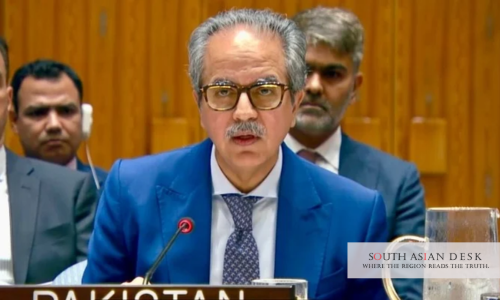
Pakistan’s Permanent Representative to the UN, Ambassador Asim Iftikhar Ahmad, made the remarks during a Security Council briefing on the implementation of Resolution 2231, amid renewed concern over US-Iran hostilities and the future of diplomatic efforts linked to the Iran nuclear issue.
Speaking at the briefing, Ahmad said the latest escalation was in no one’s interest and warned that any interruption in the diplomatic process would make it harder to resolve outstanding issues through negotiation.
Islamabad MoU described as viable roadmap
Islamabad MoU was described by Pakistan as a viable roadmap for continued dialogue, mutual understanding and regional stability.
Ahmad said all parties should uphold their respective commitments under the memorandum, which Pakistan sees as an enduring foundation for understanding, mutual respect and shared prosperity in the region and beyond.
The memorandum was reached last month as a 14-point interim arrangement between the United States and Iran. It was designed to halt hostilities and support the reopening of the Strait of Hormuz, a critical waterway for global energy trade.
Pakistan’s position is that the agreement should not be allowed to collapse because of renewed violence, public threats or diplomatic missteps. Islamabad has instead called for all efforts and energies to be directed towards implementation of the MoU.
Pakistan urges return to negotiations
Pakistan called on all parties to exercise restraint and refrain from any steps that could further damage regional peace and stability.
Ahmad said the cycle of violence and instability must end for the good of regional and international peace, security and prosperity. He added that there was no alternative to continued engagement, dialogue and diplomacy.
The statement came after US President Donald Trump said Washington and Tehran had agreed to continue talks, while also declaring that the ceasefire reached between the two sides last month was over.
Trump’s remarks followed renewed conflict during the week, including attacks on commercial tankers, US strikes on Iranian sites and Iranian strikes on US military sites in Gulf states.
Against that backdrop, Pakistan’s message at the UN was focused on preventing the diplomatic track from being overtaken by military escalation.
US-Iran hostilities raise regional risks
US-Iran hostilities have placed renewed pressure on regional security, energy markets and maritime traffic through the Strait of Hormuz.
The Strait of Hormuz is among the world’s most important energy chokepoints. Before the latest conflict, about a fifth of global oil supply passed through the waterway. Any disruption to shipping in the strait can affect global oil prices, inflation and energy security far beyond the Middle East.
Recent discussions have focused on securing safe passage for ships through the strait. Iran’s foreign minister and his Omani counterpart discussed possible mechanisms for safe passage, while Washington has sought a public assurance that attacks on shipping will stop and that all lanes will remain open without tolls.
The maritime issue is now central to the wider diplomatic crisis. Even if broader political and nuclear questions remain unresolved, safe commercial passage through the strait is an immediate priority for global markets and regional states.
Pakistan links de-escalation with nuclear diplomacy
Pakistan used the Security Council briefing to restate its support for peaceful resolution of all outstanding issues, including the Iran nuclear issue.
Resolution 2231 was adopted in 2015 to endorse the Joint Comprehensive Plan of Action, the international nuclear agreement involving Iran and major world powers. The current briefing gave Pakistan an opportunity to connect the latest military escalation with the broader need for nuclear diplomacy and sustained dialogue.
Ahmad warned that any break in the diplomatic process would complicate efforts to reach a mutually acceptable settlement. His remarks reflected Pakistan’s broader argument that military escalation cannot resolve the core issues between Washington and Tehran.
Instead, Islamabad is presenting the Islamabad MoU as a framework that can keep negotiations alive while reducing immediate risks to regional stability.
Mediators continue efforts to revive diplomacy
Regional mediators have continued efforts to prevent a wider escalation.
Qatari negotiators have held discussions with Iranian officials on de-escalation and the Strait of Hormuz. Oman has also remained involved, with talks focusing on safe shipping arrangements and possible technical mechanisms for navigation through the waterway.
A senior Iranian source said Iran, the United States, Qatar and Pakistan had agreed to negotiate in a call that mediators were trying to arrange while Iranian Foreign Minister Abbas Araqchi was in Oman. It was not immediately clear whether those efforts had succeeded.
Pakistan has said it remains ready to continue playing a constructive role. At the UN briefing, Ahmad said Pakistan and its partners had been engaged in diplomatic efforts to support de-escalation, ceasefire efforts and broader regional stability.
Messaging seen as sensitive during negotiations
Pakistan also warned against actions or messaging that could create misunderstandings while sensitive negotiations continue.
That warning is important because the crisis has been shaped not only by military action, but also by public statements, threats and claims of non-compliance. Such messaging can narrow diplomatic space and make it harder for mediators to keep both sides engaged.
Ahmad said Pakistan was encouraged by expert-level talks held so far and by positive progress made on aspects of the Islamabad MoU. However, he also made clear that continued implementation depends on restraint by all parties.
This reflects a central difficulty in ceasefire diplomacy. Interim agreements can create openings for negotiation, but they remain fragile if parties use force, accuse each other of bad faith or publicly signal that the agreement is no longer binding.
Strait of Hormuz remains central concern
The future of the Strait of Hormuz remains one of the most urgent issues linked to the Islamabad MoU.
US officials have said Washington wants Iran to publicly commit to ending attacks on shipping in the strait and to ensure open, toll-free passage. Iran, for its part, has accused the United States of violating the ceasefire agreement and has insisted on mutual compliance.
The dispute has direct economic consequences. Continued uncertainty around the strait can affect global energy prices, insurance costs, shipping routes and supply chains. For energy-importing countries, prolonged instability could translate into higher costs and inflationary pressure.
For Pakistan, the issue is especially sensitive because instability in the Gulf directly affects regional security, energy imports, overseas workers and economic conditions.
Islamabad seeks diplomatic role amid crisis
Pakistan’s latest statement also reflects its effort to maintain a diplomatic role in the US-Iran crisis.
Islamabad has presented itself as a mediator and supporter of dialogue, arguing that the region cannot afford another cycle of conflict. Its position is shaped by geography, economic vulnerability and the risks that wider conflict in the Middle East could create for South Asia.
By urging adherence to the Islamabad MoU, Pakistan is not only calling for restraint. It is also seeking to preserve a diplomatic framework associated with its own mediation efforts.
The challenge for Pakistan is that it has limited control over decisions taken in Washington and Tehran. Its influence depends on whether both sides still see value in negotiation and whether regional mediators can prevent further escalation.
Diplomatic process faces difficult test
The Islamabad MoU now faces a difficult test as renewed violence and political statements cast doubt on its durability.
Pakistan’s message at the UN was that the agreement should remain the basis for de-escalation, not be abandoned because of recent hostilities. Ahmad’s remarks emphasised restraint, diplomacy and implementation as the only viable path forward.
The immediate priority is to prevent further attacks, restore normalcy and bring the parties back to the negotiating table. The longer-term challenge is to address the Iran nuclear issue, regional security concerns and maritime stability through sustained diplomacy.
For now, Pakistan is urging all sides to avoid actions that could make the crisis harder to contain. Whether that appeal succeeds will depend on the willingness of Washington and Tehran to treat the Islamabad MoU as a continuing framework rather than a failed pause in a widening conflict.
Published in SouthAsianDesk, July 12, 2026
Follow SouthAsianDesk on X, Instagram and Facebook for insights on business and current affairs from across South Asia.
